

19
19
0
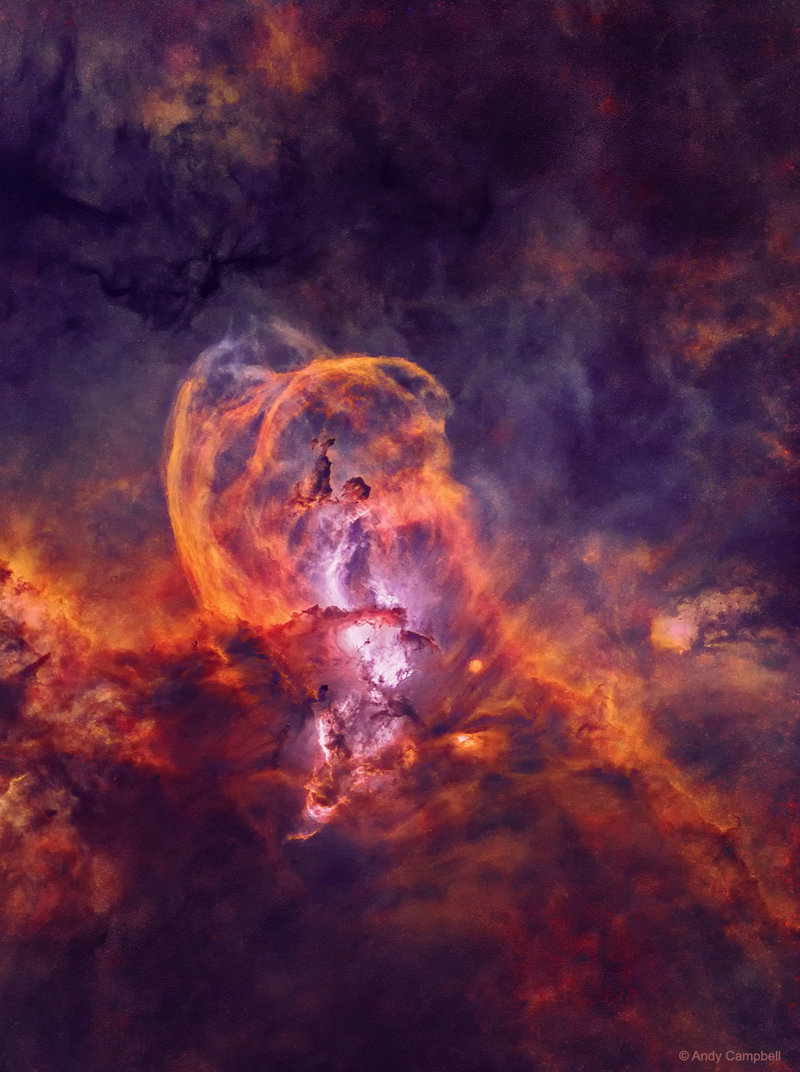
Good morning Rallypoint. Today's Astronomy Picture of the Day (APOD) is titled "Star Forming Region NGC 3582 without Stars." By digitally removing stars from the Statue of Liberty Nebula (check out NGC 3576 in Wikipedia for a picture with stars), this image showcases dense knots of dark interstellar dust, fields of glowing hydrogen gas ionized by these stars, and great loops of gas expelled by dying stars. Astronomers have also observed the clear presence of the complex carbon molecules known as polycyclic aromatic hydrocarbons (PAHs), which are thought to be an important step in the development of life on Earth. This star-forming region lies about 6,000 light years away near the constellation Carina.
Astronomy Picture of the Day
Posted from apod.nasa.gov NASA
NASA Space
Space Science
 Photography
 Astronomy
Posted >1 y ago
Responses: 7

7
7
0
Looks like a museum artwork piece- very cool. Mornign Maj William W. 'Bill' Price
LTC Stephen F. SP5 Mark Kuzinski COL Mikel J. Burroughs SMSgt Lawrence McCarter Maj William W. 'Bill' PriceCPL Dave Hoover SSG William Jones Sgt Vance Bonds Cpl (Join to see) PO1 H Gene Lawrence Maj Robert Thornton PO3 Bob McCord SPC Douglas Bolton Lt Col Charlie Brown TSgt Joe C. PO3 Craig Phillips CW5 Jack Cardwell SFC Joe S. Davis Jr., MSM, DSL SGT Mark Anderson SPC Margaret Higgins
LTC Stephen F. SP5 Mark Kuzinski COL Mikel J. Burroughs SMSgt Lawrence McCarter Maj William W. 'Bill' PriceCPL Dave Hoover SSG William Jones Sgt Vance Bonds Cpl (Join to see) PO1 H Gene Lawrence Maj Robert Thornton PO3 Bob McCord SPC Douglas Bolton Lt Col Charlie Brown TSgt Joe C. PO3 Craig Phillips CW5 Jack Cardwell SFC Joe S. Davis Jr., MSM, DSL SGT Mark Anderson SPC Margaret Higgins
(7)
(0)
4
4
0

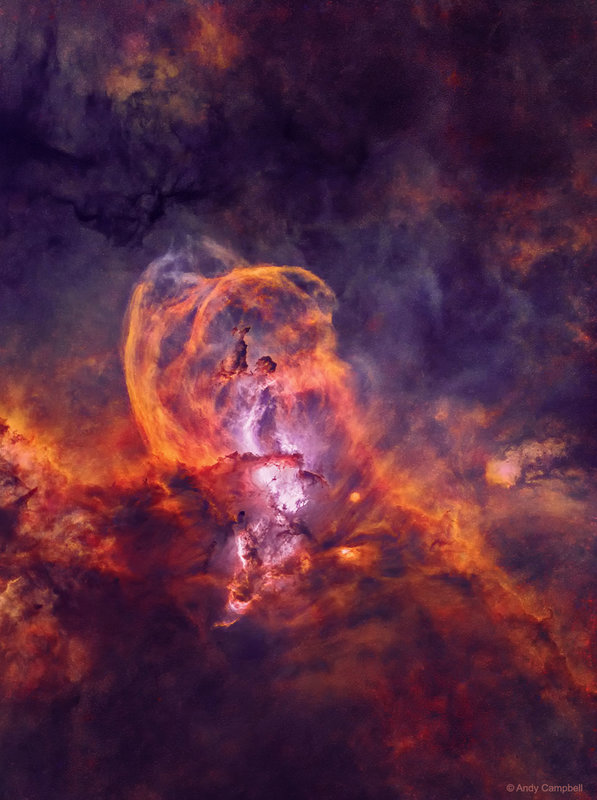
Thank you my friend Maj William W. 'Bill' Price for posting the Astronomy Picture of the Day (APOD) for July 30, 2019 entitled "Star Forming Region NGC 3582 without Stars."
Breathtaking picture!!
Image: Star Forming Region NGC 3582 without Stars - Image Credit & Copyright - Andrew Campbell
"Explanation: What's happening in the Statue of Liberty nebula? Bright stars and interesting molecules are forming and being liberated. The complex nebula resides in the star forming region called RCW 57, and besides the iconic monument, to some looks like a flying superhero or a weeping angel. By digitally removing the stars, this image showcases dense knots of dark interstellar dust, fields of glowing hydrogen gas ionized by these stars, and great loops of gas expelled by dying stars. A detailed study of NGC 3576, also known as NGC 3582 and NGC 3584, uncovered at least 33 massive stars in the end stages of formation, and the clear presence of the complex carbon molecules known as polycyclic aromatic hydrocarbons (PAHs). PAHs are thought to be created in the cooling gas of star forming regions, and their development in the Sun's formation nebula five billion years ago may have been an important step in the development of life on Earth."
Thank you my friend Maj Marty Hogan for mentioning me.
FYI TSgt Joe C. SPC Margaret Higgins SGT James Murphy SP5 Jeannie Carle PO3 Lynn Spalding PO3 Rod Arnold PO1 William "Chip" Nagel PO1 H Gene Lawrence MSgt David Hoffman MSG (Join to see) SGT Steve McFarland SFC (Join to see)
Breathtaking picture!!
Image: Star Forming Region NGC 3582 without Stars - Image Credit & Copyright - Andrew Campbell
"Explanation: What's happening in the Statue of Liberty nebula? Bright stars and interesting molecules are forming and being liberated. The complex nebula resides in the star forming region called RCW 57, and besides the iconic monument, to some looks like a flying superhero or a weeping angel. By digitally removing the stars, this image showcases dense knots of dark interstellar dust, fields of glowing hydrogen gas ionized by these stars, and great loops of gas expelled by dying stars. A detailed study of NGC 3576, also known as NGC 3582 and NGC 3584, uncovered at least 33 massive stars in the end stages of formation, and the clear presence of the complex carbon molecules known as polycyclic aromatic hydrocarbons (PAHs). PAHs are thought to be created in the cooling gas of star forming regions, and their development in the Sun's formation nebula five billion years ago may have been an important step in the development of life on Earth."
Thank you my friend Maj Marty Hogan for mentioning me.
FYI TSgt Joe C. SPC Margaret Higgins SGT James Murphy SP5 Jeannie Carle PO3 Lynn Spalding PO3 Rod Arnold PO1 William "Chip" Nagel PO1 H Gene Lawrence MSgt David Hoffman MSG (Join to see) SGT Steve McFarland SFC (Join to see)
(4)
(0)
4
4
0

Read This Next


 Continue with Facebook
 Continue with Google