

Astronomy

Astronomy
Posted on Mar 23, 2022

APOD: 2022 March 23 - The Bubble Nebula from Hubble

1.04K
23
3
6
6
0
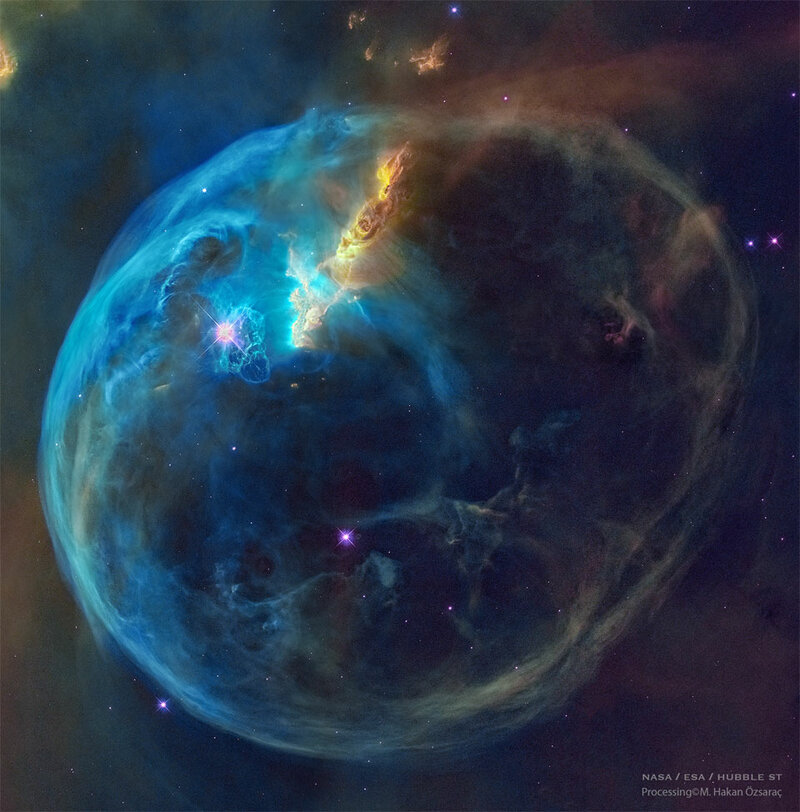
Good morning, Rallypoint, and welcome to the March 23rd Hump Day edition of the Astronomy Picture of the Day (APOD): "The Bubble Nebula from Hubble." The Bubble Nebula (NGC 7635) lies 7,100 light years away in the constellation Cassiopeia, and was discovered in 1787 by William Herschel. It is produced by the star you see at about 10 o'clock in the overall cloud complex. This star is 45 times more massive than our own Sun. Gas from the star escapes away into space as a "stellar wind" moving at over 4 million miles per hour. This outflow creates the outer edge of the bubble as it interacts with surrounding colder regions. Researchers suggest that the areas at 4 o'clock are much denser and colder than other quadrants about the star, giving the Bubble Nebula its asymmetric shape relative to its host star.
Today's APOD is a composite image of datasets collected from all three Wide Field Planetary Cameras (WFPC, WFPC2, and WFPC3) that have flown aboard Hubble. Why were there three? The first WFPC was not able to focus correctly due to a tiny error in the curvature of Hubble's main mirror (anyone remember that?). In December 1993, astronauts replaced the camera with a second-generation version, WFPC2. WFPC3 was installed in May 2009, and WFPC2 was brought back to Earth. It is now on display at the Smithsonian Air and Space Museum in Washington.
Today's APOD is a composite image of datasets collected from all three Wide Field Planetary Cameras (WFPC, WFPC2, and WFPC3) that have flown aboard Hubble. Why were there three? The first WFPC was not able to focus correctly due to a tiny error in the curvature of Hubble's main mirror (anyone remember that?). In December 1993, astronauts replaced the camera with a second-generation version, WFPC2. WFPC3 was installed in May 2009, and WFPC2 was brought back to Earth. It is now on display at the Smithsonian Air and Space Museum in Washington.
APOD: 2022 March 23 - The Bubble Nebula from Hubble
Posted from apod.nasa.gov NASA
NASA Space
Space Science
 Photography
 Astronomy
Posted 4 y ago
Responses: 3
11
11
0


Maj William W. 'Bill' Price good morning my friend, and good to see you on the RP net. I have said it many times before, yet I will say it again, "nobody does it better from above". Thank you for sharing Astronomy Picture of the Day (APOD): "The Bubble Nebula from Hubble." The Bubble Nebula (NGC 7635) lies 7,100 light years away in the constellation Cassiopeia, and was discovered in 1787 by William Herschel.
PO1 William "Chip" Nagel Lt Col Charlie Brown SSG Michael Noll Lt Col John (Jack) Christensen Cpl Vic Burk MAJ Dale E. Wilson, Ph.D. SGT Charlie Lee PO2 Marco Monsalve SGT David A. 'Cowboy' Groth ] SSG William Jones Sgt (Join to see) 1SG Dan Capri CDR Andrew McMenamin, PhD MAJ Bob Miyagishima SrA John Monette SPC Nancy Greene SGT Mark Anderson LTC (Join to see) SGT James Murphy
PO1 William "Chip" Nagel Lt Col Charlie Brown SSG Michael Noll Lt Col John (Jack) Christensen Cpl Vic Burk MAJ Dale E. Wilson, Ph.D. SGT Charlie Lee PO2 Marco Monsalve SGT David A. 'Cowboy' Groth ] SSG William Jones Sgt (Join to see) 1SG Dan Capri CDR Andrew McMenamin, PhD MAJ Bob Miyagishima SrA John Monette SPC Nancy Greene SGT Mark Anderson LTC (Join to see) SGT James Murphy
(11)
(0)
4
4
0

That's a pretty amazing composite photo and it looks like it has a vein of gold running partway through it.
(4)
(0)
2
2
0

Good morning Maj William W. 'Bill' Price - l What an amazingly beautiful Image of this 7-light-year diameter bubble, which offers evidence of violent processes at work. Outstanding APOD Post, Bill!!!
(2)
(0)
Read This Next


 Continue with Facebook
 Continue with Google