

12
12
0
I think I have the Navy enlisted ranks down, and I have the Officers down, but it seems the Navy has a lot more history in their ranks. Different colors, insignia, even titles or rates as I understand they're called. Can anyone clarify it?
 Enlisted
 Warrant Officers
 Officers
 Rank
Rank Sailors
Edited >1 y ago
Posted >1 y ago
Responses: 15

10
10
0

So you have the basic enlisted ranks that are:
Seaman Recruit
Seaman Apprentice
Seaman. These will have white stripes (0, 2 or 3 respectively)
However, depending on your eventual job those can instead be Fireman, Constructionman, or Airman (red stripes, light blue stripes, or green stripes). You can tell a Sailor's job at a glance by looking at the rating badge on his rank badge. Too many to list.
@ e4, they all convert to Petty Officers, and wear red crows, unless they've been good for 12 years, then they're gold. Those ranks are
Petty Officer 3rd class
Petty Officer 2nd Class
Petty Officer 1st Class
At E-7 they become Chief Petty Officers, then Senior Chief Petty Officer, then Master Chief Petty Officer. Their rank insignia is an anchor, then an anchor with a star, then two stars on their collar, (This confuses a lot of non-Navy SM's, and they get saluted quite a bit) and one rocker above their crows. You can call a CPO 'Chief', an SCPO 'Senior' but NEVER, EVER call an MCPO 'Master'.
All officer insignia is the same as any other service. However, the ranks are called different things:
Ensign
Lieutenant Junior Grade
Lieutenant
Lieutenant Commander
Commander
Captain
Rear Admiral (lower half)
Rear Admiral (upper half)
Vice Admiral
Admiral.
Seaman Recruit
Seaman Apprentice
Seaman. These will have white stripes (0, 2 or 3 respectively)
However, depending on your eventual job those can instead be Fireman, Constructionman, or Airman (red stripes, light blue stripes, or green stripes). You can tell a Sailor's job at a glance by looking at the rating badge on his rank badge. Too many to list.
@ e4, they all convert to Petty Officers, and wear red crows, unless they've been good for 12 years, then they're gold. Those ranks are
Petty Officer 3rd class
Petty Officer 2nd Class
Petty Officer 1st Class
At E-7 they become Chief Petty Officers, then Senior Chief Petty Officer, then Master Chief Petty Officer. Their rank insignia is an anchor, then an anchor with a star, then two stars on their collar, (This confuses a lot of non-Navy SM's, and they get saluted quite a bit) and one rocker above their crows. You can call a CPO 'Chief', an SCPO 'Senior' but NEVER, EVER call an MCPO 'Master'.
All officer insignia is the same as any other service. However, the ranks are called different things:
Ensign
Lieutenant Junior Grade
Lieutenant
Lieutenant Commander
Commander
Captain
Rear Admiral (lower half)
Rear Admiral (upper half)
Vice Admiral
Admiral.
(10)
(0)
SCPO (Join to see)
SPC (Join to see) Please, please don't ever call a Master Chief "Master". Their egos are big enough as is.
MCPO Roger Collins
MCPO Roger Collins
(5)
(0)
MCPO Roger Collins
PO3 Bob McCord - Nope, I was an ENFN for about a microsecond after completing Engineman Class A school. tried for EN1 twice, PNAd, converted to RM and never looked back.
(1)
(0)
LCDR (Join to see)
SGT Bryon Sergent - PO1 Nagel is completely correct. Also, between WWI and WWI, O-6's would promote directly to Rear Admiral (2-stars), which needless to say, ticked off Brigadier Generals. Also, for the British, O-7 (Commodore or Brigadier) is not a Flag Rank. We tried "Commodore Admiral" for 1-stars in 1983, but it didn't work, so we've just done Rear Admiral (Upper) and Rear Admiral (Lower Half). Interestingly, South Africa uses a Rear Admiral, Junior Grade.
(0)
(0)
8
8
0

Now that you got this down, go for the nicknames. Snipe, Twidget, Cookie, O'Shiter etc. Lots of them too. Have fun. Signed, Mustang.
(8)
(0)
MCPO Roger Collins
PO3 Bob McCord - Cross the equator in the engine room of a diesel submarine between two water distillers at about 130 degrees for a watch, engines not running so no fresh air. I have left my watch with the dungarees leaking sweat from the cuffs. Then, later years Nirvana, the Radio Shack, air conditioning and locked doors, if you needed a nap.
(1)
(0)
MCPO Roger Collins
Funny, I enlisted weighing 143, about three years later 193. We ate pretty good. When I retired I weighed 163 and now less than when I enlisted. As to the boats, its no different than getting in an elevator.
(1)
(0)
MCPO Roger Collins
Haven't you bee watching the movies? We have windows and periscopes. When the two guys that talked me into volunteering, I had no preconceived notions, one had bad eyes, the other had claustrophobia, both washed out. Leaving me to carry the torch. Actually I made a tour on the diesel boat at Patriot's Point with my grandsons and wondered what I was thinking.
(1)
(0)
6
6
0

It is an elaborate portion of the Naval OPSEC program, Legalman Apprentice.
(6)
(0)
6
6
0

The colors are for lower enlisted E-1 to E-3 only. If you are fulfilling an engineering job, you are a "Fireman" and your stripe color is red. If you are fulfilling an aviation job, you are an "Airman" and your stripe color is green. Other specialties, you are a "Seaman" and your stripe color is white. E-1 level is called Recruit, E-2 level Apprentice and E-3 by the specialty. So if you were in the aviation community an E-1 would be an Airman Recruit, E-2 would an Airman Apprentice and an E-3 would be an Airman, Seaman, Fireman, etc. Once you test for E-4, E-5 and E-6, you are known as a Petty Officer __ Class. Third Class for E-4, Second Class for E-5 and First Class for E-6. E-7 is a Chief Petty Officer, E-8 is a Senior Chief Petty Officer and E-9 is a Master Chief Petty Officer.
Sleeve location changed. In days pre-1950's, sailors had rank on the left sleeve or right hand sleeve. If you had a rank patch on the left hand sleeve, you were known as a "seagoing rate." Other sleeve was for jobs that did not go to sea. Also during this time period you had diamonds and letters. If someone had an "A" under their rank patch, they were really athletically physically fit and you could approach that person to help you in your fitness regimen. So if you were having trouble swimming, doing exercises, etc, an "A" would be your start. A "diamond" under or above the rank patch meant that you were a system expert. So if you were among a roomful of Electricians, the one with the diamond on his patch, would be the system expert out of the group. The reason I mention these defunct uses is because a lot of WW2-era vets will show up to events wearing diamonds and letters and people of today have no idea what they are. Another thing that was done "then" that isn't done now is "Liberty Cuffs." You had embroidery on the inside of your sleeves. And when you rolled your sleeves up, they showed up and signified that you were off-duty. So if someone needed an Electrician and walked into a room full of Electricians and three of them had cuffs showing, those three were off-limits.
The Navy has a principle called "Frocking" where you are promoted for rank, but not pay. So when I passed the E-4 test, I was frocked, meaning I could wear the E-4 patch, but didn't get paid for it until the prescribed time. The color of your rank also shows your behavior. If your stripes are gold, you have had good behavior. If they are red, you have had maybe an infraction or two. Or three. Or four...ha ha. Another interesting snippet is that watchstations are what makes the world go around. The OOD (Officer Of The Deck) is in command of the ship, no matter what rank he is. The people standing watch have the power. Some commands make you wear an arm band but a lot of commands don't. We didn't wear them, but one of our sister ships had arm bands to tell who the duty Radioman was, OOD, etc. Along those lines, you also have warfare badges which go hand in hand with your rank badges. They say that you are a system expert in your ship. So if you see a submarine sailor wearing Dolphins, it means that he/she can save their life, put out fires, etc.
Sleeve location changed. In days pre-1950's, sailors had rank on the left sleeve or right hand sleeve. If you had a rank patch on the left hand sleeve, you were known as a "seagoing rate." Other sleeve was for jobs that did not go to sea. Also during this time period you had diamonds and letters. If someone had an "A" under their rank patch, they were really athletically physically fit and you could approach that person to help you in your fitness regimen. So if you were having trouble swimming, doing exercises, etc, an "A" would be your start. A "diamond" under or above the rank patch meant that you were a system expert. So if you were among a roomful of Electricians, the one with the diamond on his patch, would be the system expert out of the group. The reason I mention these defunct uses is because a lot of WW2-era vets will show up to events wearing diamonds and letters and people of today have no idea what they are. Another thing that was done "then" that isn't done now is "Liberty Cuffs." You had embroidery on the inside of your sleeves. And when you rolled your sleeves up, they showed up and signified that you were off-duty. So if someone needed an Electrician and walked into a room full of Electricians and three of them had cuffs showing, those three were off-limits.
The Navy has a principle called "Frocking" where you are promoted for rank, but not pay. So when I passed the E-4 test, I was frocked, meaning I could wear the E-4 patch, but didn't get paid for it until the prescribed time. The color of your rank also shows your behavior. If your stripes are gold, you have had good behavior. If they are red, you have had maybe an infraction or two. Or three. Or four...ha ha. Another interesting snippet is that watchstations are what makes the world go around. The OOD (Officer Of The Deck) is in command of the ship, no matter what rank he is. The people standing watch have the power. Some commands make you wear an arm band but a lot of commands don't. We didn't wear them, but one of our sister ships had arm bands to tell who the duty Radioman was, OOD, etc. Along those lines, you also have warfare badges which go hand in hand with your rank badges. They say that you are a system expert in your ship. So if you see a submarine sailor wearing Dolphins, it means that he/she can save their life, put out fires, etc.
(6)
(0)
SPC (Join to see)
That's detailed and informative thank you. The Army doesn't practice Frocking as much anymore I don't think. I suppose we sort of do with Corporal, you're an NCO but not getting paid for it. Frocking does remind me of Brevet's, though I can't remember if they got paid for their Brevet Rank or not.
(1)
(0)
SMSgt Lawrence McCarter
P03 Murphy, Thanks for that information, I remember My Dad having that liberty cuff You mention, it appeared silk and had a dragon. I didn't know that was what it was for though. He was an 1st Class petty officer, ET1
(0)
(0)


This should have it all. Yes, I know it's Wikipedia.....
https://en.wikipedia.org/wiki/List_of_United_States_Navy_ratings
https://en.wikipedia.org/wiki/List_of_United_States_Navy_ratings
List of United States Navy ratings - Wikipedia
United States Navy ratings are general enlisted occupations used by the U.S. Navy from the 18th century, which consisted of specific skills and abilities. Each naval rating had its own specialty badge, which is worn on the left sleeve of the uniform by each enlisted person in that particular field. Working uniforms, such as camouflage Battle Dress Uniforms, utilities, coveralls, and Naval Working Uniform, bear generic rate designators with no...
(6)
(0)
4
4
0

Lot's of good explanations in this string. They Navy system, which is mirrored in the Coast Guard, is the most complex of the Services. Unlike your service (Army) and mine (Air Force) that have only a few forms of address for enlisted personnel (the Air Force has three), the Navy has combined specialty (rate) and rank (e-grade). In addition, they sometimes use different positional titles aboard ship. For example, a Master Chief Petty Officer (E-9) may be the ranking Non-Commissioned Officer on a submarine, so he or she would be the Chief of the Boat (COB), which is a job with specific qualifications and responsibilities not a rank.
The officer ranks have two versions. The collar brass is similar, but not exactly the same, as the Army and Air Force. Their shoulder and sleeve rank is based on thick and thin stripes. You can find pictures on reference charts. Just to keep it complicated, the Navy uses names for their officer ranks that are not the same as the Air Force, Army, and Marine Corps. O-1: ensign; O-2: lieutenant junior grade; O-3: Lieutenant; O-4 Lieutenant Commander; O-5: Commander; O-6: Captain; O-7: Rear Admiral (lower half) (Commodore in some situations); O-8: Rear Admiral (upper half); O-9: Vice Admiral; O-10: Admiral.
The good news is most sailors I've worked with are proud to explain their rank and rate to the uneducated members of the other Services. Courtesy and honesty will get you a long ways in most cases. As a Private, you can almost never go wrong with a "Sir" or "Ma'am" when in doubt. If the subject is a salty old Chief, he will grumble something about being a working man not an officer and tell you to call him "Chief."
The officer ranks have two versions. The collar brass is similar, but not exactly the same, as the Army and Air Force. Their shoulder and sleeve rank is based on thick and thin stripes. You can find pictures on reference charts. Just to keep it complicated, the Navy uses names for their officer ranks that are not the same as the Air Force, Army, and Marine Corps. O-1: ensign; O-2: lieutenant junior grade; O-3: Lieutenant; O-4 Lieutenant Commander; O-5: Commander; O-6: Captain; O-7: Rear Admiral (lower half) (Commodore in some situations); O-8: Rear Admiral (upper half); O-9: Vice Admiral; O-10: Admiral.
The good news is most sailors I've worked with are proud to explain their rank and rate to the uneducated members of the other Services. Courtesy and honesty will get you a long ways in most cases. As a Private, you can almost never go wrong with a "Sir" or "Ma'am" when in doubt. If the subject is a salty old Chief, he will grumble something about being a working man not an officer and tell you to call him "Chief."
(4)
(0)
3
3
0

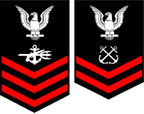
The use of the word "rank" for Navy enlisted personnel is incorrect. The term is "rate." The rating badge is a combination of rate (pay grade, as indicated by the chevrons) and rating (occupational specialty, as indicated by the symbol just above the chevrons).
The insignia here represents a Petty Officer First Class (the rate) who is a Boatswain's Mate (the rating). A rating badge is worn on the left upper sleeve of all uniforms in grades E-4 through E-6. Chief Petty Officers (E-7 through E-9) wear collar devices on their white and khaki uniforms, and rating badges on their Service Dress Blues.
The insignia here represents a Petty Officer First Class (the rate) who is a Boatswain's Mate (the rating). A rating badge is worn on the left upper sleeve of all uniforms in grades E-4 through E-6. Chief Petty Officers (E-7 through E-9) wear collar devices on their white and khaki uniforms, and rating badges on their Service Dress Blues.
(3)
(0)
SCPO (Join to see)
SCPO Morris Ramsey I've always thought we should wear our rating badges and hashmarks on the Service Dress Whites as well. Just use the same patches that are worn on the White Mess Dress Jacket.
(2)
(0)
3
3
0

USN follows the USCG, but the Navy decided to have stars instead of the shield of freedom on their sleeves or shoulders. Naval services have Warrant officers that have different roles than land forces. Chief Warrant officers are a continuation of enlisted ratings. CWO become division officers or even commanding officers of vessels or shore stations. Their commission grants them legal, financial, and personnel accountability that an enlisted member does not have. There are a few CWO that can be promoted straight to LT (O-3) to act as department heads in their specialty.
Warrant Officer (W-1) is no longer used in the USCG or USN. USCG has Chief Warrant Officers (W-2 to W-4). USN has Chief Warrant Officers (W-2 to W-5). W-1 were commissioned by their Dept Secretary. W-2 and above are commissioned by the President.
Warrant Officer (W-1) is no longer used in the USCG or USN. USCG has Chief Warrant Officers (W-2 to W-4). USN has Chief Warrant Officers (W-2 to W-5). W-1 were commissioned by their Dept Secretary. W-2 and above are commissioned by the President.
(3)
(0)
SPC (Join to see)
SCPO (Join to see) - That would make sense, no one would want to take the pay cut for more responsibility. I'm surprised yours have to be an E-7, ours are usually E-5 or E-6 though that would grant them more experience I imagine.
(1)
(0)
PO1 Jack Howell
Uhh...no LTJG, it's the other way around. The Coast Guard has followed the rank structure of the Navy. The Navy was establish 140 years before the Coast Guard (Navy-founded 13 October 115; Coast Guard-founded 4 August 1790). The Coast Guard has followed the rank structure of the Navy
(0)
(0)
LTJG Richard Bruce
Official founding of what is now known as the USCG was on Aug 04, 1790 when Alexander Hamilton created the Revenue Marine. Between 1785 and 1794, the US Navy was disbanded. Until the US Navy became fully functional again in 1797, the Revenue Marine was our nation's sole naval force for seven years.
(0)
(0)
3
3
0

SPC (Join to see) This Conversation was on Page 4 when I Searched Navy Articles on Google for the Last 24 Hours! Nice Response and Looksees.
(3)
(0)
3
3
0
Read This Next


 Continue with Facebook
 Continue with Google