
Posted on Sep 8, 2021
What suggestions do you have for renaming DoD installations honoring Confederate officers?

161K
6.02K
1.88K
1K
1K
0
Doesn't matter if you agree with this move or not - it's been directed and it's happening. What are your suggestions for renaming the following bases?
- Fort Bragg
- Fort Rucker
- Fort Benning
- Fort Gordon
- Fort Hood
- Fort Polk
- Fort A.P. Hill
- Fort Belvoir
- Fort Lee
- Fort Pickett
- Fort Bragg
- Fort Rucker
- Fort Benning
- Fort Gordon
- Fort Hood
- Fort Polk
- Fort A.P. Hill
- Fort Belvoir
- Fort Lee
- Fort Pickett
 Civil War
Posted >1 y ago
Responses: 855

8
8
0

Doesn't matter if it's directed or not. Keep your damned Communist, ANTIFA, history rewriting, American Culture destroying hands off of the names of our military installations.
Directives can be countermanded.
Directives can be countermanded.
(8)
(0)
PFC John Roscoe
Oh, STF Gary-baby- AMERICAN CULTURE????? You mean like the Americans of Hawaii? What about all the abolisionnist Americans from back then, and the Civil Rights activists of today? That "culture" include the 14% of Black America? See, American Culture is the amalgamation of the WORLD's cultures, that came here "Yearning to be Free" to be who the are, believe how they wish, express what they want. now- ya, see CAPTAIN, the US isn't you and a minority; and the ones whom whant to squash and rewrite history is the Scarlet-Necked MAGAbirds- no CRT is to be taught regarding 4 centuries of systemic racism, ya know, like the genocide against Native Americans at Wounded Knee and The Trail of Tears, Slavery and Jim Crow, Internment of Japanese Americans, wholesale destruction of prosperous Black Communities by authorities and even airforce bombing, race riots against China towns, laws against interracial-marriage, systmatic descrimination in housing, bank financing, educational and employment opportunities- see, now THAT is history, but y'all just want to focus on the traitors that took-up arms against their nation to defend slavery, as was clearly recorded in THEIR OWN HISTORICAL DOCUMENTS. Seems you are only for Democracy and individual rights and majority-rule as long as it conforms to your narrow view.
(1)
(0)
8
8
0

I nominate Ft. Rucker to become officially name Ft. "Mommy I don't know what bathroom to use"
(8)
(0)
8
8
0

8
8
0

8
8
0
Why not just call them Social Justice Warrior Bases 1-10. I’m so glad I’m out. Never thought the military I served in for almost 12 years would become a circus.
(8)
(0)
CPT (Join to see)
PFC John Roscoe U r an a hole aren't u? Phone keypads r so precise. And a pos like u isn't worth the time to proof read.
(0)
(0)
CPT (Join to see)
PFC John Roscoe
What's so sad is that u think the crap you spew demonstrates learning, rather than indoctrination by whatever leftist, anti-American u must have attended. Our country is undermined by having warped people like yourself wearing our uniform. At least, as a PFC, u r not in leadership. When Trump resumes his position of CnC, hopefully he will stop promoting SMs who hate our country.
What's so sad is that u think the crap you spew demonstrates learning, rather than indoctrination by whatever leftist, anti-American u must have attended. Our country is undermined by having warped people like yourself wearing our uniform. At least, as a PFC, u r not in leadership. When Trump resumes his position of CnC, hopefully he will stop promoting SMs who hate our country.
(0)
(0)
8
8
0
SFC Jake Middaugh CSM Charles Hayden Passed 7/29/2025 SGT Charlie Lee SFC Kenneth Hunnell
I respectfully decline to offer a suggestion. Jake Middaugh and Charles Hayden are SPOT ON‼️
I respectfully decline to offer a suggestion. Jake Middaugh and Charles Hayden are SPOT ON‼️
(8)
(0)
SSG Roger Ayscue
SSG Carlos Madden - I think that the resistance is fueled more by the fact that this is driven more by the Social Justice movement, then to honor ANYONE that has served honorably. It has not one damn thing to do with the fact that the Confederate Officers fought against what they considered to be an Army invading their homes to enforce laws and policies that they disagreed with (Treason is defined by the winners) and had Seceded from the Union over. (By the way, by the logic that the United States used to invade the Confederate States, then the Republic of China (Taiwan) should be forced to go back to the People's Republic of China and indeed the US support of Taiwan since 1949 has been mere Hypocrisy because people do not have a right to part with a government they disagree with, at least they did not in 1865...)
So It is the fact that these "Social Justice" detritus are pushing it that is causing the resistance.
I stand by my original statement...tell the Social Justice Movement to kiss a Fat Baby's Ass.
You my say it is because you want to re-name bases because of Confederate Treason, that is not it at all....I would say, Don't let them pee down your back and tell you it is raining.
So It is the fact that these "Social Justice" detritus are pushing it that is causing the resistance.
I stand by my original statement...tell the Social Justice Movement to kiss a Fat Baby's Ass.
You my say it is because you want to re-name bases because of Confederate Treason, that is not it at all....I would say, Don't let them pee down your back and tell you it is raining.
(2)
(0)
SPC Lyle Montgomery
SSG Roger Ayscue - That was a good reply. Wait until the cry baby socialist democrats are out of power and leave the names alone. Put the Confederate statues back. History is real and dont let the few wining crybabys have their way.
(3)
(0)
SSgt Robert Simonds
I agree with that those name that are so disgracefully are all the democrat warriors and that was honored for years because of who they fought for . Now it because people are waking up and it is part of our history they want destroyed. WHY? Because it proves how terrible the democrat party is and how they have lied over the years to the American people on how much they love the American constitution.
(0)
(0)
8
8
0
7
7
0

LEAVE THEM ALONE! Who cares? They’re dead, I was stationed at three of those posts and I never once thought about the name. Get over it. Move on and focus on making this a better place for everyone.
(7)
(0)
7
7
0

Well my friend SSG Carlos Madden I have spent some time pondering this and in this heightened tension period [as in many previous heightened tension period] sadly many seem to want to reinvent history without counting the economic cost and personal tension created by renaming Federal property.
1. Congress seems to be too divided on thorny issues to actually get serious about trying to rename military posts [before the 2022 mid-terms] which would impact businesses, street signs, local history museums, and so much more. Renaming posts would be an unfunded mandate or limited funding - such as changing all web pages, post signs, etc.
2. I think it makes a lot of sense to think long and hard before renaming federal property including Federal bases and especially state national guard bases [Fort Pickett and Fort A.P. Hill in Virginia and Camp Beauregard which is a Louisiana National Guard installation] since they are state property.
3. Politics makes strange bedfellows. In light of the election results in Virginia and New Jersey on November 2, renaming something at this point may well result in revenge those with influence now are thrust down in influence.
4. If there is wide concurrence in the states affected, Congress members, etc, I concur with renaming the post to a Medal of Honor recipient form that state in the modern era. [The standards for award in the Civil War were biased and political in many cases. True heroism was more common on both sides and among civilians. I concur with SSG (Join to see) PVT Mark Whitcomb
I concur with my friend Cpl Vic Burk that it would be wise to pause long and hard before renaming military installations based on current sentiments -especially by a loud minority.
The local communities should be consulted - especially businesses, places of worship, school boards, etc. Renaming may well impact the local economy.
If we have to rename anything...
A. I would concur with recommending renaming Fort Polk to Fort Wallar for Medal of Honor awardee 'corporal, Francis Asbury Wallar'
B. I would consider renaming Fort Hood to Fort Crockett in honor of Davy Crockett since he died in Texas.
C. I would consider renaming Pope Army Airfield (Joint Base Bragg) to honor B-24 flight engineer Jerome Levin who flew 35 missions in France and other parts of Europe and was awarded the Legion of Honor medals — France’s highest military and civilian merit for service to the country by French Consul General Louis de Corail on November 28, 2018
D.since Braxton Bragg success in the Mexican-American War made him a national hero. However 'his weaknesses as a military leader were exposed and exploited by the Union during the Civil War. He was also a slave owner before the start of the Civil War and owned a sugar plantation in Louisiana.'
E. I would consider leaving Fort Gordon along since John Gordon Brown since he served as a US Senator, leader of the Senate and Governor of Georgia antebellum. He 'was elected to the US Senate in 1873, and in 1879, he became the first ex-Confederate to preside over the Senate. He was a strong supporter of the "New South" and industrialization and he was a part of the Bourbon Triumvirate. Gordon resigned as senator on May 19, 1880. He was elected Governor of Georgia in 1886 and returned to the U.S. Senate from 1891 to 1897.
F. I recommend leaving Fort Lee alone, Robert E. Lee served with distinction as a US Army officer and as Superintendent of USMA. He was an is admired by many especially military historians and those informed.
G. The following are National Guard facilities and bases.
(1) Since Camp Beauregard near Pineville, Louisiana, is a Louisiana National Guard installation named for Louisiana native and Confederate General Pierre Gustave Toutant Beauregard
(2) Since Fort A.P. Hill (1941), near Bowling Green, Virginia, named for Virginia native and Confederate Lieutenant General A. P. Hill is a Virginia Army National Guard base
(3) Since Fort Pickett (1942), near Blackstone, Virginia, a Virginia National Guard installation is named for Confederate General George Pickett
As a USMA cadet [July 1976 - May 1980] and for years prior I studied the US Civil War - east and western theaters.
1. Congressional Medal of Honor awardee 22-year-old corporal, Francis Asbury Wallar [6th Wisconsin Infantry] "Color-bearer, Corporal W.B. Murphy of the 2nd Mississippi in Maj. Gen. Henry Heth’s Division of Lt. Gen. A.P. Hill’s Corps, later said that the Federals “kept rushing for my flag and there were over a dozen shot down like sheep in the mad rush for the colors.”
Murphy admitted, however, that “a large burly man made a mad rush for me and the flag. As I tore the flag from the staff he took hold of me and the colors.” That soldier was Corporal Wallar.
“I did take the flag out of the color bearer’s hands,” Wallar later revealed. “I thought about moving to the rear, but then I thought I would stay, and I threw it down and loaded and fired twice on it.” Wallar and the 6th had captured 230 Confederates, and Waller received the Medal of Honor in December 1864.'
2. Ft Benning is named for CSA Brigadier General Henry Lewis Benning. I support that name for the Columbus, Georgia base.
Per Gettysburg guide #110 Garry Adelman
1. One who fought there without distinction was CSA Brigadier General Henry Lewis Benning, who led Benning’s Brigade, Hood’s Division, Longstreet’s Corps [in the CSA Brigade CDRs were Brigadier Generals while in the USA they tended to be Colonel. Yet '“Old Rock” Benning and his four regiments of Georgians at Gettysburg are underappreciated. After all, Benning skillfully advanced his brigade over the most difficult terrain Gettysburg had to offer. He inspired his men during their deadly advance, kept his units together (even accepting some Texans into his ranks), and tipped the scales for the Confederates in capturing Devil’s Den for the second time. When his own men tried to claim capture of some cannons at Devil’s Den, Benning gave credit to the other units that deserved it. During a Union countercharge, Benning displayed his ferocity on combat: “[H]old your fire until they come right up. Then pour a volley into them, and if they don’t stop, run your bayonets into their bellies.”
Fighting savagely in areas of the battlefield now known as the Slaughter Pen, the Valley of Death, and Devil’s Den, it is not surprising that Benning’s men suffered the highest percentage of loss among the brigades in Hood’s Division. Benning lost two of his colonels, killed in the Slaughter Pen and in the Triangular Field. Also, on July 3, his brigade bore the greatest part of the Union advance after the conclusion of Pickett’s Charge.
Ten weeks after fighting in the Civil War’s bloodiest engagement, Benning and his men fought in the war’s second costliest battle at Chickamauga. In between these terrible battles, 600 miles apart, Benning managed to secure official reports from the commanders of all four of his Gettysburg regiments and submitted a detailed one of his own. That all-too-rarely accomplished feat allows us to better understand America’s greatest battle, which warms this historian’s heart and earns Benning a coveted spot among Gettysburg’s “unsung” heroes."
Update;
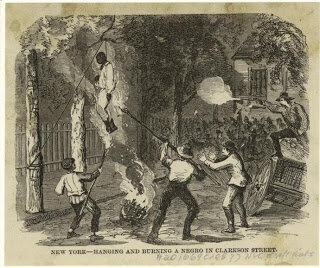
Image: 1863-07-14 The lynching of a negro in the New York Draft Riots
C. Tuesday, July 14, 1863: Draft Riots continued in NY City. African Americans were murdered in the streets and city law enforcement agencies were unable to cope. Men from the Army of the Potomac were ordered to the city to restore law and order. After a night of heavy rain, rioters returned to the streets early on Tuesday, July 14, looting and destroying businesses in the downtown area, including a large Brooks Brothers’ store, which as a contractor for the U.S. government, had been churning out thousands of pieces of military garb for more than two years. The mob also began constructing barricades around the city that proved difficult for police to overcome. The targeted attacks on blacks intensified and included the lynching of at least two African-American men: a young sailor who had been attacked after speaking to a young white boy and a man who had been captured and killed while attempting to escape to Brooklyn (reportedly disguised in his wife’s clothing). Among the dead that day was Col. Henry O’Brien, the commander of a local regiment who had come to the aid of beleaguered policemen and been attacked and killed by the angry mob. As the violence continued to spread, New York politicians squabbled amongst themselves about how to bring order to the city. The Democratic governor, who had openly opposed the draft law before it went into effect, seemed reluctant to move forcefully against the demonstrators. The city’s Republican mayor, well aware of the shortage of available police officers, formally asked the War Department to send federal troops, but stopped short of declaring martial law and turning over control of the situation to federal officials.
NY City calls out the National Guard to confront the increasing wantonness and murders in the draft riot of 1863: Wednesday, July 15, 1863: “New York City draft riots: Attack on the Arch: A group of black-occupied tenements on Thompson and Sullivan streets, between Grand and Broome, was set ablaze at 1:30 am.
Rewarding rioters? The City Council voted $2.5 million to pay the $300 commutation fee for any poor New Yorkers who were drafted.
West Side atrocities: At 6:30 a.m., James Costello was beaten and hanged on W. 32nd St. Neighboring black families were driven out of their homes. A crippled coachman, Abraham Franklin, was lynched at 27th St. and 7th Ave. His body was cut down, and he was dragged through the streets … .
Out-of-town news: Reports arrived of draft riots in Boston, Hartford, Newark, Jersey City, Hastings, Tarrytown, and Rye.
Red Hook fires: Two huge grain elevators at Erie Basin in Brooklyn were destroyed by arsonists.”
I concur with my friends SSG Byron Hewett 1SG Dan Capri SSG Willis Baker SPC Lyle Montgomery
I concur with Capt Gregory Prickett's well-reasoned response
I appreciate the humor of my friends LTC Tom Jones CSM Bob Stanek
The better sources for researching history are primary documents letters, newspaper articles [Harper's Weekly, Richmond Daily Dispatch], and official documents of the CSA and USA from the time.
A. There are many factors which together which resulted in the revolution of the American colonies and 70 years later the Civil War.
(1) Federalist anti-federalist supporters debated states right.
(2) the British Slavery Abolition Act, (1833) abolished slavery in most British colonies, freeing more than 800,000 enslaved Africans in the Caribbean and South Africa as well as a small number in Canada. It received Royal Assent on August 28, 1833, and took effect on August 1, 1834. This act cut off the supply of slaves to the USA and resulted in slave auctions to redistribute slaves
(3) political and economic power struggles - Democratic-party dominated states insisted slavery was a state issue. Their influence was so extensive it lasted until 1864.
(4) Military officers wrestled with the decision to support separating form the union of states. Robert E. Lee was offered command of the Federal forces and turned it down as he resigned. His personal letters as well as those of Thomas Stonewall Jackson are great background.
B. Slavery was supported by most northern states as well as southern states. This was the impetus for the 1854 Kansas-Nebraska act which allowed settlers to choose slavery or no-slavery within their states borders [al each subsequent state admitted to the union]. The democrat party supported slavery and was anti-choice on that issue.
Here is a section of the 1856 National Democratic Party platform. You will note that slavery was supported by the national democratic party in 1856 my friend MAJ Dale E. Wilson, Ph.D.
"Resolved, That we reiterate with renewed energy of purpose the well considered declarations of former Conventions upon the sectional issue of Domestic slavery, and concerning the reserved rights of the States.
1. That Congress has no power under the Constitution, to interfere with or control the domestic institutions of the several States, and that such States are the sole and proper judges of everything appertaining to their own affairs, not prohibited by the Constitution; that all efforts of the abolitionists, or others, made to induce Congress to interfere with questions of slavery, or to take incipient steps in relation thereto, are calculated to lead to the most alarming and dangerous consequences; and that all such efforts have an inevitable tendency to diminish the happiness of the people and endanger the stability and permanency of the Union, and ought not to be countenanced by any friend of our political institutions.
2. That the foregoing proposition covers, and was intended to embrace the whole subject of slavery agitation in Congress; and therefore, the Democratic party of the Union, standing on this national platform, will abide by and adhere to a faithful execution of the acts known as the compromise measures, settled by the Congress of 1850; "the act for reclaiming fugitives from service or labor," included; which act being designed to carry out an express provision of the Constitution, cannot, with fidelity thereto, be repealed, or so changed as to destroy or impair its efficiency.
3. That the Democratic party will resist all attempts at renewing, in Congress or out of it, the agitation of the slavery question under whatever shape or color the attempt may be made.
4. That the Democratic party will faithfully abide by and uphold, the principles laid down in the Kentucky and Virginia resolutions of 1798, and in the report of Mr. Madison to the Virginia Legislature in 1799; that it adopts those principles as constituting one of the main foundations of its political creed, and is resolved to carry them out in their obvious meaning and import.
And that we may more distinctly meet the issue on which a sectional party, subsisting exclusively on slavery agitation, now relies to test the fidelity of the people, North and South, to the Constitution and the Union—
1. Resolved, That claiming fellowship with, and desiring the co-operation of all who regard the preservation of the Union under the Constitution as the paramount issue—and repudiating all sectional parties and platforms concerning domestic slavery, which seek to embroil the States and incite to treason and armed resistance to law in the Territories; and whose avowed purposes, if consummated, must end in civil war and disunion, the American Democracy recognize and adopt the principles contained in the organic laws establishing the Territories of Kansas and Nebraska as embodying the only sound and safe solution of the "slavery question" upon which the great national idea of the people of this whole country can repose in its determined conservatism of the Union—NON-INTERFERENCE BY CONGRESS WITH SLAVERY IN STATE AND TERRITORY, OR IN THE DISTRICT OF COLUMBIA.
2. That this was the basis of the compromises of 1850 confirmed by both the Democratic and Whig parties in national Conventions—ratified by the people in the election of 1852, and rightly applied to the organization of Territories in 1854.
3. That by the uniform application of this Democratic principle to the organization of territories, and to the admission of new States, with or without domestic slavery, as they may elect—the equal rights, of all the States will be preserved intact; the original compacts of the Constitution maintained inviolate; and the perpetuity and expansion of this Union insured to its utmost capacity of embracing, in peace and harmony, every future American State that may be constituted or annexed, with a republican form of government.
Resolved, That we recognize the right of the people of all the Territories, including Kansas and Nebraska, acting through the legally and fairly expressed will of a majority of actual residents, and whenever the number of their inhabitants justifies it, to form a Constitution, with or without domestic slavery, and be admitted into the Union upon terms of perfect equality with the other States."
C. Federalism and anti-federalism factions debated vigorously throughout that period from 1760s to 1860's and beyond. The Federalist papers are well worth reading if you have not. the collection known as the anti-federalist papers is more loosely linked.
a. Federalism is a system of government in which the same territory is controlled by two levels of government. l[aw.cornell.edu/wex/federalism] [Federal and state]
b. Anti-Federalists, in early U.S. history, a loose political coalition of popular politicians, such as Patrick Henry, who unsuccessfully opposed the strong central government envisioned in the U.S. Constitution of 1787 and whose agitations led to the addition of a Bill of Rights. [Britannica]
2. Slavery was an economic system [and still is in parts of the world] which also included indentured servants [early on]. Slavery flourished in Maryland and many other southern states through 1863.
a. 'the Kansas Nebraska act Officially titled "An Act to Organize the Territories of Nebraska and Kansas," this act repealed the Missouri Compromise, which had outlawed slavery above the 36º30' latitude in the Louisiana territories, and reopened the national struggle over slavery in the western territories. In January 1854, Senator Stephen Douglas of Illinois introduced a bill that divided the land immediately west of Missouri into two territories, Kansas and Nebraska. He argued in favor of popular sovereignty, or the idea that the settlers of the new territories should decide if slavery would be legal there. Anti-slavery supporters were outraged because, under the terms of the Missouri Compromise of 1820, slavery would have been outlawed in both territories since they were both north of the 36º30' N dividing line between "slave" and "free" states. [Background from milestone-documents/kansas-nebraska-act]
b. the Dred Scott case decision essentially was once a slave always a slave. No freemen or freewomen. Dred Scott v. Sandford case of 1857, popularly known as the "Dred Scott decision".
c. the Republican party was formed on March 20, 1854 in Ripon, Wisconsin to expand federal authority in order to oppose slavery and polygamy.
FYI SSgt Robert MarxSSG Leo Bell Maj Bill Smith, Ph.D. Maj William W. 'Bill' PriceCOL Lisandro Murphy LTC Greg Henning LTC Tom Jones
1. Congress seems to be too divided on thorny issues to actually get serious about trying to rename military posts [before the 2022 mid-terms] which would impact businesses, street signs, local history museums, and so much more. Renaming posts would be an unfunded mandate or limited funding - such as changing all web pages, post signs, etc.
2. I think it makes a lot of sense to think long and hard before renaming federal property including Federal bases and especially state national guard bases [Fort Pickett and Fort A.P. Hill in Virginia and Camp Beauregard which is a Louisiana National Guard installation] since they are state property.
3. Politics makes strange bedfellows. In light of the election results in Virginia and New Jersey on November 2, renaming something at this point may well result in revenge those with influence now are thrust down in influence.
4. If there is wide concurrence in the states affected, Congress members, etc, I concur with renaming the post to a Medal of Honor recipient form that state in the modern era. [The standards for award in the Civil War were biased and political in many cases. True heroism was more common on both sides and among civilians. I concur with SSG (Join to see) PVT Mark Whitcomb
I concur with my friend Cpl Vic Burk that it would be wise to pause long and hard before renaming military installations based on current sentiments -especially by a loud minority.
The local communities should be consulted - especially businesses, places of worship, school boards, etc. Renaming may well impact the local economy.
If we have to rename anything...
A. I would concur with recommending renaming Fort Polk to Fort Wallar for Medal of Honor awardee 'corporal, Francis Asbury Wallar'
B. I would consider renaming Fort Hood to Fort Crockett in honor of Davy Crockett since he died in Texas.
C. I would consider renaming Pope Army Airfield (Joint Base Bragg) to honor B-24 flight engineer Jerome Levin who flew 35 missions in France and other parts of Europe and was awarded the Legion of Honor medals — France’s highest military and civilian merit for service to the country by French Consul General Louis de Corail on November 28, 2018
D.since Braxton Bragg success in the Mexican-American War made him a national hero. However 'his weaknesses as a military leader were exposed and exploited by the Union during the Civil War. He was also a slave owner before the start of the Civil War and owned a sugar plantation in Louisiana.'
E. I would consider leaving Fort Gordon along since John Gordon Brown since he served as a US Senator, leader of the Senate and Governor of Georgia antebellum. He 'was elected to the US Senate in 1873, and in 1879, he became the first ex-Confederate to preside over the Senate. He was a strong supporter of the "New South" and industrialization and he was a part of the Bourbon Triumvirate. Gordon resigned as senator on May 19, 1880. He was elected Governor of Georgia in 1886 and returned to the U.S. Senate from 1891 to 1897.
F. I recommend leaving Fort Lee alone, Robert E. Lee served with distinction as a US Army officer and as Superintendent of USMA. He was an is admired by many especially military historians and those informed.
G. The following are National Guard facilities and bases.
(1) Since Camp Beauregard near Pineville, Louisiana, is a Louisiana National Guard installation named for Louisiana native and Confederate General Pierre Gustave Toutant Beauregard
(2) Since Fort A.P. Hill (1941), near Bowling Green, Virginia, named for Virginia native and Confederate Lieutenant General A. P. Hill is a Virginia Army National Guard base
(3) Since Fort Pickett (1942), near Blackstone, Virginia, a Virginia National Guard installation is named for Confederate General George Pickett
As a USMA cadet [July 1976 - May 1980] and for years prior I studied the US Civil War - east and western theaters.
1. Congressional Medal of Honor awardee 22-year-old corporal, Francis Asbury Wallar [6th Wisconsin Infantry] "Color-bearer, Corporal W.B. Murphy of the 2nd Mississippi in Maj. Gen. Henry Heth’s Division of Lt. Gen. A.P. Hill’s Corps, later said that the Federals “kept rushing for my flag and there were over a dozen shot down like sheep in the mad rush for the colors.”
Murphy admitted, however, that “a large burly man made a mad rush for me and the flag. As I tore the flag from the staff he took hold of me and the colors.” That soldier was Corporal Wallar.
“I did take the flag out of the color bearer’s hands,” Wallar later revealed. “I thought about moving to the rear, but then I thought I would stay, and I threw it down and loaded and fired twice on it.” Wallar and the 6th had captured 230 Confederates, and Waller received the Medal of Honor in December 1864.'
2. Ft Benning is named for CSA Brigadier General Henry Lewis Benning. I support that name for the Columbus, Georgia base.
Per Gettysburg guide #110 Garry Adelman
1. One who fought there without distinction was CSA Brigadier General Henry Lewis Benning, who led Benning’s Brigade, Hood’s Division, Longstreet’s Corps [in the CSA Brigade CDRs were Brigadier Generals while in the USA they tended to be Colonel. Yet '“Old Rock” Benning and his four regiments of Georgians at Gettysburg are underappreciated. After all, Benning skillfully advanced his brigade over the most difficult terrain Gettysburg had to offer. He inspired his men during their deadly advance, kept his units together (even accepting some Texans into his ranks), and tipped the scales for the Confederates in capturing Devil’s Den for the second time. When his own men tried to claim capture of some cannons at Devil’s Den, Benning gave credit to the other units that deserved it. During a Union countercharge, Benning displayed his ferocity on combat: “[H]old your fire until they come right up. Then pour a volley into them, and if they don’t stop, run your bayonets into their bellies.”
Fighting savagely in areas of the battlefield now known as the Slaughter Pen, the Valley of Death, and Devil’s Den, it is not surprising that Benning’s men suffered the highest percentage of loss among the brigades in Hood’s Division. Benning lost two of his colonels, killed in the Slaughter Pen and in the Triangular Field. Also, on July 3, his brigade bore the greatest part of the Union advance after the conclusion of Pickett’s Charge.
Ten weeks after fighting in the Civil War’s bloodiest engagement, Benning and his men fought in the war’s second costliest battle at Chickamauga. In between these terrible battles, 600 miles apart, Benning managed to secure official reports from the commanders of all four of his Gettysburg regiments and submitted a detailed one of his own. That all-too-rarely accomplished feat allows us to better understand America’s greatest battle, which warms this historian’s heart and earns Benning a coveted spot among Gettysburg’s “unsung” heroes."
Update;
Image: 1863-07-14 The lynching of a negro in the New York Draft Riots
C. Tuesday, July 14, 1863: Draft Riots continued in NY City. African Americans were murdered in the streets and city law enforcement agencies were unable to cope. Men from the Army of the Potomac were ordered to the city to restore law and order. After a night of heavy rain, rioters returned to the streets early on Tuesday, July 14, looting and destroying businesses in the downtown area, including a large Brooks Brothers’ store, which as a contractor for the U.S. government, had been churning out thousands of pieces of military garb for more than two years. The mob also began constructing barricades around the city that proved difficult for police to overcome. The targeted attacks on blacks intensified and included the lynching of at least two African-American men: a young sailor who had been attacked after speaking to a young white boy and a man who had been captured and killed while attempting to escape to Brooklyn (reportedly disguised in his wife’s clothing). Among the dead that day was Col. Henry O’Brien, the commander of a local regiment who had come to the aid of beleaguered policemen and been attacked and killed by the angry mob. As the violence continued to spread, New York politicians squabbled amongst themselves about how to bring order to the city. The Democratic governor, who had openly opposed the draft law before it went into effect, seemed reluctant to move forcefully against the demonstrators. The city’s Republican mayor, well aware of the shortage of available police officers, formally asked the War Department to send federal troops, but stopped short of declaring martial law and turning over control of the situation to federal officials.
NY City calls out the National Guard to confront the increasing wantonness and murders in the draft riot of 1863: Wednesday, July 15, 1863: “New York City draft riots: Attack on the Arch: A group of black-occupied tenements on Thompson and Sullivan streets, between Grand and Broome, was set ablaze at 1:30 am.
Rewarding rioters? The City Council voted $2.5 million to pay the $300 commutation fee for any poor New Yorkers who were drafted.
West Side atrocities: At 6:30 a.m., James Costello was beaten and hanged on W. 32nd St. Neighboring black families were driven out of their homes. A crippled coachman, Abraham Franklin, was lynched at 27th St. and 7th Ave. His body was cut down, and he was dragged through the streets … .
Out-of-town news: Reports arrived of draft riots in Boston, Hartford, Newark, Jersey City, Hastings, Tarrytown, and Rye.
Red Hook fires: Two huge grain elevators at Erie Basin in Brooklyn were destroyed by arsonists.”
I concur with my friends SSG Byron Hewett 1SG Dan Capri SSG Willis Baker SPC Lyle Montgomery
I concur with Capt Gregory Prickett's well-reasoned response
I appreciate the humor of my friends LTC Tom Jones CSM Bob Stanek
The better sources for researching history are primary documents letters, newspaper articles [Harper's Weekly, Richmond Daily Dispatch], and official documents of the CSA and USA from the time.
A. There are many factors which together which resulted in the revolution of the American colonies and 70 years later the Civil War.
(1) Federalist anti-federalist supporters debated states right.
(2) the British Slavery Abolition Act, (1833) abolished slavery in most British colonies, freeing more than 800,000 enslaved Africans in the Caribbean and South Africa as well as a small number in Canada. It received Royal Assent on August 28, 1833, and took effect on August 1, 1834. This act cut off the supply of slaves to the USA and resulted in slave auctions to redistribute slaves
(3) political and economic power struggles - Democratic-party dominated states insisted slavery was a state issue. Their influence was so extensive it lasted until 1864.
(4) Military officers wrestled with the decision to support separating form the union of states. Robert E. Lee was offered command of the Federal forces and turned it down as he resigned. His personal letters as well as those of Thomas Stonewall Jackson are great background.
B. Slavery was supported by most northern states as well as southern states. This was the impetus for the 1854 Kansas-Nebraska act which allowed settlers to choose slavery or no-slavery within their states borders [al each subsequent state admitted to the union]. The democrat party supported slavery and was anti-choice on that issue.
Here is a section of the 1856 National Democratic Party platform. You will note that slavery was supported by the national democratic party in 1856 my friend MAJ Dale E. Wilson, Ph.D.
"Resolved, That we reiterate with renewed energy of purpose the well considered declarations of former Conventions upon the sectional issue of Domestic slavery, and concerning the reserved rights of the States.
1. That Congress has no power under the Constitution, to interfere with or control the domestic institutions of the several States, and that such States are the sole and proper judges of everything appertaining to their own affairs, not prohibited by the Constitution; that all efforts of the abolitionists, or others, made to induce Congress to interfere with questions of slavery, or to take incipient steps in relation thereto, are calculated to lead to the most alarming and dangerous consequences; and that all such efforts have an inevitable tendency to diminish the happiness of the people and endanger the stability and permanency of the Union, and ought not to be countenanced by any friend of our political institutions.
2. That the foregoing proposition covers, and was intended to embrace the whole subject of slavery agitation in Congress; and therefore, the Democratic party of the Union, standing on this national platform, will abide by and adhere to a faithful execution of the acts known as the compromise measures, settled by the Congress of 1850; "the act for reclaiming fugitives from service or labor," included; which act being designed to carry out an express provision of the Constitution, cannot, with fidelity thereto, be repealed, or so changed as to destroy or impair its efficiency.
3. That the Democratic party will resist all attempts at renewing, in Congress or out of it, the agitation of the slavery question under whatever shape or color the attempt may be made.
4. That the Democratic party will faithfully abide by and uphold, the principles laid down in the Kentucky and Virginia resolutions of 1798, and in the report of Mr. Madison to the Virginia Legislature in 1799; that it adopts those principles as constituting one of the main foundations of its political creed, and is resolved to carry them out in their obvious meaning and import.
And that we may more distinctly meet the issue on which a sectional party, subsisting exclusively on slavery agitation, now relies to test the fidelity of the people, North and South, to the Constitution and the Union—
1. Resolved, That claiming fellowship with, and desiring the co-operation of all who regard the preservation of the Union under the Constitution as the paramount issue—and repudiating all sectional parties and platforms concerning domestic slavery, which seek to embroil the States and incite to treason and armed resistance to law in the Territories; and whose avowed purposes, if consummated, must end in civil war and disunion, the American Democracy recognize and adopt the principles contained in the organic laws establishing the Territories of Kansas and Nebraska as embodying the only sound and safe solution of the "slavery question" upon which the great national idea of the people of this whole country can repose in its determined conservatism of the Union—NON-INTERFERENCE BY CONGRESS WITH SLAVERY IN STATE AND TERRITORY, OR IN THE DISTRICT OF COLUMBIA.
2. That this was the basis of the compromises of 1850 confirmed by both the Democratic and Whig parties in national Conventions—ratified by the people in the election of 1852, and rightly applied to the organization of Territories in 1854.
3. That by the uniform application of this Democratic principle to the organization of territories, and to the admission of new States, with or without domestic slavery, as they may elect—the equal rights, of all the States will be preserved intact; the original compacts of the Constitution maintained inviolate; and the perpetuity and expansion of this Union insured to its utmost capacity of embracing, in peace and harmony, every future American State that may be constituted or annexed, with a republican form of government.
Resolved, That we recognize the right of the people of all the Territories, including Kansas and Nebraska, acting through the legally and fairly expressed will of a majority of actual residents, and whenever the number of their inhabitants justifies it, to form a Constitution, with or without domestic slavery, and be admitted into the Union upon terms of perfect equality with the other States."
C. Federalism and anti-federalism factions debated vigorously throughout that period from 1760s to 1860's and beyond. The Federalist papers are well worth reading if you have not. the collection known as the anti-federalist papers is more loosely linked.
a. Federalism is a system of government in which the same territory is controlled by two levels of government. l[aw.cornell.edu/wex/federalism] [Federal and state]
b. Anti-Federalists, in early U.S. history, a loose political coalition of popular politicians, such as Patrick Henry, who unsuccessfully opposed the strong central government envisioned in the U.S. Constitution of 1787 and whose agitations led to the addition of a Bill of Rights. [Britannica]
2. Slavery was an economic system [and still is in parts of the world] which also included indentured servants [early on]. Slavery flourished in Maryland and many other southern states through 1863.
a. 'the Kansas Nebraska act Officially titled "An Act to Organize the Territories of Nebraska and Kansas," this act repealed the Missouri Compromise, which had outlawed slavery above the 36º30' latitude in the Louisiana territories, and reopened the national struggle over slavery in the western territories. In January 1854, Senator Stephen Douglas of Illinois introduced a bill that divided the land immediately west of Missouri into two territories, Kansas and Nebraska. He argued in favor of popular sovereignty, or the idea that the settlers of the new territories should decide if slavery would be legal there. Anti-slavery supporters were outraged because, under the terms of the Missouri Compromise of 1820, slavery would have been outlawed in both territories since they were both north of the 36º30' N dividing line between "slave" and "free" states. [Background from milestone-documents/kansas-nebraska-act]
b. the Dred Scott case decision essentially was once a slave always a slave. No freemen or freewomen. Dred Scott v. Sandford case of 1857, popularly known as the "Dred Scott decision".
c. the Republican party was formed on March 20, 1854 in Ripon, Wisconsin to expand federal authority in order to oppose slavery and polygamy.
FYI SSgt Robert MarxSSG Leo Bell Maj Bill Smith, Ph.D. Maj William W. 'Bill' PriceCOL Lisandro Murphy LTC Greg Henning LTC Tom Jones
(7)
(0)
7
7
0

They are not honoring Confederate officers they are honoring soldiers, good ones They are my BROTHERS.The army is not political . We are not black or white we are Green we are Brothers and
Sisters in a big family If the army is not then It is losers and i am ashamed to let people know that I was part of the failure. I went their this same thing when I came back from Vet Nam. Get out of the politic-it and stay out
Sisters in a big family If the army is not then It is losers and i am ashamed to let people know that I was part of the failure. I went their this same thing when I came back from Vet Nam. Get out of the politic-it and stay out
(7)
(0)
PFC John Roscoe
You must be lovin' you some of them Storm Troopers, eh? Good soldiers, eh" Do you f'in hear yourself?
(0)
(0)
Read This Next


 Continue with Facebook
 Continue with Google