

19
19
0
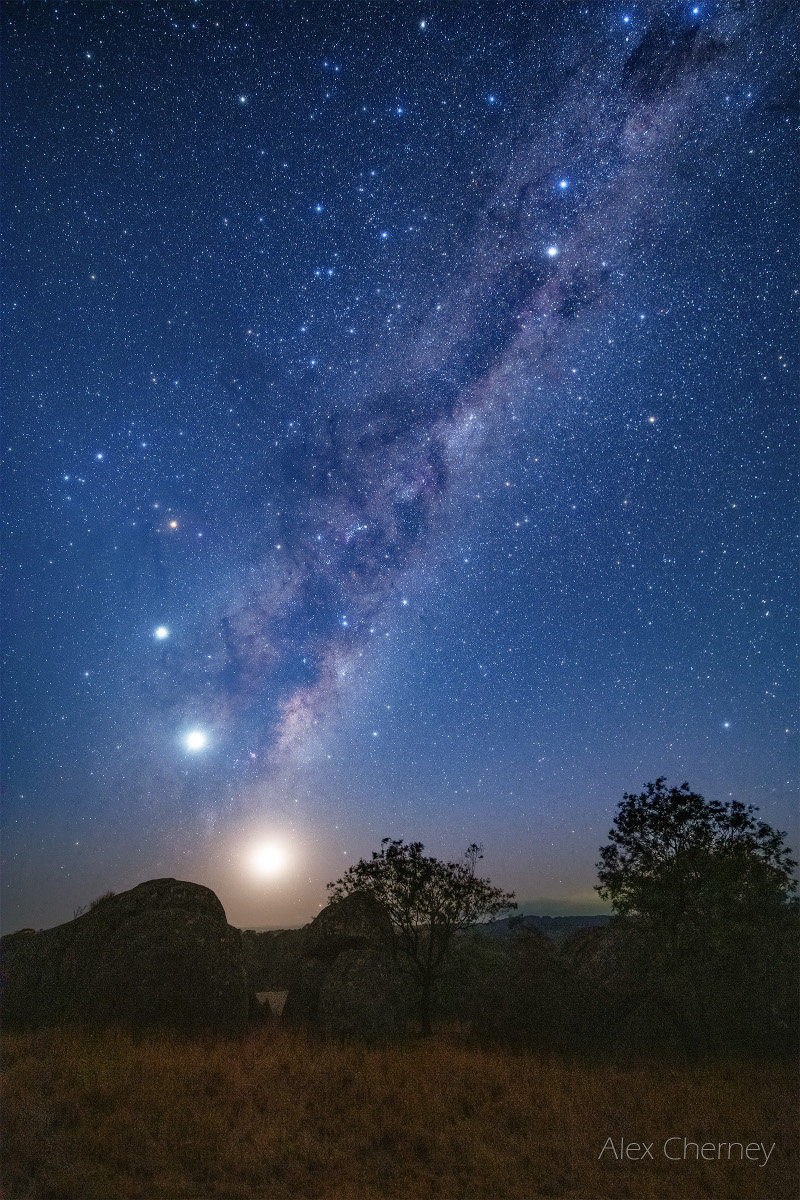
Good Red Friday morning RP. Today's picture is from the Land Down-Under (G'day Cynthia Croft), and is titled "Moon, Four Planets, and Emu."
Astronomy Picture of the Day
Posted from apod.nasa.gov NASA
NASA Space
Space Science
 Photography
 Astronomy
Edited 7 y ago
Posted 7 y ago
Responses: 10

10
10
0

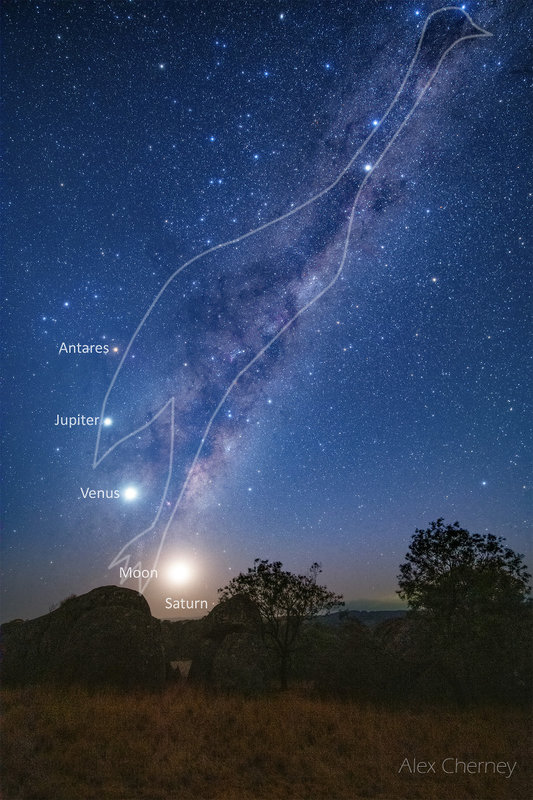
Thank you, my friend Maj William W. 'Bill' Price for continuing your daily series of posts from NASA. In this case "Moon, Four Planets, and Emu."
Thank for mentioning our friend Cynthia Croft :-)
Thanks for mentioning me, my friend Maj Marty Hogan
Background from your link: "Explanation: A luminous Milky Way falls toward the horizon in this deep skyscape, starting at the top of the frame from the stars of the Southern Cross and the dark Coalsack Nebula. Captured in the dark predawn of February 2nd from Central Victoria, Australia, planet Earth, the 26 day old waning crescent Moon still shines brightly near the horizon. The second and third brightest celestial beacons are Venus and Jupiter along the lower part of the Milky Way's central bulge. Almost in line with the brighter planets and Moon, Saturn is the pinprick of light just visible below and right of the lunar glow. Australia's first astronomers saw the elongated, bulging shape of the familiar Milky Way as a great celestial Emu. The Moon and planets could almost be the Emu's eggs on this starry night."
FYI LTC Stephen C. LTC (Join to see) Lt Col John (Jack) Christensen Maj Bill Smith, Ph.D. Maj William W. 'Bill' Price SCPO Morris Ramsey SGT Mark Halmrast Sgt Randy Wilber Sgt John H. SGT Gregory Lawritson CPL Dave Hoover SPC Margaret Higgins SSgt Brian Brakke 1stSgt Eugene Harless
Thank for mentioning our friend Cynthia Croft :-)
Thanks for mentioning me, my friend Maj Marty Hogan
Background from your link: "Explanation: A luminous Milky Way falls toward the horizon in this deep skyscape, starting at the top of the frame from the stars of the Southern Cross and the dark Coalsack Nebula. Captured in the dark predawn of February 2nd from Central Victoria, Australia, planet Earth, the 26 day old waning crescent Moon still shines brightly near the horizon. The second and third brightest celestial beacons are Venus and Jupiter along the lower part of the Milky Way's central bulge. Almost in line with the brighter planets and Moon, Saturn is the pinprick of light just visible below and right of the lunar glow. Australia's first astronomers saw the elongated, bulging shape of the familiar Milky Way as a great celestial Emu. The Moon and planets could almost be the Emu's eggs on this starry night."
FYI LTC Stephen C. LTC (Join to see) Lt Col John (Jack) Christensen Maj Bill Smith, Ph.D. Maj William W. 'Bill' Price SCPO Morris Ramsey SGT Mark Halmrast Sgt Randy Wilber Sgt John H. SGT Gregory Lawritson CPL Dave Hoover SPC Margaret Higgins SSgt Brian Brakke 1stSgt Eugene Harless
(10)
(0)
SPC Margaret Higgins
Oh, Wow, LTC Stephen F.! That is Really something! I remember lying in a meadow; and our camp's Director pointed his flashlight at the constellations! What Fun!
(4)
(0)
8
8
0
Wish I had more time to "see" all of these- over time I think I shall try
LTC Stephen F. SP5 Mark Kuzinski COL Mikel J. Burroughs SMSgt Lawrence McCarter Maj William W. 'Bill' PriceCPL Dave Hoover SSG William Jones Sgt Vance Bonds SGT (Join to see) Cpl (Join to see) SGT Rick Colburn PO1 H Gene Lawrence Maj Robert Thornton PO3 Bob McCord SPC Douglas Bolton CWO3 Dennis M. Lt Col Charlie Brown TSgt Joe C. PO3 Craig Phillips CW5 Jack Cardwell
LTC Stephen F. SP5 Mark Kuzinski COL Mikel J. Burroughs SMSgt Lawrence McCarter Maj William W. 'Bill' PriceCPL Dave Hoover SSG William Jones Sgt Vance Bonds SGT (Join to see) Cpl (Join to see) SGT Rick Colburn PO1 H Gene Lawrence Maj Robert Thornton PO3 Bob McCord SPC Douglas Bolton CWO3 Dennis M. Lt Col Charlie Brown TSgt Joe C. PO3 Craig Phillips CW5 Jack Cardwell
(8)
(0)
5
5
0

Read This Next


 Continue with Facebook
 Continue with Google