
Posted on Mar 10, 2019

United States Tunnel Rats - Vietnam War HD

7.83K
162
10
34
34
0
BONUS VIETNAM WAR SHARE OF THE DAY
THE TUNNEL-RAT
Published on Dec 20, 2014
The American tunnel rats were volunteer soldiers who performed underground search and destroy missions during the Vietnam War.
The tunnels presented many deadly booby traps: enemy soldiers, some manned holes on the sides of tunnels through which spears could be thrust, impaling a crawling intruder. Often there were flooded U-bends in the tunnels to trap poison gas. There were also dangerous creatures, such as venomous snakes, spiders, scorpions, ants, rats, Black-Bearded Tomb Bats and Lesser Dawn Bats.
Category
Education
Song
Intro
Artist
Graveland
Album
The Celtic Winter
Licensed to YouTube by
The Orchard Music, [Merlin] FUGA Aggregation (on behalf of Sepulchral Silence); ABKCO Music, Inc., and 3 Music Rights Societies
THE TUNNEL-RAT
Published on Dec 20, 2014
The American tunnel rats were volunteer soldiers who performed underground search and destroy missions during the Vietnam War.
The tunnels presented many deadly booby traps: enemy soldiers, some manned holes on the sides of tunnels through which spears could be thrust, impaling a crawling intruder. Often there were flooded U-bends in the tunnels to trap poison gas. There were also dangerous creatures, such as venomous snakes, spiders, scorpions, ants, rats, Black-Bearded Tomb Bats and Lesser Dawn Bats.
Category
Education
Song
Intro
Artist
Graveland
Album
The Celtic Winter
Licensed to YouTube by
The Orchard Music, [Merlin] FUGA Aggregation (on behalf of Sepulchral Silence); ABKCO Music, Inc., and 3 Music Rights Societies
Posted in these groups:  Vietnam War
Vietnam War
Posted 7 y ago
Responses: 8
13
13
0

SFC Joe S. Davis Jr., MSM, DSL
SSG Jeffrey Leake thank you my friend for the heartfelt response, I AM WITH YOU ON THE RESPECT!
Maj Marty Hogan SGT (Join to see) SPC Margaret Higgins SGT David A. 'Cowboy' Groth CW5 Jack CardwellCOL Mikel J. Burroughs CPL Dave Hoover SSG William Jones Lt Col Charlie Brown PO1 H Gene Lawrence Lt Col John (Jack) Christensen SCPO Morris Ramsey TSgt Joe C. PVT Mark Zehner SSgt Terry P. CPL Karen Hamilton SGT Elizabeth Scheck SPC Robert CoventryLTC Stephen F.
Maj Marty Hogan SGT (Join to see) SPC Margaret Higgins SGT David A. 'Cowboy' Groth CW5 Jack CardwellCOL Mikel J. Burroughs CPL Dave Hoover SSG William Jones Lt Col Charlie Brown PO1 H Gene Lawrence Lt Col John (Jack) Christensen SCPO Morris Ramsey TSgt Joe C. PVT Mark Zehner SSgt Terry P. CPL Karen Hamilton SGT Elizabeth Scheck SPC Robert CoventryLTC Stephen F.
(12)
(0)
8
8
0


Thank you, my friend SFC Joe S. Davis Jr., MSM, DSL for sharing the video I posted on June 26, 2018 is response to you image of Lonnie Robbins RA12902953 KIA September 18, 1967 in the Ho Bo woods.
Images:
1. 1967 tunnel rat at work with a suppressed revolver, Vietnam war
2. An infantryman is lowered into a tunnel during 'Operation Oregon', 1967
3. Lonnie Robbins RA12902953 KIA September 18, 1967 in the Ho Bo woods. He is coming out of tunnel 10 minutes before he died of a booby trap.
4. Typical Viet Cong Tunnel Complex 1960-1970
Background from https://cherrieswriter.com/2016/02/02/tunnel-rats-in-vietnam/
"Me and my partner, (Chops) Chalmers McElroy, are in picture # 25. Been there, done that, for a whole year (1966/1967) We were in the Tunnels of Cu Chi, our base camp at Cu Chi was actually built over a number of the tunnels which we only discovered after we were getting attacks from inside our perimeter and yet our perimeter was not breached! After they discovered them they were eventually sealed off and they made a tunnel rat school for future tunnel rats. Chops and I were some of the original tunnel rats and all our training was OJT!
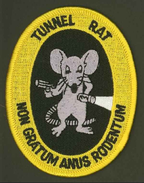
Tunnel rats were US, Australian and Newzelander soldiers who went inside Viet Cong(VC) tunnels to kill any VC inside, gather any Intel, recover arms and finally demolish the tunnels by planting explosives.Their unofficial moto was " Non gratum anus rodentum" in Latin. It meant " Not worth a rat' s @ss". Tunnel ratting required nerves of steel.
Tunnel rats were US, Australian and Newzelander soldiers who went inside Viet Cong (VC) tunnels to kill any VC inside, gather any Intel, recover arms and finally demolish the tunnels by planting explosives.Their unofficial motto was ” Non gratum anus rodentum” in Latin. It meant ” Not worth a rat’s @ss”. Tunnel ratting required nerves of steel
Originally the tunnels were started during the war against the French, but which were rapidly expanded upon when the American's arrived. They were constructed by volunteer village labourers using simple hoe's and baskets. The Laterite clay in which the tunnels were dug has a dull reddish appearance and dries rock hard during the dry season. During the wet season it is very soft and much easier to work. Because of the very nature of the Laterite clay's ability to dry rock hard it made a very good (if a somewhat difficult substance to work) soil in which to carve out a tunnel. The passages themselves were not cut in dead straight lines, rather they were made with corners that had between a 60 - degree and a 120 - degree angle to them. In other words the corners were constructed with no less than a 60 - degree angle and no more than a 120 - degree angle. This made shooting in a straight line impossible, and helped to deflect explosive blasts from grenades that might be thrown down.
Originally the tunnels were started during the war against the French, but which were rapidly expanded upon when the American’s arrived. They were constructed by volunteer village laborers using simple hoe’s and baskets. The Laterite clay in which the tunnels were dug has a dull reddish appearance and dries rock hard during the dry season. During the wet season it is very soft and much easier to work. Because of the very nature of the Laterite clay’s ability to dry rock hard it made a very good (if a somewhat difficult substance to work) soil in which to carve out a tunnel.
The passages themselves were not cut in dead straight lines, rather they were made with corners that had between a 60 – degree and a 120 – degree angle to them. In other words, the corners were constructed with no less than a 60 – degree angle and no more than a 120 – degree angle. This made shooting in a straight line impossible and helped to deflect explosive blasts from grenades that might be thrown down.
The tunnel systems (where the water table permitted) had several levels, each level was separated by a watertight trap door which would seal the rest of the system against gas, flooding, etc. The trap doors themselves were virtually undetectable and could fool a person into believing that the tunnel finished in a dead end, when in reality it led into a huge system of other passages. These passages would in turn lead to underground ammo dumps, kitchens, air raid shelters, hospitals, store rooms, workshops, latrines, and even theatres for the performances of political plays.
The tunnel systems (where the water table permitted) had several levels, each level was separated by a watertight trap door which would seal the rest of the system against gas, flooding, etc. The trap doors themselves were virtually undetectable and could fool a person into believing that the tunnel finished in a dead end, when in reality it led into a huge system of other passages. These passages would lead to underground ammo dumps, kitchens, air raid shelters, hospitals, store rooms, workshops, latrines, and even theatres for the performances of political plays.
The VC also dragged the bodies of their dead comrades underground in order to inter them in temporary graves when it became impossible to bury them above ground due to the presence of American/Australian troops. Once they had been dragged underground they were buried in the foetus position in the tunnel walls and covered with a thin layer of clay.
The VC also dragged the bodies of their dead comrades underground in order to intern them in temporary graves when it became impossible to bury them above ground due to the presence of American/Australian troops. Once they had been dragged underground they were buried in the fetus position in the tunnel walls and covered with a thin layer of clay.
The common practice to deny tunnels to the enemy in US forces was to seal the entrances or throw tear gas inside to force the occupants of the tunnels out. When the US forces started a massive search and destroy operation against VC (Viet Cong) in the Bo Ho woods, Northwest of Saigon, they suffered serious casualties but the enemy usually disappeared when the US forces gave a chase. It then appeared that the VC were using complex tunnel systems for movements and ambushes. Sergeant Sweetheart Green of the Australian army gave the VC a chase by entering their tunnels.
The common practice to deny tunnels to the enemy in US forces was to seal the entrances or throw tear gas inside to force the occupants of the tunnels out.
When the US forces started a massive search and destroy operation against VC (Viet Cong) in the Bo Ho woods, Northwest of Saigon, they suffered serious casualties but the enemy usually disappeared when the US forces gave a chase. It then appeared that the VC used complex tunnel systems for movements and ambushes.
Sergeant Sweetheart Green of the Australian army gave the VC a chase by entering their tunnels.
Hazards troops might face in the tunnels include booby traps, pressure release bombs, punji stakes, snake traps( VC would tie a deadly bamboo pit viper which has a hemotoxin venom to ceilings,bushes so that they bite an unaware enemy in the neck, face or hands. VC would also hide snakes in sacks, crates etc), and mines. As well, enemy combatants ambushes. Apart from regular ambushes, some tunnels had special holes in the walls for VC to thrust stakes through them and impale any intruder. Sometimes VC would lay in wait on trap doors and entrances and wait for soldier to emerge and then kill them with stakes, shots, knives. Some non fatal dangers included bat swarms, spiders and the notorious Vietnamese fire ants. Not to mention one could also get lost in the tunnels.
Hazards troops might face in the tunnels include booby traps, pressure release bombs, punji stakes, snake traps ( VC would tie a deadly bamboo pit viper which has a hemotoxin venom to ceilings, bushes so that they bite an unaware enemy in the neck, face or hands. VC would also hide snakes in sacks, crates etc), and mines. Apart from regular ambushes, some tunnels had special holes in the walls for VC to thrust stakes through them and impale any intruder.
Sometimes VC would lay in wait on trap doors and entrances and wait for a soldier to emerge and then kill them with stakes, shots, and knives.
Some non-fatal dangers included bat swarms, spiders, and the notorious Vietnamese fire ants. Not to mention one could also get lost in the tunnels.
Upon detecting a tunnel entrance, soldiers would check the surrounding area of any booby traps and disarm them if found and a grenade would be thrown inside the tunnel entrance. Then the point man would be lowered head first into the tunnel held by his feet by his comrades. He would be holding a pistol in his right hand and a flashlight in left hand. He would see for any enemy and feel the walls and ground for any booby traps and mines. He would be secured by a rope so that he may be pulled out in case of any emergency.The second man would then come inside. The point man would constantly look for booby traps and enemy activity while the second man would note the soil and amount of overburden which would be later required in demolition calculations. They would sense for the enemy and alert to movements and sounds like cocking of weapon or sound of grenade pin being pulled.
Upon detecting a tunnel entrance, soldiers would check the surrounding area of any booby traps and disarm them if found and a grenade would be thrown inside the tunnel entrance.
Then the point man would be lowered head first into the tunnel held by his feet by his comrades. He would be holding a pistol in his right hand and a flashlight in left hand. He would see for any enemy and feel the walls and ground for any booby traps and mines. He would be secured by a rope so that he may be pulled out in case of any emergency. The second man would then come inside.
The point man would constantly look for booby traps and enemy activity while the second man would note the soil and amount of overburden which would be later required in demolition calculations.
They would sense for the enemy and alert to movements and sounds like cocking of weapon or sound of grenade pin being pulled.
The primary mission was to kill the enemies and troops were instructed not to fire 5-6 shots in a row as it would tell the enemy that tunnel rats were about to reload. They would then search the tunnel for S2 intelligence, maps and documents and would recover any arms and ammunition found in tunnels. After searching the tunnel and getting out, they would get in again with C4 explosive charges which would be placed at tunnel bends and at strong points in calculated amounts. After getting out and at a safe distance, they would detonate the charges and hence demolish the tunnel.
The primary mission was to kill the enemies and troops were instructed not to fire 5-6 shots in a row as it would tell the enemy that tunnel rats were about to reload.
They would then search the tunnel for S2 intelligence, maps and documents and would recover any arms and ammunition found in tunnels.
After searching the tunnel and getting out, they would get in again with C4 explosive charges which would be placed at tunnel bends and at strong points in calculated amounts. After getting out and at a safe distance, they would detonate the charges and hence demolish the tunnel.
One can not imagine the feeling of crawling into a tiny whole, not knowing who is in there, where it leads and what dangers lie beyond each turn. We have the utmost respect and admiration for those bad a$$ enough to have been tunnel rats! Below is an interview with a tunnel rat that quickly will help you realize the reality the tunnel rats faced.
One can’t imagine the feeling of crawling into a tiny hole, not knowing who is in there, where it leads and what dangers lie beyond each turn. We have the utmost respect and admiration for those bad a$$ enough to have been tunnel rats!"
The American tunnel rats were volunteer soldiers who performed underground search and destroy missions during the Vietnam War."
FYI LTC Stephen C. LTC (Join to see) Lt Col John (Jack) Christensen Lt Col Charlie Brown Maj Bill Smith, Ph.D. Maj William W. 'Bill' Price Maj Marty Hogan SCPO Morris Ramsey SFC William Farrell SGT Mark Halmrast Sgt Randy Wilber Sgt John H. SGT Gregory Lawritson CPL Dave Hoover SPC Margaret Higgins SSgt Brian Brakke 1stSgt Eugene Harless SSG William Jones SSG Diane R.
Images:
1. 1967 tunnel rat at work with a suppressed revolver, Vietnam war
2. An infantryman is lowered into a tunnel during 'Operation Oregon', 1967
3. Lonnie Robbins RA12902953 KIA September 18, 1967 in the Ho Bo woods. He is coming out of tunnel 10 minutes before he died of a booby trap.
4. Typical Viet Cong Tunnel Complex 1960-1970
Background from https://cherrieswriter.com/2016/02/02/tunnel-rats-in-vietnam/
"Me and my partner, (Chops) Chalmers McElroy, are in picture # 25. Been there, done that, for a whole year (1966/1967) We were in the Tunnels of Cu Chi, our base camp at Cu Chi was actually built over a number of the tunnels which we only discovered after we were getting attacks from inside our perimeter and yet our perimeter was not breached! After they discovered them they were eventually sealed off and they made a tunnel rat school for future tunnel rats. Chops and I were some of the original tunnel rats and all our training was OJT!
Tunnel rats were US, Australian and Newzelander soldiers who went inside Viet Cong(VC) tunnels to kill any VC inside, gather any Intel, recover arms and finally demolish the tunnels by planting explosives.Their unofficial moto was " Non gratum anus rodentum" in Latin. It meant " Not worth a rat' s @ss". Tunnel ratting required nerves of steel.
Tunnel rats were US, Australian and Newzelander soldiers who went inside Viet Cong (VC) tunnels to kill any VC inside, gather any Intel, recover arms and finally demolish the tunnels by planting explosives.Their unofficial motto was ” Non gratum anus rodentum” in Latin. It meant ” Not worth a rat’s @ss”. Tunnel ratting required nerves of steel
Originally the tunnels were started during the war against the French, but which were rapidly expanded upon when the American's arrived. They were constructed by volunteer village labourers using simple hoe's and baskets. The Laterite clay in which the tunnels were dug has a dull reddish appearance and dries rock hard during the dry season. During the wet season it is very soft and much easier to work. Because of the very nature of the Laterite clay's ability to dry rock hard it made a very good (if a somewhat difficult substance to work) soil in which to carve out a tunnel. The passages themselves were not cut in dead straight lines, rather they were made with corners that had between a 60 - degree and a 120 - degree angle to them. In other words the corners were constructed with no less than a 60 - degree angle and no more than a 120 - degree angle. This made shooting in a straight line impossible, and helped to deflect explosive blasts from grenades that might be thrown down.
Originally the tunnels were started during the war against the French, but which were rapidly expanded upon when the American’s arrived. They were constructed by volunteer village laborers using simple hoe’s and baskets. The Laterite clay in which the tunnels were dug has a dull reddish appearance and dries rock hard during the dry season. During the wet season it is very soft and much easier to work. Because of the very nature of the Laterite clay’s ability to dry rock hard it made a very good (if a somewhat difficult substance to work) soil in which to carve out a tunnel.
The passages themselves were not cut in dead straight lines, rather they were made with corners that had between a 60 – degree and a 120 – degree angle to them. In other words, the corners were constructed with no less than a 60 – degree angle and no more than a 120 – degree angle. This made shooting in a straight line impossible and helped to deflect explosive blasts from grenades that might be thrown down.
The tunnel systems (where the water table permitted) had several levels, each level was separated by a watertight trap door which would seal the rest of the system against gas, flooding, etc. The trap doors themselves were virtually undetectable and could fool a person into believing that the tunnel finished in a dead end, when in reality it led into a huge system of other passages. These passages would in turn lead to underground ammo dumps, kitchens, air raid shelters, hospitals, store rooms, workshops, latrines, and even theatres for the performances of political plays.
The tunnel systems (where the water table permitted) had several levels, each level was separated by a watertight trap door which would seal the rest of the system against gas, flooding, etc. The trap doors themselves were virtually undetectable and could fool a person into believing that the tunnel finished in a dead end, when in reality it led into a huge system of other passages. These passages would lead to underground ammo dumps, kitchens, air raid shelters, hospitals, store rooms, workshops, latrines, and even theatres for the performances of political plays.
The VC also dragged the bodies of their dead comrades underground in order to inter them in temporary graves when it became impossible to bury them above ground due to the presence of American/Australian troops. Once they had been dragged underground they were buried in the foetus position in the tunnel walls and covered with a thin layer of clay.
The VC also dragged the bodies of their dead comrades underground in order to intern them in temporary graves when it became impossible to bury them above ground due to the presence of American/Australian troops. Once they had been dragged underground they were buried in the fetus position in the tunnel walls and covered with a thin layer of clay.
The common practice to deny tunnels to the enemy in US forces was to seal the entrances or throw tear gas inside to force the occupants of the tunnels out. When the US forces started a massive search and destroy operation against VC (Viet Cong) in the Bo Ho woods, Northwest of Saigon, they suffered serious casualties but the enemy usually disappeared when the US forces gave a chase. It then appeared that the VC were using complex tunnel systems for movements and ambushes. Sergeant Sweetheart Green of the Australian army gave the VC a chase by entering their tunnels.
The common practice to deny tunnels to the enemy in US forces was to seal the entrances or throw tear gas inside to force the occupants of the tunnels out.
When the US forces started a massive search and destroy operation against VC (Viet Cong) in the Bo Ho woods, Northwest of Saigon, they suffered serious casualties but the enemy usually disappeared when the US forces gave a chase. It then appeared that the VC used complex tunnel systems for movements and ambushes.
Sergeant Sweetheart Green of the Australian army gave the VC a chase by entering their tunnels.
Hazards troops might face in the tunnels include booby traps, pressure release bombs, punji stakes, snake traps( VC would tie a deadly bamboo pit viper which has a hemotoxin venom to ceilings,bushes so that they bite an unaware enemy in the neck, face or hands. VC would also hide snakes in sacks, crates etc), and mines. As well, enemy combatants ambushes. Apart from regular ambushes, some tunnels had special holes in the walls for VC to thrust stakes through them and impale any intruder. Sometimes VC would lay in wait on trap doors and entrances and wait for soldier to emerge and then kill them with stakes, shots, knives. Some non fatal dangers included bat swarms, spiders and the notorious Vietnamese fire ants. Not to mention one could also get lost in the tunnels.
Hazards troops might face in the tunnels include booby traps, pressure release bombs, punji stakes, snake traps ( VC would tie a deadly bamboo pit viper which has a hemotoxin venom to ceilings, bushes so that they bite an unaware enemy in the neck, face or hands. VC would also hide snakes in sacks, crates etc), and mines. Apart from regular ambushes, some tunnels had special holes in the walls for VC to thrust stakes through them and impale any intruder.
Sometimes VC would lay in wait on trap doors and entrances and wait for a soldier to emerge and then kill them with stakes, shots, and knives.
Some non-fatal dangers included bat swarms, spiders, and the notorious Vietnamese fire ants. Not to mention one could also get lost in the tunnels.
Upon detecting a tunnel entrance, soldiers would check the surrounding area of any booby traps and disarm them if found and a grenade would be thrown inside the tunnel entrance. Then the point man would be lowered head first into the tunnel held by his feet by his comrades. He would be holding a pistol in his right hand and a flashlight in left hand. He would see for any enemy and feel the walls and ground for any booby traps and mines. He would be secured by a rope so that he may be pulled out in case of any emergency.The second man would then come inside. The point man would constantly look for booby traps and enemy activity while the second man would note the soil and amount of overburden which would be later required in demolition calculations. They would sense for the enemy and alert to movements and sounds like cocking of weapon or sound of grenade pin being pulled.
Upon detecting a tunnel entrance, soldiers would check the surrounding area of any booby traps and disarm them if found and a grenade would be thrown inside the tunnel entrance.
Then the point man would be lowered head first into the tunnel held by his feet by his comrades. He would be holding a pistol in his right hand and a flashlight in left hand. He would see for any enemy and feel the walls and ground for any booby traps and mines. He would be secured by a rope so that he may be pulled out in case of any emergency. The second man would then come inside.
The point man would constantly look for booby traps and enemy activity while the second man would note the soil and amount of overburden which would be later required in demolition calculations.
They would sense for the enemy and alert to movements and sounds like cocking of weapon or sound of grenade pin being pulled.
The primary mission was to kill the enemies and troops were instructed not to fire 5-6 shots in a row as it would tell the enemy that tunnel rats were about to reload. They would then search the tunnel for S2 intelligence, maps and documents and would recover any arms and ammunition found in tunnels. After searching the tunnel and getting out, they would get in again with C4 explosive charges which would be placed at tunnel bends and at strong points in calculated amounts. After getting out and at a safe distance, they would detonate the charges and hence demolish the tunnel.
The primary mission was to kill the enemies and troops were instructed not to fire 5-6 shots in a row as it would tell the enemy that tunnel rats were about to reload.
They would then search the tunnel for S2 intelligence, maps and documents and would recover any arms and ammunition found in tunnels.
After searching the tunnel and getting out, they would get in again with C4 explosive charges which would be placed at tunnel bends and at strong points in calculated amounts. After getting out and at a safe distance, they would detonate the charges and hence demolish the tunnel.
One can not imagine the feeling of crawling into a tiny whole, not knowing who is in there, where it leads and what dangers lie beyond each turn. We have the utmost respect and admiration for those bad a$$ enough to have been tunnel rats! Below is an interview with a tunnel rat that quickly will help you realize the reality the tunnel rats faced.
One can’t imagine the feeling of crawling into a tiny hole, not knowing who is in there, where it leads and what dangers lie beyond each turn. We have the utmost respect and admiration for those bad a$$ enough to have been tunnel rats!"
The American tunnel rats were volunteer soldiers who performed underground search and destroy missions during the Vietnam War."
FYI LTC Stephen C. LTC (Join to see) Lt Col John (Jack) Christensen Lt Col Charlie Brown Maj Bill Smith, Ph.D. Maj William W. 'Bill' Price Maj Marty Hogan SCPO Morris Ramsey SFC William Farrell SGT Mark Halmrast Sgt Randy Wilber Sgt John H. SGT Gregory Lawritson CPL Dave Hoover SPC Margaret Higgins SSgt Brian Brakke 1stSgt Eugene Harless SSG William Jones SSG Diane R.
This story originally appeared in: Thebrigade.com on January 14, 2016 by Chuck My FB friend, Richard Bradley, recently posted the link to this story on his page with the following note: Me an…
(8)
(0)
8
8
0

Read This Next


 Continue with Facebook
 Continue with Google