
Posted on Feb 26, 2020

APOD: 2020 February 26 - NGST 10b: Discovery of a Doomed Planet

1.22K
79
12
21
21
0
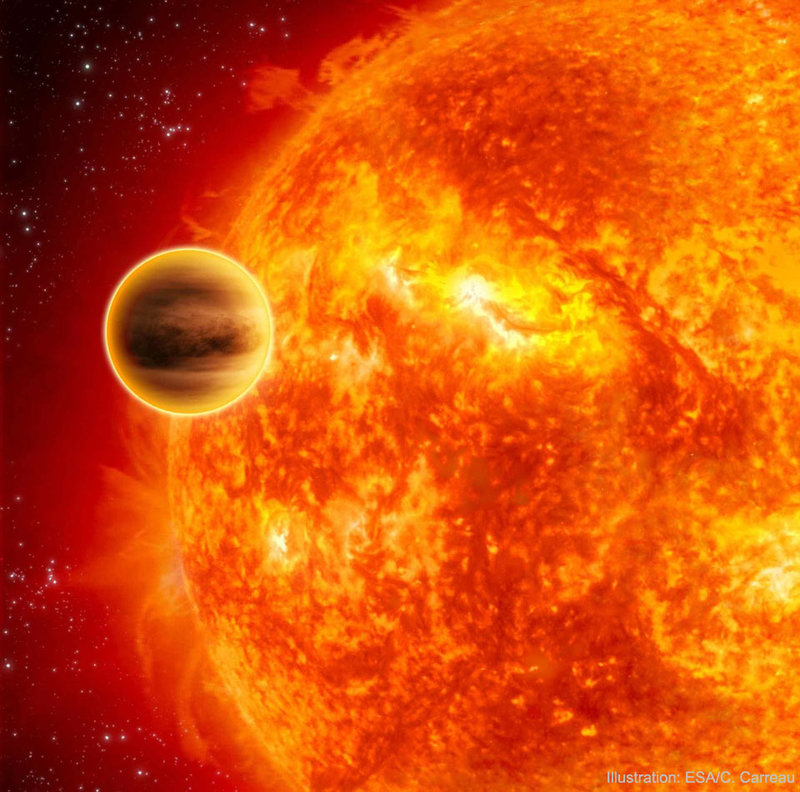
Good morning, Rallypoint. Today's Astronomy Picture of the Day (APOD) is titled "NGST 10b: Discovery of a Doomed Planet." Ever heard of a "hot jupiter"? Me neither. Hot jupiters are gas giant planets like Jupiter that orbit much closer to their parent stars than Mercury does to our Sun. This proximity means their orbital periods about the star are much shorter (10 days or less). The image depicted here is of the newly discovered planet, which has an orbital period of 18 hours.
The parent star lies about 1,000 light years from Earth, and was detected by the amount of light from the star the planet blocked as it followed its orbital path. Using a technique called transit photometry, scientists know that the planet is 20% bigger than our Jupiter and just over twice the mass according to radial velocity measurements. Its distance from the star is only twice the diameter of the star itself - in other words, 27 times closer to the star than the planet Mercury is to our Sun.
The parent star lies about 1,000 light years from Earth, and was detected by the amount of light from the star the planet blocked as it followed its orbital path. Using a technique called transit photometry, scientists know that the planet is 20% bigger than our Jupiter and just over twice the mass according to radial velocity measurements. Its distance from the star is only twice the diameter of the star itself - in other words, 27 times closer to the star than the planet Mercury is to our Sun.
APOD: 2020 February 26 - NGST 10b: Discovery of a Doomed Planet
Posted from apod.nasa.gov NASA
NASA Space
Space Science
 Photography
 Astronomy
Posted 6 y ago
Responses: 11
9
9
0

There is speculation that these "hot Jupiters" probably are a sign of no life as we know it in that system, as the Jupiter would have formed in the normal place, and slowly spiraled inward, absorbing any terrestrial type planets, or disrupting their orbits to the extent they most likely tumbled into the star.
(9)
(0)
SGT Kevin Hughes
That makes sense, as one of the things a Planet does, is clear its orbit...and something that doggone big would certainly mow down anything in its path.
(1)
(0)
7
7
0

Excellent astronomy picture share sir, have a great morning and day sir.
(7)
(0)
6
6
0

Provided to YouTube by YouTube CSV2DDEX Doomed Planet (Original Mix) · Haryzmo Headless Planets EP 2015 Double The Throne Released on: 2015-02-09 Auto-gene...
Thank you, my friend Maj William W. 'Bill' Price for posting the NASA Astronomy Picture of the Day (APOD)for Wednesday, February 26, 2020 entitled "NGST 10b: Discovery of a Doomed Planet."
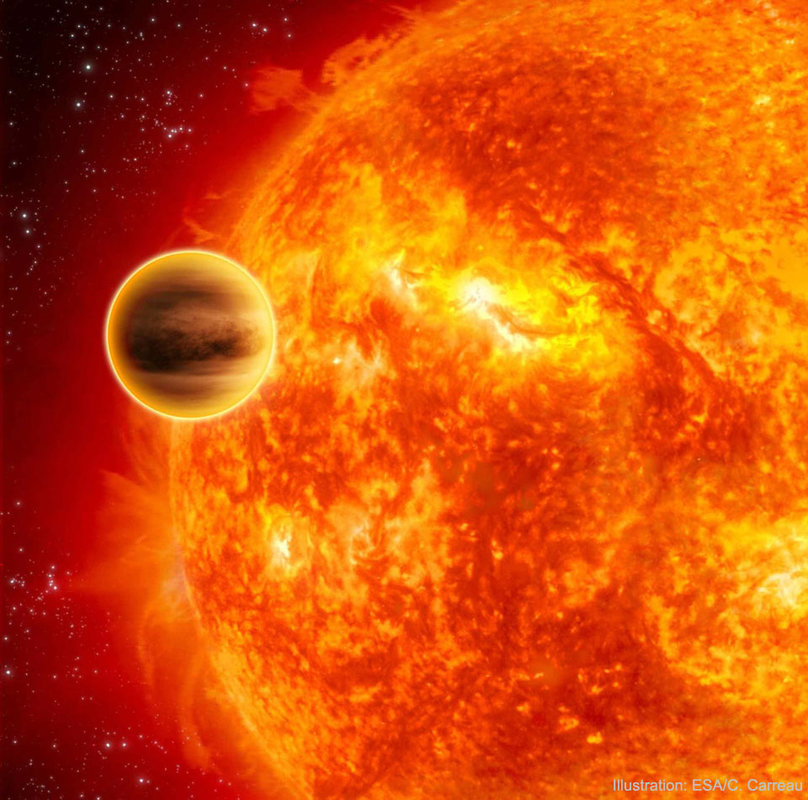
Image: NGTS-10b: Discovery of a Doomed Planet - Illustration Credit - ESA, C. Carreau; Text - Alex R. Howe (NASA_USRA, Science Meets Fiction Blog)
Explanation: This hot jupiter is doomed. Hot jupiters are giant planets like Jupiter that orbit much closer to their parent stars than Mercury does to our Sun. But some hot jupiters are more extreme than others. NGTS-10b, illustrated generically, is the closest and fastest-orbiting giant planet yet discovered, circling its home star in only 18 hours. NGTS-10b is a little larger than Jupiter, but it orbits less than two times the diameter of its parent star away from the star’s surface. When a planet orbits this close, it is expected to spiral inward, pulled down by tidal forces to be eventually ripped apart by the star’s gravity. NGTS-10b, discovered by researchers at the University of Warwick, is named after the Next Generation Transit Survey, which detected the imperiled planet when it passed in front of its star, blocking some of the light. Although the violent demise of NGTS-10b will happen eventually, we don't yet know when. "
Doomed Planet (Original Mix)
https://www.youtube.com/watch?v=Q2_VaOSNU9I
FYI PO1 William "Chip" Nagel Capt Dwayne Conyers SMSgt Lawrence McCarter PO1 H Gene Lawrence TSgt David L. TSgt Joe C. SPC Chris Bayner-Cwik SPC Margaret Higgins MSgt Robert "Rock" Aldi COL Mikel J. Burroughs SGT Steve McFarland SP5 Mark Kuzinski Maj Kim Patterson Maj Bill Smith, Ph.D. SP5 Jeannie CarlePO1 Robert GeorgeSSG Robert Mark Odom SSG Robert "Rob" Wentworth
Image: NGTS-10b: Discovery of a Doomed Planet - Illustration Credit - ESA, C. Carreau; Text - Alex R. Howe (NASA_USRA, Science Meets Fiction Blog)
Explanation: This hot jupiter is doomed. Hot jupiters are giant planets like Jupiter that orbit much closer to their parent stars than Mercury does to our Sun. But some hot jupiters are more extreme than others. NGTS-10b, illustrated generically, is the closest and fastest-orbiting giant planet yet discovered, circling its home star in only 18 hours. NGTS-10b is a little larger than Jupiter, but it orbits less than two times the diameter of its parent star away from the star’s surface. When a planet orbits this close, it is expected to spiral inward, pulled down by tidal forces to be eventually ripped apart by the star’s gravity. NGTS-10b, discovered by researchers at the University of Warwick, is named after the Next Generation Transit Survey, which detected the imperiled planet when it passed in front of its star, blocking some of the light. Although the violent demise of NGTS-10b will happen eventually, we don't yet know when. "
Doomed Planet (Original Mix)
https://www.youtube.com/watch?v=Q2_VaOSNU9I
FYI PO1 William "Chip" Nagel Capt Dwayne Conyers SMSgt Lawrence McCarter PO1 H Gene Lawrence TSgt David L. TSgt Joe C. SPC Chris Bayner-Cwik SPC Margaret Higgins MSgt Robert "Rock" Aldi COL Mikel J. Burroughs SGT Steve McFarland SP5 Mark Kuzinski Maj Kim Patterson Maj Bill Smith, Ph.D. SP5 Jeannie CarlePO1 Robert GeorgeSSG Robert Mark Odom SSG Robert "Rob" Wentworth
(6)
(0)
Read This Next


 Continue with Facebook
 Continue with Google