
Posted on Feb 10, 2021

APOD: 2021 February 10 - Firing Lasers to Tame the Sky

1.09K
142
20
24
24
0
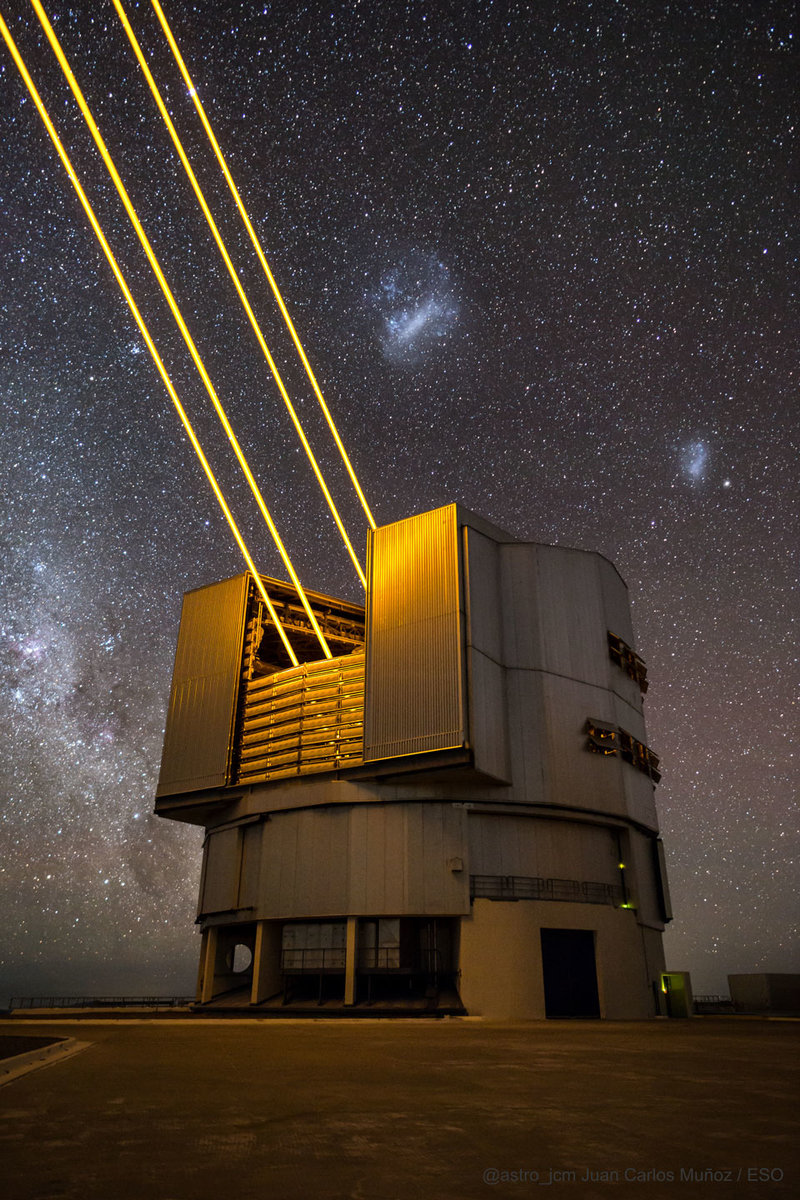
Good morning, Rallypoint. Today's Astronomy Picture of the Day (APOD) is titled "Firing Lasers to Tame the Sky." While it looks like something from a Star Wars movie, the Paranal Observatory in Chilé is equipped with four lasers that it uses to model atmospheric turbulence. Stars 'twinkle' due to the turbulence caused by pockets of air at different temperatures in constant motion. The lasers create artificial stars (which also 'twinkle') which are recorded and passed to a flexible mirror that deforms hundreds of times per second. This counteracts atmospheric turbulence in an area under study and results in crisper images. It's not quite like being on the Hubble, but it's close.
APOD: 2021 February 10 - Firing Lasers to Tame the Sky
Posted from apod.nasa.gov NASA
NASA Space
Space Science
 Photography
 Astronomy
Posted 5 y ago
Responses: 14
12
12
0

11
11
0

Oliver - Good Morning Starshine
https://www.facebook.com/pages/Release-your-mind-with-music/108293209506915?ref=hl Good Morning Starshine Good morning starshineThe earth says, "Hello"You...
Thank you my friend Maj William W. 'Bill' Price for posting the NASA Astronomy Picture of the Day (APOD) for Wednesday, February 10, 2021 entitled "Firing Lasers to Tame the Sky."
Image: Firing Lasers to Tame the Sky - Image Credit & Copyright - Juan Carlos Muñoz - ESO; Text- Juan Carlos Muñoz
This may be an effort to announce the death knell of 'Twinkle, Twinkle Little Star' :-)
The image title seems to be over-the-top - "de-twinkling of stars is a developing field of technology and allows, in some cases, Hubble-class images to be taken from the ground."
Blaming sodium seems to be all-too-common. From too much sodium in food and drink to now sodium left by passing meteors which develop into artificial twinklers which impact the view of space :-)
Considering the fact that stars are hundreds and thousands of light-years away, the twinkling effects are centuries to millennia old :-)
APOD Background
"Explanation: Why do stars twinkle? Our atmosphere is to blame as pockets of slightly off-temperature air, in constant motion, distort the light paths from distant astronomical objects. Atmospheric turbulence is a problem for astronomers because it blurs the images of the sources they want to study. The telescope featured in this image, located at ESO’s Paranal Observatory, is equipped with four lasers to combat this turbulence. The lasers are tuned to a color that excites atoms floating high in Earth's atmosphere -- sodium left by passing meteors. These glowing sodium spots act as artificial stars whose twinkling is immediately recorded and passed to a flexible mirror that deforms hundreds of times per second, counteracting atmospheric turbulence and resulting in crisper images. The de-twinkling of stars is a developing field of technology and allows, in some cases, Hubble-class images to be taken from the ground. This technique has also led to spin-off applications in human vision science, where it is used to obtain very sharp images of the retina.'
Oliver - Good Morning Starshine
https://www.youtube.com/watch?v=whmzEXywq40
FYI Maj Robert Thornton Lt Col Charlie Brown COL Mikel J. Burroughs Sgt (Join to see) PO1 William "Chip" Nagel Maj Bill Smith, Ph.D. Lt Col John (Jack) Christensen SGT Denny Espinosa Sgt Vance Bonds MAJ Dale E. Wilson, Ph.D. TSgt David L. SPC Nancy GreenePO2 (Join to see) SSG Michael Noll SPC Margaret Higgins Maj Marty Hogan SMSgt David A Asbury SMSgt Lawrence McCarter CPT Richard Trione
Image: Firing Lasers to Tame the Sky - Image Credit & Copyright - Juan Carlos Muñoz - ESO; Text- Juan Carlos Muñoz
This may be an effort to announce the death knell of 'Twinkle, Twinkle Little Star' :-)
The image title seems to be over-the-top - "de-twinkling of stars is a developing field of technology and allows, in some cases, Hubble-class images to be taken from the ground."
Blaming sodium seems to be all-too-common. From too much sodium in food and drink to now sodium left by passing meteors which develop into artificial twinklers which impact the view of space :-)
Considering the fact that stars are hundreds and thousands of light-years away, the twinkling effects are centuries to millennia old :-)
APOD Background
"Explanation: Why do stars twinkle? Our atmosphere is to blame as pockets of slightly off-temperature air, in constant motion, distort the light paths from distant astronomical objects. Atmospheric turbulence is a problem for astronomers because it blurs the images of the sources they want to study. The telescope featured in this image, located at ESO’s Paranal Observatory, is equipped with four lasers to combat this turbulence. The lasers are tuned to a color that excites atoms floating high in Earth's atmosphere -- sodium left by passing meteors. These glowing sodium spots act as artificial stars whose twinkling is immediately recorded and passed to a flexible mirror that deforms hundreds of times per second, counteracting atmospheric turbulence and resulting in crisper images. The de-twinkling of stars is a developing field of technology and allows, in some cases, Hubble-class images to be taken from the ground. This technique has also led to spin-off applications in human vision science, where it is used to obtain very sharp images of the retina.'
Oliver - Good Morning Starshine
https://www.youtube.com/watch?v=whmzEXywq40
FYI Maj Robert Thornton Lt Col Charlie Brown COL Mikel J. Burroughs Sgt (Join to see) PO1 William "Chip" Nagel Maj Bill Smith, Ph.D. Lt Col John (Jack) Christensen SGT Denny Espinosa Sgt Vance Bonds MAJ Dale E. Wilson, Ph.D. TSgt David L. SPC Nancy GreenePO2 (Join to see) SSG Michael Noll SPC Margaret Higgins Maj Marty Hogan SMSgt David A Asbury SMSgt Lawrence McCarter CPT Richard Trione
(11)
(0)
LTC Stephen F.
The Young Rascals - Groovin' (1967)
Really couldn't get away too soon
The Young Rascals - Groovin' (1967)
https://www.youtube.com/watch?v=4JIq8Zn0AJE&list=RD4JIq8Zn0AJE&start_radio=1&t=3
FYI SSG Franklin BriantSgt John H. CW5 Jack Cardwell SGT David A. 'Cowboy' Groth SGT (Join to see)SSG Jeffrey LeakeSPC Michael Duricko, Ph.D SPC Matthew Lamb CPT Gurinder (Gene) Rana SSG Samuel Kermon LTC Wayne Brandon Maj Kim Patterson Sgt (Join to see) SSG Samuel KermonMSgt Paul Connors SPC Margaret Higgins SPC Nancy Greene
https://www.youtube.com/watch?v=4JIq8Zn0AJE&list=RD4JIq8Zn0AJE&start_radio=1&t=3
FYI SSG Franklin BriantSgt John H. CW5 Jack Cardwell SGT David A. 'Cowboy' Groth SGT (Join to see)SSG Jeffrey LeakeSPC Michael Duricko, Ph.D SPC Matthew Lamb CPT Gurinder (Gene) Rana SSG Samuel Kermon LTC Wayne Brandon Maj Kim Patterson Sgt (Join to see) SSG Samuel KermonMSgt Paul Connors SPC Margaret Higgins SPC Nancy Greene
(7)
(0)
SPC Margaret Higgins
LTC Stephen F. - May GOD ALMIGHTY HIMSELF: both eternally and infinitely bless you; and, your Darling wife; my Dear Brother-in-CHRIST.
(6)
(0)
9
9
0

I've read about this before (I'm an old school nerd, I still subscribe to Astronomy magazine), however the picture is really cool. Is that what it actually looks like in operation, or has it been retouched?
(9)
(0)
Read This Next


 Continue with Facebook
 Continue with Google