

17
17
0
Knute Rockne
https://en.wikipedia.org/wiki/Knute_Rockne
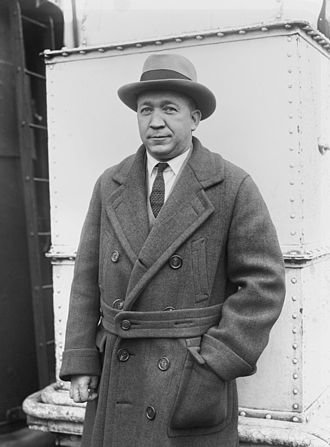
Knute Kenneth Rockne (/kəˈnuːt/ kə-NOOT; March 4, 1888 – March 31, 1931) was a Norwegian-American football player and coach at the University of Notre Dame.
Rockne is regarded as one of the greatest coaches in college football history.[3] His biography at the College Football Hall of Fame identifies him as "without question, American football's most-renowned coach". Rockne helped to popularize the forward pass and made the Notre Dame Fighting Irish a major factor in college football.
https://en.wikipedia.org/wiki/Knute_Rockne
Knute Kenneth Rockne (/kəˈnuːt/ kə-NOOT; March 4, 1888 – March 31, 1931) was a Norwegian-American football player and coach at the University of Notre Dame.
Rockne is regarded as one of the greatest coaches in college football history.[3] His biography at the College Football Hall of Fame identifies him as "without question, American football's most-renowned coach". Rockne helped to popularize the forward pass and made the Notre Dame Fighting Irish a major factor in college football.
Posted in these groups:  Birthday
 American History
 Leadership
 University of Notre Dame
 College Football
Birthday American History Leadership University of Notre Dame College Football
Edited 6 y ago
Posted 6 y ago
Responses: 5

5
5
0


THE KNUTE ROCKNE STORY 1920s NOTRE DAME UNIVERSITY FOOTBALL DOCUMENTARY 54114
The film begins with views of the University of Notre Dame (:06-:24). Knute’s life is explored, beginning with helmeted young boys in Chicago who huddle toge...
Thank you, my friend Maj Marty Hogan for making us aware that March 4 is the anniversary of the birth of Norwegian-American football player and coach at the University- of-Notre-Dame Knute Kenneth Rockne who was regarded as one of the greatest coaches in college football history.
Rest in peace Knute Rockne!
THE KNUTE ROCKNE STORY 1920s NOTRE DAME UNIVERSITY FOOTBALL DOCUMENTARY 54114
The film begins with views of the University of Notre Dame (:06-:24). Knute’s life is explored, beginning with helmeted young boys in Chicago who huddle together and play football in a field. (:25-:41). The post office (:42) is where he earned enough money at 22 to go to Notre Dame in 1910. Photos of the University are shown (:43-:56). A photo is shown of Knute in 1913 as a track team star (1:01) and one as captain of the football team (1:03). Next is of Knute as a Chemistry instructor (1:08), and an assistant football coach (1:10-1:15). A 1914 photo shows Knute and his new wife, Bonnie Skiles (1:20). A 1918 photos shows him as head coach (1:22). Knute is shown training players (1:27-1:52). His star player, George Gipp, “the Gipper” is shown in a photo and on the field. The team is untied and undefeated in 1919 and in 1920 (1:55-2:15). Gipp dies of streptococcal throat infection and pneumonia in his senior season (2:16-2:25). The next photo shows Rockne with his “Four Horseman” as he tries to rebuild the team (2:28). The four were quarterback Harry Stuhldreher (2:32), fullback Elmer Layden (2:34), right halfback Jim Crowley (2:38), and left halfback Don Miller (2:40). The four are shown on horseback (2:46). A touchdown in 1923 is shown, followed by one in 1924 (2:52-3:19). The Rose Bowl field has the Notre Dame logo shown by a group of students with signs (3:21). A touchdown in the 1925 win against Stanford is shown (3:23-3:34). A packed parade follows in South Bend (3:35-3:46). In the winter of 1925, Knute visited Columbia University in New York City (3:47-4:00). Even though the newspapers claimed he was quitting Notre Dame, he did not and is shown in an interview (4:01-4:22). 1928 begins a new season, as the team runs to him. Knute is shown talking to them (4:34-4:30). The team drills for the game against West Point (4:31-4:46). 80,000 people attend the game at Yankee Stadium. Kickoff is shown. (4:48-5:16). Knute watches from the sidelines as his team struggled (5:17-5:32). In the dressing room at half time, Knute is shown talking. He tells of George Gipp’s dying wish; that if the boys were ever down, to go out and “win one for the Gipper.” The team returns to the field and the tying touchdown is shown (5:33-6:21). A forward pass to Johnny O’Brien, who’d been sent it for this single play, was a touchdown to win the game (6:22-6:36). Rockne is shown giving a speech defending football (6:37-7:06). 1929’s team stars included John Law (7:23), Marty Brill (7:25), Frank Carideo (7:30), who travel by train to Southern California to defeat the Trojans (7:32-8:30). Another celebration awaits the team at South Bend (8:31-8:39) but Knute reminds his players to study (8:40-8:59). March 31, 1931, Knute boards a TWA Fokker F-10, shown taking off. The wreckage is shown, killing all aboard (9:00-9:32). The funeral is well-attended and he is buried on campus grounds (9:33-10:19)."
https://www.youtube.com/watch?v=--QypgIu0Ng
Images:
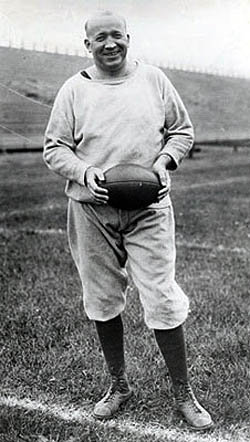
1. Knute Rockne holding a football and smiling characteristically
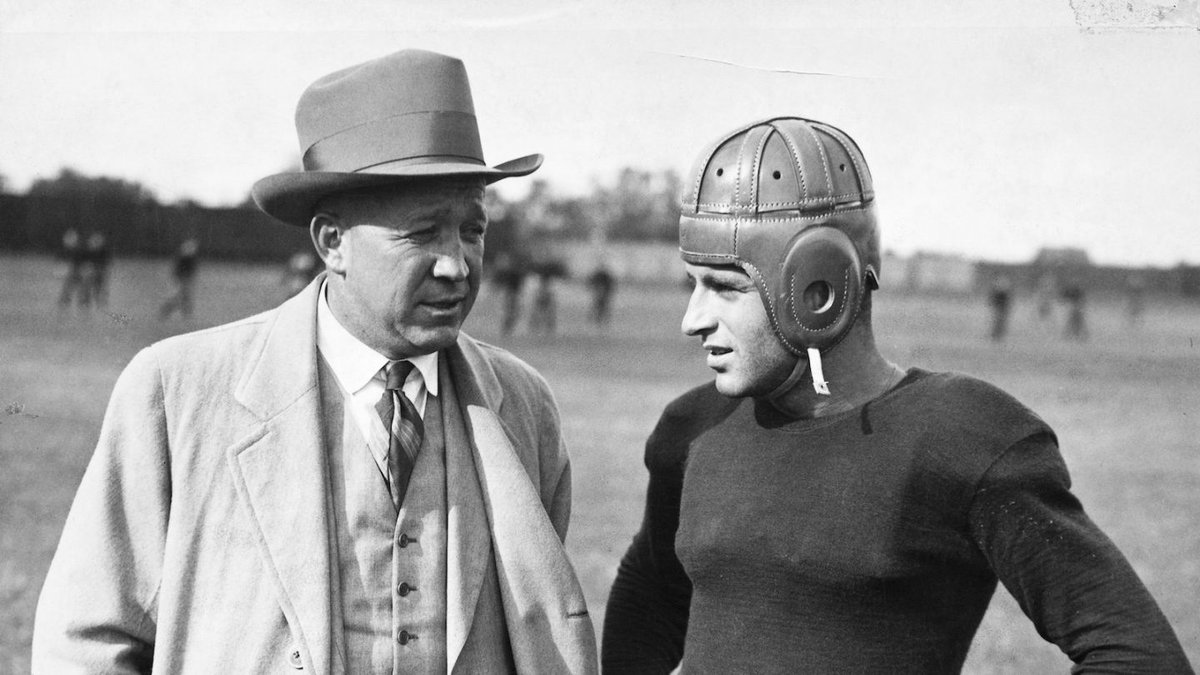
2. Notre Dame football coach Knute Rockne talks with a player. (George Rinhart-Corbis via Getty Images)
3. Knute Rockne with his wife Bonnie Gwendoline Skiles Rockne
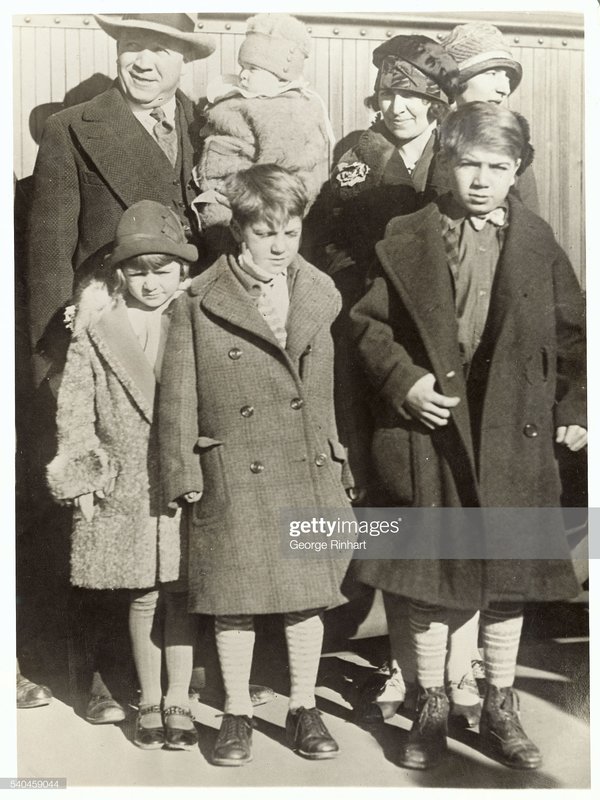
4. Portrait of Knute Rockne with wife Bonnie - children William Dorias, Knute Lars Jr., John Vincent Rockne, Mary Jeane (Photo by George Rinhart)
Biographies:
1. espn.com/classic/biography/s/Rockne_Knute.html
2. artofmanliness.com/articles/lessons-in-manliness-from-knute-rockne/]
1. Background from [https://www.espn.com/classic/biography/s/Rockne_Knute.html]
"Knute Rockne was Notre Dame's master motivator
By Bob Carter - Special to ESPN.com
"It was almost the size of President Kennedy's type impact. It was amazing. They turned out on the train, and at the funeral. He was a national hero," says Elmer Layden, one of Notre Dame's "Four Horseman," about his coach, Knute Rockne.
No college football coach has ever had the success of Knute Rockne. In his 13 years as the leader of Notre Dame, his teams went 105-12-5, making his .881 winning percentage the highest in history. Emphasizing quickness, deception and finesse, he had five undefeated teams and won three national championships.
His squads more than quadrupled their opponents' scoring.
Much like the grand design of his football program, Rockne's oratory carried few statutes of limitations. He was renowned for his inspirational pep talks and his magnetic personality won over not only players but alumni, school officials, sportswriters and all those important to the growth of his football fiefdom.
"There never was a greater showman than Knute Rockne," said John Cavanaugh, a Notre Dame president.
And when Rockne wanted something badly enough, he wasn't adverse to stretching the truth. In one locker-room speech, he concocted a story about his six-year-old son being hospitalized and pleading for a victory. In another, Rockne dramatically told of a possible Rose Bowl bid awaiting the team.
In yet another, he implied that Indiana's fierce tackling style the previous year might have contributed to Notre Dame star George Gipp's death. Gipp, though, had died of pneumonia.
"They were all lies, blatant lies," said Jim Crowley, a Rockne admirer and part of Notre Dame's famed "Four Horsemen" backfield in 1924. "The Jesuits call it mental reservation, but he had it in abundance."
Rockne's celebrated "win one for the Gipper" halftime speech during the 1928 Army game, which purportedly revived Gipps' last words eight years after the player's death, fostered much debate. By some accounts, the coach hadn't been at Gipp's bedside in his final days and the reference was fabrication.
Beyond the pomp, play-acting and persuasion, though, was undeniable coaching genius. Rockne developed a passing offense that helped to broaden the game's appeal. His "Notre Dame shift" -- a quick, pre-snap movement by his backfield -- was so successful that college rules-makers soon outlawed it.
He was among the first to teach his linemen brush blocks, to break his team into smaller groups, a precursor of platoon football, and to employ "shock troops," early-game substitutes who tried to wear down rivals.
A master motivator, he publicized his team endlessly, often angering faculty who were worried about football's rise. Rockne fended off accusations that his program was growing too professional, that he was illegally paying players, that the growing schedule was requiring too much travel. He argued that football's revenues supported minor sports and that its regimen built character.
"Four years of football," Rockne said, "are calculated to breed in the average man more of the ingredients of success in life than almost any academic course he takes."
Fans swooned over Rockne's teams and attendance swelled, at home and on the road, widening the path for the game's expansion. The attraction of Notre Dame football, especially among Catholics, continued even after Rockne's death in 1931.
Rockne was born on March 4, 1888 in Voss, Norway. His father, a carriage maker, brought the family to the United States when Knute was five. At Chicago's North West Division High School, Rockne ran track and played football briefly, but he didn't graduate. After working as a postal clerk for several years, he passed an entrance exam to Notre Dame and, at 22, enrolled in 1910.
"I went to South Bend with a suitcase and $1,000," he wrote later, "feeling the strangeness of being a lone Norse Protestant invading a Catholic stronghold."
Notre Dame became his home, and in 1925 he converted to Catholicism.
Undaunted by his stature (5-foot-8, 160 pounds), Rockne went out for football, playing sparingly as a fullback and end as a freshman. The next season, he was a starting end under new coach John Marks.
In the summer of 1913, Rockne and quarterback Gus Dorais practiced the forward pass on an Ohio beach. "Dorais would throw from all angles," Rockne recalled. "People who didn't know we were two college seniors making painstaking preparations for our final season probably thought we were crazy."
The team unveiled a different offensive look that fall under new coach Jess Harper and upset Army 35-13 as Dorais completed 14-of-17 passes for 243 yards, including a touchdown to Rockne, a third-team All-American.
Rockne graduated with honors in 1914, receiving a bachelor's degree in chemistry and pharmacology. He considered going to medical school in St. Louis but stayed at Notre Dame to teach chemistry and serve as Harper's assistant.
Notre Dame lost five games in his four years as an assistant. After rejecting Michigan State's head coaching offer in 1917, Rockne took over for Harper, who resigned in early 1918.
Rockne's first team went 3-1-2 in a season shortened by World War I, and he began upgrading the schedule the next year. The 1919 and 1920 teams were unbeaten, led by Gipp, a renegade who enjoyed pool, poker, partying and skipping classes. Though Rockne had a deserved reputation for toughness, his pragmatism helped him deal with Gipp's escapades. Rockne called the all-purpose back "the greatest player Notre Dame ever produced."
The boom times were just starting, and when the Irish played Army in 1921 a crowd of 20,000 watched, a West Point record. Soon, Rockne sought larger sites for the Army game, with the teams meeting at Ebbets Field, the Polo Grounds and Yankee Stadium. Notre Dame's own Cartier Field held 3,000, far too small for the football revolution, but by 1930, Rockne's last season, the school had a stadium seating 54,000.
Thanks to Grantland Rice and other sportswriters, the fame of Notre Dame players grew as well. After the small but shifty backfield of Crowley, Harry Stuhldreher, Don Miller and Elmer Layden lifted the Irish to a 13-7 victory over Army in 1924, Rice penned a famous homage to the quartet that began, "Outlined against a blue-gray October sky, the Four Horseman rode again."
Supported by a line dubbed "The Seven Mules," Notre Dame won its first national championship that season, capped by a 27-10 victory over Stanford in the 1925 Rose Bowl.
Rockne, who said the 1924 team was his favorite, sensed early on that the Horsemen would be special, describing them later as a "product of destiny."
After a two-loss season in 1925, Rockne agreed to take the head coaching job at Columbia for $25,000 - $15,000 more than his Notre Dame salary. When the agreement went public, much to his embarrassment, he decided to stay at South Bend.
The near-exit irritated some supporters but did nothing to slow his program. Notre Dame lost only twice over the next two years, though one defeat brought adverse publicity. Rockne put an assistant coach in charge against Carnegie Tech in 1926 while he went to the Army-Navy game to do some publicity work and to scout the Midshipmen for the next fall. Carnegie Tech won 19-0, ruining Notre Dame's bid for an unbeaten season.
While slumping to 5-4 in 1928, Rockne's worst record, Notre Dame recorded one of its more memorable victories when it rallied to upset Army 12-6 after the "Gipper" speech.
Notre Dame rebounded the next season, when Rockne was diagnosed with life-threatening phlebitis in his leg, missed some games and at times directed the team from a wheelchair. The team went 9-0, punctuated by a 13-12 victory over powerful USC, and won the national title. Notre Dame followed up with a 10-0 record and another national championship in 1930 as Rockne regained his health.
Early the next year, Rockne received a lucrative offer to help in the production of a Hollywood movie, "The Spirit of Notre Dame." Traveling to Los Angeles on March 31, he was killed when his plane crashed in a pasture near Bazaar, Kan. Knute Rockne was 43."
2. Background from [https://www.artofmanliness.com/articles/lessons-in-manliness-from-knute-rockne/]
"Lessons in Manliness: Knute Rockne
There was never a decade in America as sports crazy as the 1920’s. The true frontier had vanished into legend, and the playing field became the new arena for “pioneers” to demonstrate their ruggedness, determination, and ingenuity. Americans thus elevated the status of athletes and coaches to that of saintly heroes. Few of these heroes shined so brightly as Knute Rockne. Knute (pronounced ka-noot) was one of the greatest football coaches of all time. Although Rockne was famous for spinning yarns and exaggerating his exploits, such embellishments were hardly necessary; the facts stood for themselves. In his 13 years as the head coach of the Notre Dame football team, Rockne racked up 5 undefeated seasons and 6 national championships. Most importantly, he loved and embraced manliness. He encouraged men to stop dallying in effeminate hobbies and take up rough, physical pursuits like football. “America should be a place for rugged men, not flabby ones,” he proclaimed. While a plane crash cut short his life at age 43, his lessons in manliness echo on:
Be a renaissance man. Knute was a jock who loved sports and was passionate about football. But he cultivated his mind too. While a student at Notre Dame, he didn’t let his role as an athlete take away from his studies. A diligent student, Rockne’s average was a 90.52% (this was before the grade point system). He was equally adept as science (receiving a 97% in chemistry) as he was in English and philosophy (earning a 98% and 94% respectively). He also found time to serve as a yearbook editor and play the flute in the orchestra (if Knute Rockne played the flute, I may have to reconsider the manliness quotient of that instrument). Knute graduated magna cum laude from Notre Dame and was offered a job as chemistry assistant at the school, a position he took in addition to various coaching jobs.
Be in tune with the winds of change and don’t be afraid to ride them. Contrary to popular myth, Rockne did not invent the forward pass, but he was one of the first players to see and then utilize its potential. During the summer of 1913, while other players were taking a break from football, Knute and his friend and teammate Gus Dorais were relentlessly perfecting the art of passing and receiving. In the fall, during their first ever meeting with national powerhouse Army, Rockne and the Hoosiers (as the Fighting Irish were then known) unleashed their new offensive weapon. At first, the Black Knights’ defense pummeled Notre Dame. But then Dorais stepped back and Rockne headed downfield. Dorais started shooting passes to Knute and the other Hoosier receivers, just as they had practiced many times. Army was caught completely flat footed. The final score was 35-13 and the game of football had been opened up and forever changed. Seeing the potential of the forward pass required some forward thinking, and Knute was a guy who was always looking for a new edge.
Stay humble and hungry. Rockne believed that “overconfidence is the toughest poison a coach has to face. It can wreck any team…If your team isn’t keyed up and the other team is, the other team can easily overcome a handicap of two or three touchdowns.” Rockne always worked to keep his team’s confidence from turning into arrogant cockiness. In 1916, while riding by train to the annual Army-Notre Dame game, fellow passenger and former president Theodore Roosevelt chatted up the team. One the players boasted of how they were going to make mincemeat of Army. TR, a lover of bravado, declared, “That sounds just bully, Coach! “Yes sir, just plain bull sir,” Rockne replied. Indeed, Army went on to demolish Notre Dame 30-10. Knute understood that football, like everything in life, is “60 percent leg drive and 30 percent fight.” You gotta stay hungry.
Learn how to wield the power of oratory. Rockne practically invented the art of the inspiring locker room speech. He was a master of oratory. The motivational pep talk was an essential part of his coaching tools. He would spin together humor, sentiment, machismo, and folksy wisdom into a magnetic speech. His gift extended beyond the locker room; he could wax poetic on a myriad of subjects at the drop of hat and in any setting. But he was never boring. He always kept his remarks short and pithy, leaving the audience riveted and wanting more. His most famous speech took place during halftime of the 1928 Army-Notre Dame matchup. Rockne fired up his players by telling them that George Gipp, a legendary Hoosier who had died of a strep infection while playing for Rockne, had on his deathbed told Knute that if the team was ever down, to “Win one for the Gipper.” Whether Gipp ever said this is highly debatable (it certainly sounded good coming out of Reagan’s mouth), but the effect of the speech was electric; the players charged from the locker room and went on to win the game. What made Rockne’s oratory skills all the more remarkable was the fact that he wasn’t born with them; for most of his life he had stammered when he tried to speak publicly. But he worked on this weakness, taking speech lessons and practicing until he had attained a powerful silver tongue. Here’s another one of Rockne’s famous locker room speeches:
Be loyal. Today’s coaches promise to stay forever with a team, only to bolt the minute another school waves some dollar bills in their face. Not Knute. In 1921, after suffering a bitter loss to Iowa which snapped their 22 game winning streak, Rockne and his players gloomily traveled by train back to South Bend. Arriving at one o’clock in the morning, the train was met by over a thousand students who had hoofed the 3 mile walk into town to greet their heroes. They implored Rockne to make some remarks. Overcome by this show of support in the face of defeat, Knute proclaimed, “As long as you want me, I’ll be here.” His success would soon have colleges across the country chomping at the bit to have him on board and during his 13 year tenure at Notre Dame, Rockne was sorely tempted to jump ship (and during a debacle with Columbia almost did). Yet even with a less than stellar salary, and an often unsupportive university administration, Rockne was true to his word."
FYI Maj Robert Thornton SFC (Join to see) SGT Steve McFarland MSG Andrew White COL Mikel J. Burroughs SMSgt Lawrence McCarter LTC Greg Henning SGT Gregory Lawritson SP5 Mark Kuzinski CWO3 (Join to see) PO1 William "Chip" Nagel SSgt Boyd Herrst Col Carl Whicker SPC Margaret HigginsPO1 Robert GeorgeSSG Robert Mark OdomLTC (Join to see)SP5 Jeannie CarleSPC Chris Bayner-Cwik
Rest in peace Knute Rockne!
THE KNUTE ROCKNE STORY 1920s NOTRE DAME UNIVERSITY FOOTBALL DOCUMENTARY 54114
The film begins with views of the University of Notre Dame (:06-:24). Knute’s life is explored, beginning with helmeted young boys in Chicago who huddle together and play football in a field. (:25-:41). The post office (:42) is where he earned enough money at 22 to go to Notre Dame in 1910. Photos of the University are shown (:43-:56). A photo is shown of Knute in 1913 as a track team star (1:01) and one as captain of the football team (1:03). Next is of Knute as a Chemistry instructor (1:08), and an assistant football coach (1:10-1:15). A 1914 photo shows Knute and his new wife, Bonnie Skiles (1:20). A 1918 photos shows him as head coach (1:22). Knute is shown training players (1:27-1:52). His star player, George Gipp, “the Gipper” is shown in a photo and on the field. The team is untied and undefeated in 1919 and in 1920 (1:55-2:15). Gipp dies of streptococcal throat infection and pneumonia in his senior season (2:16-2:25). The next photo shows Rockne with his “Four Horseman” as he tries to rebuild the team (2:28). The four were quarterback Harry Stuhldreher (2:32), fullback Elmer Layden (2:34), right halfback Jim Crowley (2:38), and left halfback Don Miller (2:40). The four are shown on horseback (2:46). A touchdown in 1923 is shown, followed by one in 1924 (2:52-3:19). The Rose Bowl field has the Notre Dame logo shown by a group of students with signs (3:21). A touchdown in the 1925 win against Stanford is shown (3:23-3:34). A packed parade follows in South Bend (3:35-3:46). In the winter of 1925, Knute visited Columbia University in New York City (3:47-4:00). Even though the newspapers claimed he was quitting Notre Dame, he did not and is shown in an interview (4:01-4:22). 1928 begins a new season, as the team runs to him. Knute is shown talking to them (4:34-4:30). The team drills for the game against West Point (4:31-4:46). 80,000 people attend the game at Yankee Stadium. Kickoff is shown. (4:48-5:16). Knute watches from the sidelines as his team struggled (5:17-5:32). In the dressing room at half time, Knute is shown talking. He tells of George Gipp’s dying wish; that if the boys were ever down, to go out and “win one for the Gipper.” The team returns to the field and the tying touchdown is shown (5:33-6:21). A forward pass to Johnny O’Brien, who’d been sent it for this single play, was a touchdown to win the game (6:22-6:36). Rockne is shown giving a speech defending football (6:37-7:06). 1929’s team stars included John Law (7:23), Marty Brill (7:25), Frank Carideo (7:30), who travel by train to Southern California to defeat the Trojans (7:32-8:30). Another celebration awaits the team at South Bend (8:31-8:39) but Knute reminds his players to study (8:40-8:59). March 31, 1931, Knute boards a TWA Fokker F-10, shown taking off. The wreckage is shown, killing all aboard (9:00-9:32). The funeral is well-attended and he is buried on campus grounds (9:33-10:19)."
https://www.youtube.com/watch?v=--QypgIu0Ng
Images:
1. Knute Rockne holding a football and smiling characteristically
2. Notre Dame football coach Knute Rockne talks with a player. (George Rinhart-Corbis via Getty Images)
3. Knute Rockne with his wife Bonnie Gwendoline Skiles Rockne
4. Portrait of Knute Rockne with wife Bonnie - children William Dorias, Knute Lars Jr., John Vincent Rockne, Mary Jeane (Photo by George Rinhart)
Biographies:
1. espn.com/classic/biography/s/Rockne_Knute.html
2. artofmanliness.com/articles/lessons-in-manliness-from-knute-rockne/]
1. Background from [https://www.espn.com/classic/biography/s/Rockne_Knute.html]
"Knute Rockne was Notre Dame's master motivator
By Bob Carter - Special to ESPN.com
"It was almost the size of President Kennedy's type impact. It was amazing. They turned out on the train, and at the funeral. He was a national hero," says Elmer Layden, one of Notre Dame's "Four Horseman," about his coach, Knute Rockne.
No college football coach has ever had the success of Knute Rockne. In his 13 years as the leader of Notre Dame, his teams went 105-12-5, making his .881 winning percentage the highest in history. Emphasizing quickness, deception and finesse, he had five undefeated teams and won three national championships.
His squads more than quadrupled their opponents' scoring.
Much like the grand design of his football program, Rockne's oratory carried few statutes of limitations. He was renowned for his inspirational pep talks and his magnetic personality won over not only players but alumni, school officials, sportswriters and all those important to the growth of his football fiefdom.
"There never was a greater showman than Knute Rockne," said John Cavanaugh, a Notre Dame president.
And when Rockne wanted something badly enough, he wasn't adverse to stretching the truth. In one locker-room speech, he concocted a story about his six-year-old son being hospitalized and pleading for a victory. In another, Rockne dramatically told of a possible Rose Bowl bid awaiting the team.
In yet another, he implied that Indiana's fierce tackling style the previous year might have contributed to Notre Dame star George Gipp's death. Gipp, though, had died of pneumonia.
"They were all lies, blatant lies," said Jim Crowley, a Rockne admirer and part of Notre Dame's famed "Four Horsemen" backfield in 1924. "The Jesuits call it mental reservation, but he had it in abundance."
Rockne's celebrated "win one for the Gipper" halftime speech during the 1928 Army game, which purportedly revived Gipps' last words eight years after the player's death, fostered much debate. By some accounts, the coach hadn't been at Gipp's bedside in his final days and the reference was fabrication.
Beyond the pomp, play-acting and persuasion, though, was undeniable coaching genius. Rockne developed a passing offense that helped to broaden the game's appeal. His "Notre Dame shift" -- a quick, pre-snap movement by his backfield -- was so successful that college rules-makers soon outlawed it.
He was among the first to teach his linemen brush blocks, to break his team into smaller groups, a precursor of platoon football, and to employ "shock troops," early-game substitutes who tried to wear down rivals.
A master motivator, he publicized his team endlessly, often angering faculty who were worried about football's rise. Rockne fended off accusations that his program was growing too professional, that he was illegally paying players, that the growing schedule was requiring too much travel. He argued that football's revenues supported minor sports and that its regimen built character.
"Four years of football," Rockne said, "are calculated to breed in the average man more of the ingredients of success in life than almost any academic course he takes."
Fans swooned over Rockne's teams and attendance swelled, at home and on the road, widening the path for the game's expansion. The attraction of Notre Dame football, especially among Catholics, continued even after Rockne's death in 1931.
Rockne was born on March 4, 1888 in Voss, Norway. His father, a carriage maker, brought the family to the United States when Knute was five. At Chicago's North West Division High School, Rockne ran track and played football briefly, but he didn't graduate. After working as a postal clerk for several years, he passed an entrance exam to Notre Dame and, at 22, enrolled in 1910.
"I went to South Bend with a suitcase and $1,000," he wrote later, "feeling the strangeness of being a lone Norse Protestant invading a Catholic stronghold."
Notre Dame became his home, and in 1925 he converted to Catholicism.
Undaunted by his stature (5-foot-8, 160 pounds), Rockne went out for football, playing sparingly as a fullback and end as a freshman. The next season, he was a starting end under new coach John Marks.
In the summer of 1913, Rockne and quarterback Gus Dorais practiced the forward pass on an Ohio beach. "Dorais would throw from all angles," Rockne recalled. "People who didn't know we were two college seniors making painstaking preparations for our final season probably thought we were crazy."
The team unveiled a different offensive look that fall under new coach Jess Harper and upset Army 35-13 as Dorais completed 14-of-17 passes for 243 yards, including a touchdown to Rockne, a third-team All-American.
Rockne graduated with honors in 1914, receiving a bachelor's degree in chemistry and pharmacology. He considered going to medical school in St. Louis but stayed at Notre Dame to teach chemistry and serve as Harper's assistant.
Notre Dame lost five games in his four years as an assistant. After rejecting Michigan State's head coaching offer in 1917, Rockne took over for Harper, who resigned in early 1918.
Rockne's first team went 3-1-2 in a season shortened by World War I, and he began upgrading the schedule the next year. The 1919 and 1920 teams were unbeaten, led by Gipp, a renegade who enjoyed pool, poker, partying and skipping classes. Though Rockne had a deserved reputation for toughness, his pragmatism helped him deal with Gipp's escapades. Rockne called the all-purpose back "the greatest player Notre Dame ever produced."
The boom times were just starting, and when the Irish played Army in 1921 a crowd of 20,000 watched, a West Point record. Soon, Rockne sought larger sites for the Army game, with the teams meeting at Ebbets Field, the Polo Grounds and Yankee Stadium. Notre Dame's own Cartier Field held 3,000, far too small for the football revolution, but by 1930, Rockne's last season, the school had a stadium seating 54,000.
Thanks to Grantland Rice and other sportswriters, the fame of Notre Dame players grew as well. After the small but shifty backfield of Crowley, Harry Stuhldreher, Don Miller and Elmer Layden lifted the Irish to a 13-7 victory over Army in 1924, Rice penned a famous homage to the quartet that began, "Outlined against a blue-gray October sky, the Four Horseman rode again."
Supported by a line dubbed "The Seven Mules," Notre Dame won its first national championship that season, capped by a 27-10 victory over Stanford in the 1925 Rose Bowl.
Rockne, who said the 1924 team was his favorite, sensed early on that the Horsemen would be special, describing them later as a "product of destiny."
After a two-loss season in 1925, Rockne agreed to take the head coaching job at Columbia for $25,000 - $15,000 more than his Notre Dame salary. When the agreement went public, much to his embarrassment, he decided to stay at South Bend.
The near-exit irritated some supporters but did nothing to slow his program. Notre Dame lost only twice over the next two years, though one defeat brought adverse publicity. Rockne put an assistant coach in charge against Carnegie Tech in 1926 while he went to the Army-Navy game to do some publicity work and to scout the Midshipmen for the next fall. Carnegie Tech won 19-0, ruining Notre Dame's bid for an unbeaten season.
While slumping to 5-4 in 1928, Rockne's worst record, Notre Dame recorded one of its more memorable victories when it rallied to upset Army 12-6 after the "Gipper" speech.
Notre Dame rebounded the next season, when Rockne was diagnosed with life-threatening phlebitis in his leg, missed some games and at times directed the team from a wheelchair. The team went 9-0, punctuated by a 13-12 victory over powerful USC, and won the national title. Notre Dame followed up with a 10-0 record and another national championship in 1930 as Rockne regained his health.
Early the next year, Rockne received a lucrative offer to help in the production of a Hollywood movie, "The Spirit of Notre Dame." Traveling to Los Angeles on March 31, he was killed when his plane crashed in a pasture near Bazaar, Kan. Knute Rockne was 43."
2. Background from [https://www.artofmanliness.com/articles/lessons-in-manliness-from-knute-rockne/]
"Lessons in Manliness: Knute Rockne
There was never a decade in America as sports crazy as the 1920’s. The true frontier had vanished into legend, and the playing field became the new arena for “pioneers” to demonstrate their ruggedness, determination, and ingenuity. Americans thus elevated the status of athletes and coaches to that of saintly heroes. Few of these heroes shined so brightly as Knute Rockne. Knute (pronounced ka-noot) was one of the greatest football coaches of all time. Although Rockne was famous for spinning yarns and exaggerating his exploits, such embellishments were hardly necessary; the facts stood for themselves. In his 13 years as the head coach of the Notre Dame football team, Rockne racked up 5 undefeated seasons and 6 national championships. Most importantly, he loved and embraced manliness. He encouraged men to stop dallying in effeminate hobbies and take up rough, physical pursuits like football. “America should be a place for rugged men, not flabby ones,” he proclaimed. While a plane crash cut short his life at age 43, his lessons in manliness echo on:
Be a renaissance man. Knute was a jock who loved sports and was passionate about football. But he cultivated his mind too. While a student at Notre Dame, he didn’t let his role as an athlete take away from his studies. A diligent student, Rockne’s average was a 90.52% (this was before the grade point system). He was equally adept as science (receiving a 97% in chemistry) as he was in English and philosophy (earning a 98% and 94% respectively). He also found time to serve as a yearbook editor and play the flute in the orchestra (if Knute Rockne played the flute, I may have to reconsider the manliness quotient of that instrument). Knute graduated magna cum laude from Notre Dame and was offered a job as chemistry assistant at the school, a position he took in addition to various coaching jobs.
Be in tune with the winds of change and don’t be afraid to ride them. Contrary to popular myth, Rockne did not invent the forward pass, but he was one of the first players to see and then utilize its potential. During the summer of 1913, while other players were taking a break from football, Knute and his friend and teammate Gus Dorais were relentlessly perfecting the art of passing and receiving. In the fall, during their first ever meeting with national powerhouse Army, Rockne and the Hoosiers (as the Fighting Irish were then known) unleashed their new offensive weapon. At first, the Black Knights’ defense pummeled Notre Dame. But then Dorais stepped back and Rockne headed downfield. Dorais started shooting passes to Knute and the other Hoosier receivers, just as they had practiced many times. Army was caught completely flat footed. The final score was 35-13 and the game of football had been opened up and forever changed. Seeing the potential of the forward pass required some forward thinking, and Knute was a guy who was always looking for a new edge.
Stay humble and hungry. Rockne believed that “overconfidence is the toughest poison a coach has to face. It can wreck any team…If your team isn’t keyed up and the other team is, the other team can easily overcome a handicap of two or three touchdowns.” Rockne always worked to keep his team’s confidence from turning into arrogant cockiness. In 1916, while riding by train to the annual Army-Notre Dame game, fellow passenger and former president Theodore Roosevelt chatted up the team. One the players boasted of how they were going to make mincemeat of Army. TR, a lover of bravado, declared, “That sounds just bully, Coach! “Yes sir, just plain bull sir,” Rockne replied. Indeed, Army went on to demolish Notre Dame 30-10. Knute understood that football, like everything in life, is “60 percent leg drive and 30 percent fight.” You gotta stay hungry.
Learn how to wield the power of oratory. Rockne practically invented the art of the inspiring locker room speech. He was a master of oratory. The motivational pep talk was an essential part of his coaching tools. He would spin together humor, sentiment, machismo, and folksy wisdom into a magnetic speech. His gift extended beyond the locker room; he could wax poetic on a myriad of subjects at the drop of hat and in any setting. But he was never boring. He always kept his remarks short and pithy, leaving the audience riveted and wanting more. His most famous speech took place during halftime of the 1928 Army-Notre Dame matchup. Rockne fired up his players by telling them that George Gipp, a legendary Hoosier who had died of a strep infection while playing for Rockne, had on his deathbed told Knute that if the team was ever down, to “Win one for the Gipper.” Whether Gipp ever said this is highly debatable (it certainly sounded good coming out of Reagan’s mouth), but the effect of the speech was electric; the players charged from the locker room and went on to win the game. What made Rockne’s oratory skills all the more remarkable was the fact that he wasn’t born with them; for most of his life he had stammered when he tried to speak publicly. But he worked on this weakness, taking speech lessons and practicing until he had attained a powerful silver tongue. Here’s another one of Rockne’s famous locker room speeches:
Be loyal. Today’s coaches promise to stay forever with a team, only to bolt the minute another school waves some dollar bills in their face. Not Knute. In 1921, after suffering a bitter loss to Iowa which snapped their 22 game winning streak, Rockne and his players gloomily traveled by train back to South Bend. Arriving at one o’clock in the morning, the train was met by over a thousand students who had hoofed the 3 mile walk into town to greet their heroes. They implored Rockne to make some remarks. Overcome by this show of support in the face of defeat, Knute proclaimed, “As long as you want me, I’ll be here.” His success would soon have colleges across the country chomping at the bit to have him on board and during his 13 year tenure at Notre Dame, Rockne was sorely tempted to jump ship (and during a debacle with Columbia almost did). Yet even with a less than stellar salary, and an often unsupportive university administration, Rockne was true to his word."
FYI Maj Robert Thornton SFC (Join to see) SGT Steve McFarland MSG Andrew White COL Mikel J. Burroughs SMSgt Lawrence McCarter LTC Greg Henning SGT Gregory Lawritson SP5 Mark Kuzinski CWO3 (Join to see) PO1 William "Chip" Nagel SSgt Boyd Herrst Col Carl Whicker SPC Margaret HigginsPO1 Robert GeorgeSSG Robert Mark OdomLTC (Join to see)SP5 Jeannie CarleSPC Chris Bayner-Cwik
(5)
(0)
LTC Stephen F.
Knute Rockne Speech
https://www.youtube.com/watch?v=8cHteTe01y0
Images:
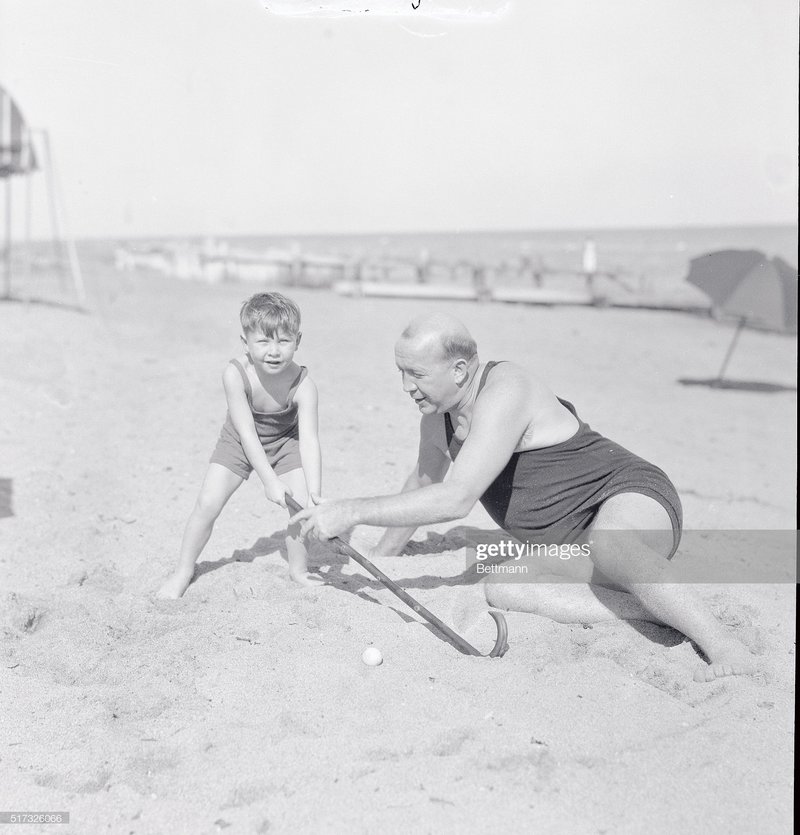
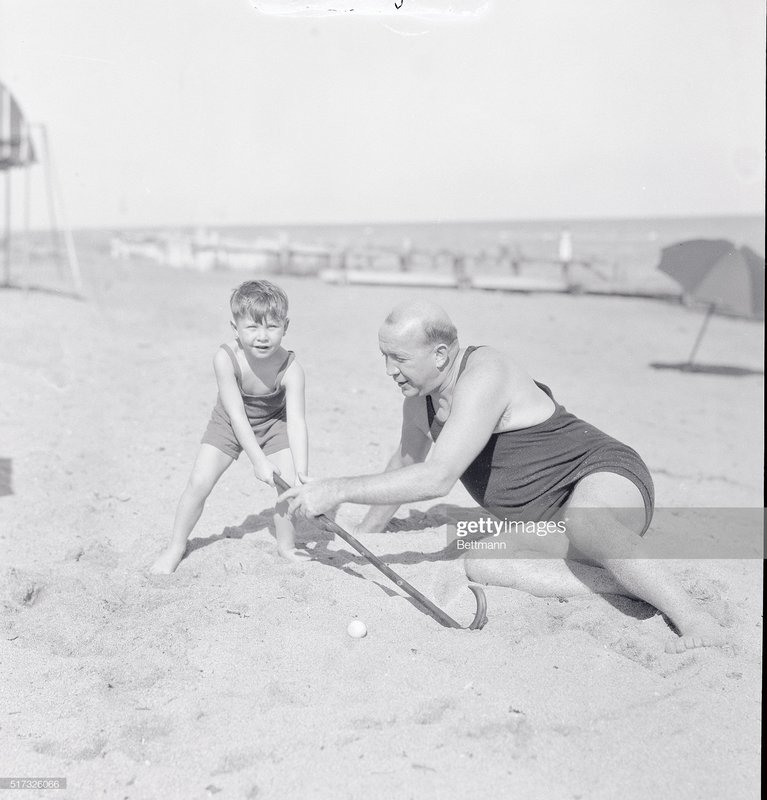
1. Knute Rockne is shown here teaching his son Jack the proper stance before a golf ball at Miami Beach.
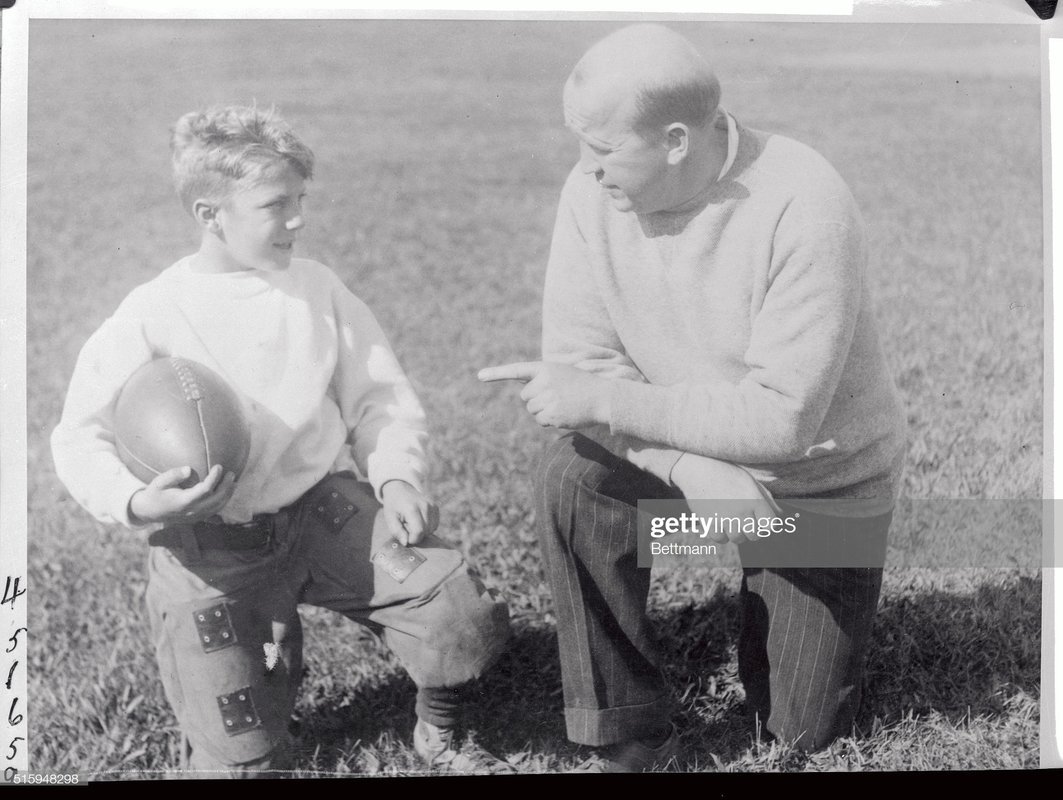
2. Knute Rockne and his son Knute Jr. are shown in this photo at Carter Field.
FYI SGT Steve McFarlandCol Carl WhickerSGT Mark AndersonSSG Michael NollSFC David Reid, M.S, PHR, SHRM-CP, DTMSFC Jay ThompsonPO2 John ZodunPVT Kenneth Krause SPC Jon O.PO1 Robert GeorgeSGT John MelvinSP5 Jesse EngelSPC Matthew LambSSG Robert "Rob" Wentworth
SFC Terry WilcoxPO2 Roger LafarletteSPC Nancy GreeneSSG Franklin Briant1stsgt Glenn BrackinCPT Paul Whitmer
https://www.youtube.com/watch?v=8cHteTe01y0
Images:
1. Knute Rockne is shown here teaching his son Jack the proper stance before a golf ball at Miami Beach.
2. Knute Rockne and his son Knute Jr. are shown in this photo at Carter Field.
FYI SGT Steve McFarlandCol Carl WhickerSGT Mark AndersonSSG Michael NollSFC David Reid, M.S, PHR, SHRM-CP, DTMSFC Jay ThompsonPO2 John ZodunPVT Kenneth Krause SPC Jon O.PO1 Robert GeorgeSGT John MelvinSP5 Jesse EngelSPC Matthew LambSSG Robert "Rob" Wentworth
SFC Terry WilcoxPO2 Roger LafarletteSPC Nancy GreeneSSG Franklin Briant1stsgt Glenn BrackinCPT Paul Whitmer
(2)
(0)
(1)
(0)
5
5
0

5
5
0

Read This Next


 Continue with Facebook
 Continue with Google