

14
14
0
Louis Freeh
https://en.wikipedia.org/wiki/Louis_Freeh
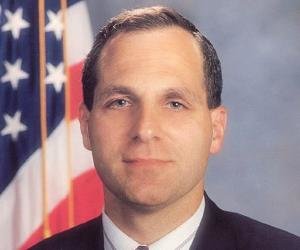
Louis Joseph Freeh (born January 6, 1950) is an American attorney and former judge who served as the fifth Director of the Federal Bureau of Investigation from September 1993 to June 2001. Freeh began his career as a special agent in the FBI, and was later an Assistant United States Attorney and United States District Judge of the United States District Court for the Southern District of New York. A Republican, he was later appointed as FBI director by President Bill Clinton.[1][2] He is now a lawyer and consultant in the private sector.
Freeh was born January 6, 1950, in Jersey City, New Jersey, the son of Italian-American parents Bernice (née Chinchiolo), a former bookkeeper, and William Freeh, Sr., a real estate broker.[3][4][5] Freeh, a native of North Bergen,[6] graduated from St. Joseph's High School in West New York, NJ in 1967, where he was taught by Christian Brothers.[7] He then graduated Phi Beta Kappa from Rutgers University–New Brunswick with a Bachelor of Arts degree in 1971, and received a Juris Doctor degree from Rutgers School of Law–Newark in 1974 and a Master of Laws degree in criminal law from New York University School of Law in 1984. Freeh was an FBI Special Agent from 1975 to 1981 in the New York City field office and at FBI Headquarters in Washington, D.C. In 1981, he joined the U.S. Attorney's Office for the Southern District of New York as an Assistant United States Attorney. Subsequently, he held positions there as Chief of the Organized Crime Unit, Deputy United States Attorney, and Associate United States Attorney. He was also a first lieutenant in the United States Army Reserve.[8][9]
As a youth, Freeh became an Eagle Scout in 1963 and in 1995 was awarded the Distinguished Eagle Scout Award by the Boy Scouts of America.[10][11]
https://en.wikipedia.org/wiki/Louis_Freeh
Louis Joseph Freeh (born January 6, 1950) is an American attorney and former judge who served as the fifth Director of the Federal Bureau of Investigation from September 1993 to June 2001. Freeh began his career as a special agent in the FBI, and was later an Assistant United States Attorney and United States District Judge of the United States District Court for the Southern District of New York. A Republican, he was later appointed as FBI director by President Bill Clinton.[1][2] He is now a lawyer and consultant in the private sector.
Freeh was born January 6, 1950, in Jersey City, New Jersey, the son of Italian-American parents Bernice (née Chinchiolo), a former bookkeeper, and William Freeh, Sr., a real estate broker.[3][4][5] Freeh, a native of North Bergen,[6] graduated from St. Joseph's High School in West New York, NJ in 1967, where he was taught by Christian Brothers.[7] He then graduated Phi Beta Kappa from Rutgers University–New Brunswick with a Bachelor of Arts degree in 1971, and received a Juris Doctor degree from Rutgers School of Law–Newark in 1974 and a Master of Laws degree in criminal law from New York University School of Law in 1984. Freeh was an FBI Special Agent from 1975 to 1981 in the New York City field office and at FBI Headquarters in Washington, D.C. In 1981, he joined the U.S. Attorney's Office for the Southern District of New York as an Assistant United States Attorney. Subsequently, he held positions there as Chief of the Organized Crime Unit, Deputy United States Attorney, and Associate United States Attorney. He was also a first lieutenant in the United States Army Reserve.[8][9]
As a youth, Freeh became an Eagle Scout in 1963 and in 1995 was awarded the Distinguished Eagle Scout Award by the Boy Scouts of America.[10][11]
 Birthday
 American History
 Attorney
 Judge
Judge FBI
FBI
Edited 6 y ago
Posted 6 y ago
Responses: 3

8
8
0

6
6
0

Remarks by Louis J. Freeh, Former Director, FBI
Freeh spoke at Risking Safety At All Costs, a conference hosted by the Partnership for Safe Medicines, April 4, 2017 at the National Press Club in Washington...
Thank you, my friend Maj Marty Hogan for making us aware that January 6 is the anniversary of the birth of American attorney and former judge Louis Joseph Freeh "who served as the fifth Director of the Federal Bureau of Investigation from September 1993 to June 2001. "
Happy 70th birthday Louis Joseph Freeh.
Remarks by Louis J. Freeh, Former Director, FBI
"Freeh spoke at Risking Safety At All Costs, a conference hosted by the Partnership for Safe Medicines, April 4, 2017 at the National Press Club in Washington D.C."
https://www.youtube.com/watch?v=IRgx1BzuqUU
Images:
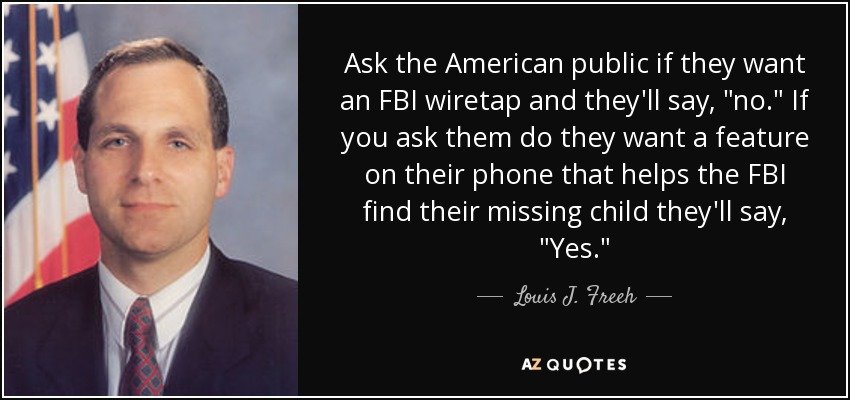
1. Louis J. Freeh 'Ask the American public if they want an FBI wiretap and they'll say, 'no.' If you ask them do they want a feature on their phone that helps the FBI find their missing child they'll say, 'Yes.'
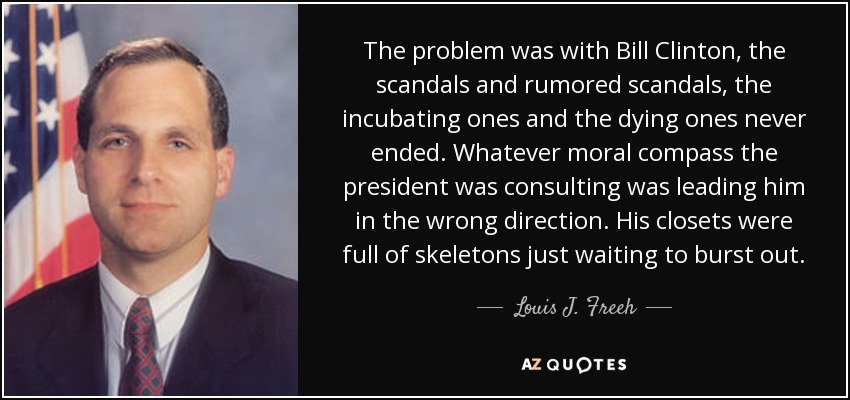
2. Louis J. Freeh 'The problem was with Bill Clinton, the scandals and rumored scandals, the incubating ones and the dying ones never ended. Whatever moral compass the president was consulting was leading him in the wrong direction. His closets were full of skeletons just waiting to burst out.'
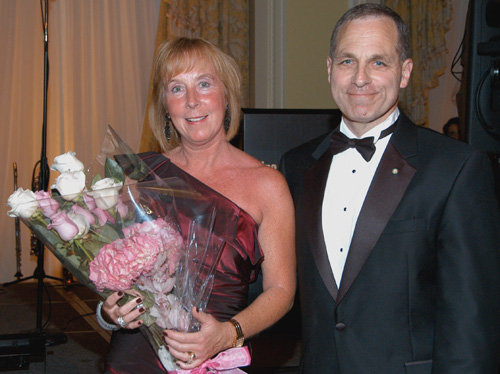
3. Marilyn Freeh and former FBI Director Louis Freeh, Il Circolo's Man-of-the-Year 2010 Photo by Davidoff
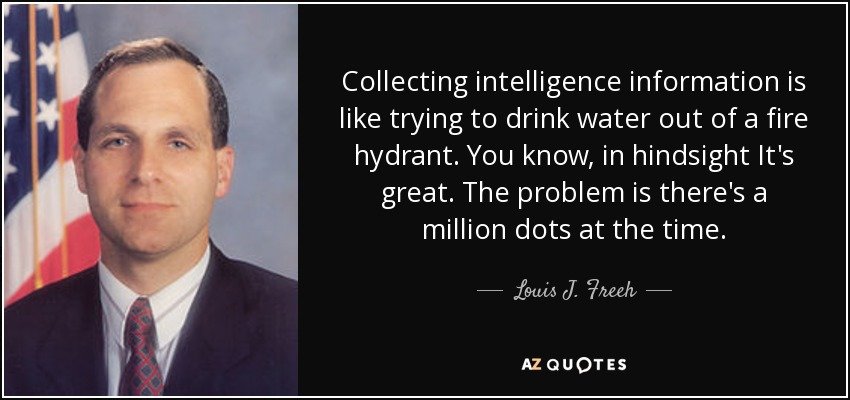
4. Louis J. Freeh 'Collecting intelligence information is like trying to drink water out of a fire hydrant. You know, in hindsight It's great. The problem is there's a million dots at the time.'
Biographies:
1. biography.yourdictionary.com/louis-j-freeh
2. prabook.com/web/louis.freeh/3733577
1. Background from biography.yourdictionary.com/louis-j-freeh
"Louis J. Freeh Facts
Appointed director of the Federal Bureau of Investigation (FBI) in 1993, Louis J. Freeh (born 1950) was selected for this promotion because of the reputation he had earned in federal law enforcement. As an FBI agent and then a federal prosecutor, Freeh had helped win convictions in high-profile criminal cases. Despite controversy that swirled around the FBI during his watch, Freeh remained committed to running the bureau for as long as he could be effective.
The son of Beatrice and William Freeh, Sr., Louis Freeh was born on January 6, 1950, in Jersey City, New Jersey. Although a youth of considerable promise and ambition, Freeh came from a family of modest means. As a result he attended local public universities and worked to defray his expenses. His family lived in three rooms on the first floor of their house, renting the second story, after his father, a transplanted Brooklynite and real estate broker, moved the family to Hudson County. Graduating Phi Beta Kappa from Rutgers University in 1971, Freeh earned his law degree in 1974 from Rutgers Law School at Newark. In 1974-1975 he served as a law clerk in the Newark office of New Jersey's Republican senator, Clifford Case, leaving in 1975 to accept an appointment as an agent with the Federal Bureau of Investigation (FBI).
Assigned to New York Office
Assigned to the FBI's New York office, Freeh worked in the organized crime unit. His diligence and skills were fully demonstrated in a major investigation he headed of corruption on the New York waterfront that resulted in the conviction of 125 union and waterfront officials on federal racketeering charges. Anthony Scotto, the president of the International Longshoremen's Union, was one of those convicted. For this achievement Freeh was awarded a special FBI commendation and was promoted to supervisor in the Organized Crime Unit at FBI headquarters in Washington. While employed as an FBI agent Freeh met his future wife, Marilyn, at the time employed as a clerk at FBI headquarters. They became the parents of five sons.
Freeh's demonstrated skills and close cooperation with federal prosecutors earned him a further promotion in 1981 to assistant U.S. attorney in the Southern District of New York (New York City). Concurrent with this assignment, Freeh attended New York University Law School, earning the LLM degree in 1984. From 1988 to 1992 he served as adjunct associate professor at Fordham Law School. His matriculation and part-time teaching reflected his desire to enhance his knowledge of criminal law and his credentials for promotion in the federal judiciary.
Rose On His Record
His impressive record as prosecutor ensured such promotion, with his most important case involving the successful indictment and eventual conviction in 1987 of 16 of 17 crime leaders in the so-called Pizza Connection case. This complex criminal case involved a Sicilian-based drug-dealing (heroin) and money-laundering operation stretching from Turkey to Brazil that in the United States used pizza parlors as fronts for money laundering. Freeh not only won the respect of the law enforcement community for his skill in recruiting informers and tracing the elaborate ruses employed to sell drugs and launder money, but even defense attorneys praised his fairness when arguing the government's case in court. An innovative prosecutor, Freeh, for example, secured the cooperation of second-level criminals who provided the testimony that helped convict high-level Mafia leaders by setting up a U.S. witness protection program for foreign informers.
The successful prosecution of the Pizza Connection case led in 1987 to his promotions first to head the Organized Crime Unit in the New York office and then, in January 1989, to deputy U.S. attorney. In addition, in 1989 he received the Federal Law Enforcement Officers Achievement Award.
A Leading Prosecutor
Recognized as one of the leading prosecutors in the nation, Freeh was selected by Attorney General Richard Thornburgh in May 1990 to head a special federal investigation into the mail bombing deaths of Federal Judge Robert Vance of Birmingham, Alabama, and Savannah (Georgia) alderman and NAACP official Robert Robinson. Freeh masterminded a nationwide investigation that culminated in the arrest and conviction of Walter Lee Moody for terrorist acts (which also included sending mail bombs to other civil rights offices throughout the South). His handling of this investigation earned him the Attorney General's Award for Distinguished Service in 1991 and then, in July 1991, his nomination by President George Bush and Senate confirmation as federal district judge in the Southern District of New York.
Only 41 years old at the time of his appointment to the federal bench, Freeh's meteoric rise was based on his credentials as a skilled investigator and prosecutor and on his ability to work closely and effectively with others. Unlike others whose judicial appointments had been based on political connections, Freeh had never been directly involved in partisan politics.
His reputation for fairness and ability to provide leadership earned him the unprecedented promotion, given his youthful age of 43, to the post of FBI director. President Bill Clinton's decision to fire FBI Director William Sessions came on July 19, 1993, owing to questions raised beginning in October 1992 about Sessions' personal abuse of office. Sessions was known to travel in an armored limousine and in a private jet at taxpayers' expense. Now the president needed the appointment of someone who could lead the bureau at a transitional time in its history and at the same time win quick confirmation. Nominated on July 20, 1993, Freeh's reputation in the law enforcement community and with leaders of the Senate (notably Senators Daniel Moynihan, Sam Nunn, and Joseph Biden) resulted in a trouble-free and speedy Senate confirmation on August 6, 1993.
Freeh's appointment came at a critical time in the history of the FBI, confronting as he would the twin problems of redefining how the FBI should respond in the post-Cold War era to the international character of organized crime and religiously-based terrorism and at the same time finally settle the legacies of former FBI Director J. Edgar Hoover's controversial 48-year tenure. Under Hoover the FBI had strayed away from law enforcement to monitor and seek to contain the influence of dissident political organizations, had avoided hiring and promoting women and ethnic and racial minorities as agents, and had been constrained from instituting more innovative procedures and revised priorities to ensure successful prosecution of organized crime, political corruption, and white collar crime. Hoover's successors had moved slowly to contain FBI political surveillance, to increase the recruitment and promotion of women and minorities, and to adopt more flexible procedures and innovative strategies to address the more complex problems confronting the law enforcement community. Internal conflict within the bureau hierarchy, moreover, had slowed the pace of these administrative and personnel reforms.
Toward the end of 1993 Freeh traveled to Sicily to honor an Italian official assassinated by the Mafia. The visit and his words became a pledge to curb the Mafia.
Not Without Controversy
Further into his 10-year term, Freeh was beset by a series of embarrassments that tarnished the reputation of the FBI as well as his own. In 1996, the FBI was maligned for being overzealous in its pursuit of Richard Jewell, suspected of detonating a bomb at the 1996 Olympics in Atlanta. Jewell turned out to be innocent. The bureau's crime laboratory was found by the Justice Department's Inspector General in 1997 to be so sloppy in its practices that it potentially tainted hundreds of cases. "We're going to get hundreds, if not thousands, of motions that are going to encompass every part of the lab, from latent-fingerprint comparisons to tire-tread analysis," said one ranking FBI agent.
On a different front, Freeh quarrelled with the Clinton White House over whether agents investigating possible Chinese influence on elected U.S. officials told National Security Council aides receiving information from the investigation that they could pass it on to their superiors. Clinton maintained the agents told the security council aides they could not pass the information, and Freeh contradicted the president. An associate of Freeh's leaked an advance copy of an unflattering book about the White House written by a former FBI agent. The same associate also provided "hundreds of personal files" to White House security aides. In response to the charges, Freeh made it harder for the White House to obtain sensitive material from the FBI. The director recruited a scientist to run the FBI lab and made numerous procedural changes as well.
Freeh also was criticized for showing favoritism to his friends, micromanaging bureau operations, and being aloof from the news media. Freeh's defenders lauded the director for cutting "chair-warmers" from bureau staff, streamlining the organization, getting in closer contact with agents working in the field, and fostering cooperation with the rival Central Intelligence Agency (CIA). It also was noted that Freeh abandoned the personal excesses of his predecessor, opting to ride in a minivan instead of a limousine and fly on commercial jets instead of a private plane.
Despite the controversies, Freeh had the support of agents in the field. "In spite of well-publicized difficulties, the director's support within the bureau is largely intact," John J. Sennett, president of the FBI Agents Association told The New York Times in 1997. "Yet agents are very disturbed by recent negative press. Freeh's most significant shortcoming in the minds of agents has been his apparent unwillingness to get the bureau's story out."
Despite the FBI's image problems, Freeh said he intended remain director until the end of his term or for as long has he can be effective running the large bureaucracy with an annual budget of about $3 billion and about 25,000 agents."
2. Background from prabook.com/web/louis.freeh/3733577
"Louis Joseph Freeh; judge attorney
Louis Joseph Freeh is an American attorney and former judge who served as the fifth Director of the Federal Bureau of Investigation from September 1993 to June 2001.
Background
Freeh was born January 6, 1950, in Jersey City, New Jersey, the son of Bernice (née Chinchiolo) and William Freeh, Sr.
Although a youth of considerable promise and ambition, Freeh came from a family of modest means.
Education
As a result he attended local public universities and worked to defray his expenses. His family lived in three rooms on the first floor of their house, renting the second story, after his father, a transplanted Brooklynite and real estate broker, moved the family to Hudson County. Graduating Phi Beta Kappa from Rutgers University in 1971, Freeh earned his law degree in 1974 from Rutgers Law School at Newark.
Career
As an FBI agent and then a federal prosecutor, Freeh had helped win convictions in high-profile criminal cases. Despite controversy that swirled around the FBI during his watch, Freeh remained committed to running the bureau for as long as he could be effective.
In 1974-1975 he served as a law clerk in the Newark office of New Jersey's Republican senator, Clifford Case, leaving in 1975 to accept an appointment as an agent with the Federal Bureau of Investigation (FBI). Assigned to New York Office Assigned to the FBI's New York office, Freeh worked in the organized crime unit. His diligence and skills were fully demonstrated in a major investigation he headed of corruption on the New York waterfront that resulted in the conviction of 125 union and waterfront officials on federal racketeering charges. Anthony Scotto, the president of the International Longshoremen's Union, was one of those convicted. For this achievement Freeh was awarded a special FBI commendation and was promoted to supervisor in the Organized Crime Unit at FBI headquarters in Washington.
Freeh's demonstrated skills and close cooperation with federal prosecutors earned him a further promotion in 1981 to assistant U. S. attorney in the Southern District of New York (New York City). Concurrent with this assignment, Freeh attended New York University Law School, earning the LLM degree in 1984. From 1988 to 1992 he served as adjunct associate professor at Fordham Law School. His matriculation and part-time teaching reflected his desire to enhance his knowledge of criminal law and his credentials for promotion in the federal judiciary.
His impressive record as prosecutor ensured such promotion, with his most important case involving the successful indictment and eventual conviction in 1987 of 16 of 17 crime leaders in the so-called Pizza Connection case. This complex criminal case involved a Sicilian-based drug-dealing (heroin) and money-laundering operation stretching from Turkey to Brazil that in the United States used pizza parlors as fronts for money laundering. Freeh not only won the respect of the law enforcement community for his skill in recruiting informers and tracing the elaborate ruses employed to sell drugs and launder money, but even defense attorneys praised his fairness when arguing the government's case in court. An innovative prosecutor, Freeh, for example, secured the cooperation of second-level criminals who provided the testimony that helped convict high-level Mafia leaders by setting up a U. S. witness protection program for foreign informers. The successful prosecution of the Pizza Connection case led in 1987 to his promotions first to head the Organized Crime Unit in the New York office and then, in January 1989, to deputy U. S. attorney. In addition, in 1989 he received the Federal Law Enforcement Officers Achievement Award. A Leading Prosecutor Recognized as one of the leading prosecutors in the nation, Freeh was selected by Attorney General Richard Thornburgh in May 1990 to head a special federal investigation into the mail bombing deaths of Federal Judge Robert Vance of Birmingham, Alabama, and Savannah (Georgia) alderman and NAACP official Robert Robinson. Freeh masterminded a nationwide investigation that culminated in the arrest and conviction of Walter Lee Moody for terrorist acts (which also included sending mail bombs to other civil rights offices throughout the South). His handling of this investigation earned him the Attorney General's Award for Distinguished Service in 1991 and then, in July 1991, his nomination by President George Bush and Senate confirmation as federal district judge in the Southern District of New York. Only 41 years old at the time of his appointment to the federal bench, Freeh's meteoric rise was based on his credentials as a skilled investigator and prosecutor and on his ability to work closely and effectively with others. His reputation for fairness and ability to provide leadership earned him the unprecedented promotion, given his youthful age of 43, to the post of FBI director. President Bill Clinton's decision to fire FBI Director William Sessions came on July 19, 1993, owing to questions raised beginning in October 1992 about Sessions' personal abuse of office. Sessions was known to travel in an armored limousine and in a private jet at taxpayers' expense. Now the president needed the appointment of someone who could lead the bureau at a transitional time in its history and at the same time win quick confirmation. Nominated on July 20, 1993, Freeh's reputation in the law enforcement community and with leaders of the Senate (notably Senators Daniel Moynihan, Sam Nunn, and Joseph Biden) resulted in a trouble-free and speedy Senate confirmation on August 6, 1993. Freeh's appointment came at a critical time in the history of the FBI, confronting as he would the twin problems of redefining how the FBI should respond in the post-Cold War era to the international character of organized crime and religiously-based terrorism and at the same time finally settle the legacies of former FBI Director J. Edgar Hoover's controversial 48-year tenure. Under Hoover the FBI had strayed away from law enforcement to monitor and seek to contain the influence of dissident political organizations, had avoided hiring and promoting women and ethnic and racial minorities as agents, and had been constrained from instituting more innovative procedures and revised priorities to ensure successful prosecution of organized crime, political corruption, and white collar crime. Hoover's successors had moved slowly to contain FBI political surveillance, to increase the recruitment and promotion of women and minorities, and to adopt more flexible procedures and innovative strategies to address the more complex problems confronting the law enforcement community. Internal conflict within the bureau hierarchy, moreover, had slowed the pace of these administrative and personnel reforms. Toward the end of 1993 Freeh traveled to Sicily to honor an Italian official assassinated by the Mafia. The visit and his words became a pledge to curb the Mafia. Not Without Controversy Further into his 10-year term, Freeh was beset by a series of embarrassments that tarnished the reputation of the FBI as well as his own. In 1996, the FBI was maligned for being overzealous in its pursuit of Richard Jewell, suspected of detonating a bomb at the 1996 Olympics in Atlanta. Jewell turned out to be innocent. The bureau's crime laboratory was found by the Justice Department's Inspector General in 1997 to be so sloppy in its practices that it potentially tainted hundreds of cases. "We're going to get hundreds, if not thousands, of motions that are going to encompass every part of the lab, from latent- fingerprint comparisons to tire-tread analysis, " said one ranking FBI agent. On a different front, Freeh quarrelled with the Clinton White House over whether agents investigating possible Chinese influence on elected U. S. officials told National Security Council aides receiving information from the investigation that they could pass it on to their superiors. Clinton maintained the agents told the security council aides they could not pass the information, and Freeh contradicted the president. An associate of Freeh's leaked an advance copy of an unflattering book about the White House written by a former FBI agent. The same associate also provided "hundreds of personal files" to White House security aides. In response to the charges, Freeh made it harder for the White House to obtain sensitive material from the FBI. The director recruited a scientist to run the FBI lab and made numerous procedural changes as well. Freeh also was criticized for showing favoritism to his friends, micromanaging bureau operations, and being aloof from the news media. Freeh's defenders lauded the director for cutting "chair-warmers" from bureau staff, streamlining the organization, getting in closer contact with agents working in the field, and fostering cooperation with the rival Central Intelligence Agency (CIA). It also was noted that Freeh abandoned the personal excesses of his predecessor, opting to ride in a minivan instead of a limousine and fly on commercial jets instead of a private plane. Despite the controversies, Freeh had the support of agents in the field. "In spite of well-publicized difficulties, the director's support within the bureau is largely intact, " John J. Sennett, president of the FBI Agents Association told The New York Times in 1997. "Yet agents are very disturbed by recent negative press. Freeh's most significant shortcoming in the minds of agents has been his apparent unwillingness to get the bureau's story out. " Despite the FBI's image problems, Freeh said he intended remain director until the end of his term or for as long has he can be effective running the large bureaucracy with an annual budget of about $3 billion and about 25, 000 agents.
Achievements
Freeh began his career as a special agent in the FBI, and was later an Assistant United States Attorney and United States District Judge of the United States District Court for the Southern District of New York. A Republican, he was later appointed as FBI director by President Bill Clinton. He is now a lawyer and consultant in the private sector.
Politics
Unlike others whose judicial appointments had been based on political connections, Freeh had never been directly involved in partisan politics.
Freeh approached acting New Jersey Governor Donald DiFrancesco, and offered to serve, without salary, as the state's anti-terrorism "czar". Di Francesco approached both major-party candidates for governor to secure their approval; Bret Schundler, the Republican candidate, agreed "in principle". However, Democrat Jim McGreevey, who won the gubernatorial election, turned down Freeh in favor of Golan Cipel. It was later discovered that McGreevey and Cipel had been involved in a sexual relationship. McGreevey was heavily criticized for giving the post to Cipel rather than Freeh or another experienced individual.
In September 2001, Freeh was appointed to the board of directors of credit card issuer MBNA; he also served as the bank's general counsel, as well as corporate secretary and ethics officer. Likewise, Bristol-Myers Squibb elected him to its board of directors.
Freeh is also a member of the board of consultants of the Gavel Consulting Group, formed by current and former federal judges and high-ranking government officials to provide advice and counseling to the private sector.
Beginning in 2004 Freeh began teaching as an adjunct law professor for Widener University School of Law. Drawing on his years of experience, he has taught White Collar Crime.
In 2007, Freeh formed Freeh Group International Solutions, a consulting and investigative firm headquartered in Wilmington, Delaware with regional offices in Washington DC and New York. Affiliated firms include Freeh Group Europe and the law firm Freeh, Sporkin & Sullivan, LLP. The latter firm includes Eugene R. Sullivan, a retired Federal Judge in Washington D. C. and Eugene R. Sullivan II amongst partners and Stanley Sporkin as senior counsel. Sporkin is a retired Federal judge who earlier served as head of the Securities and Exchange Commission's Division of Enforcement and as general counsel to the Central Intelligence Agency.
Membership
He was a member of the board of consultants of the Gavel Consulting Group.
Connections
Freeh and his wife, Marilyn, have six sons. Freeh is a devout Roman Catholic although not a member of the Opus Dei prelature. According to The Bureau and the Mole, a book by David A. Vise, one of Freeh's sons was enrolled at The Heights School in Potomac, Maryland, which Vise describes as "an Opus Dei academy". Several of his sons graduated from Archmere Academy, a Catholic school in Claymont, Delaware. One of his sons attended Georgetown University, a Catholic university in Washington, D. C.
Spouse:
Marilyn Freeh"
FYI COL Mikel J. Burroughs Lt Col John (Jack) Christensen Lt Col Charlie Brown LTC Greg Henning LTC Jeff Shearer Maj Bill Smith, Ph.D. Maj William W. 'Bill' Price CPT Scott Sharon CWO3 Dennis M. SFC Joe S. Davis Jr., MSM, DSL SSG William Jones SGT (Join to see) SGT John " Mac " McConnell SP5 Mark Kuzinski PO1 H Gene Lawrence PO2 Kevin Parker PO3 Bob McCord SMSgt Lawrence McCarter
Happy 70th birthday Louis Joseph Freeh.
Remarks by Louis J. Freeh, Former Director, FBI
"Freeh spoke at Risking Safety At All Costs, a conference hosted by the Partnership for Safe Medicines, April 4, 2017 at the National Press Club in Washington D.C."
https://www.youtube.com/watch?v=IRgx1BzuqUU
Images:
1. Louis J. Freeh 'Ask the American public if they want an FBI wiretap and they'll say, 'no.' If you ask them do they want a feature on their phone that helps the FBI find their missing child they'll say, 'Yes.'
2. Louis J. Freeh 'The problem was with Bill Clinton, the scandals and rumored scandals, the incubating ones and the dying ones never ended. Whatever moral compass the president was consulting was leading him in the wrong direction. His closets were full of skeletons just waiting to burst out.'
3. Marilyn Freeh and former FBI Director Louis Freeh, Il Circolo's Man-of-the-Year 2010 Photo by Davidoff
4. Louis J. Freeh 'Collecting intelligence information is like trying to drink water out of a fire hydrant. You know, in hindsight It's great. The problem is there's a million dots at the time.'
Biographies:
1. biography.yourdictionary.com/louis-j-freeh
2. prabook.com/web/louis.freeh/3733577
1. Background from biography.yourdictionary.com/louis-j-freeh
"Louis J. Freeh Facts
Appointed director of the Federal Bureau of Investigation (FBI) in 1993, Louis J. Freeh (born 1950) was selected for this promotion because of the reputation he had earned in federal law enforcement. As an FBI agent and then a federal prosecutor, Freeh had helped win convictions in high-profile criminal cases. Despite controversy that swirled around the FBI during his watch, Freeh remained committed to running the bureau for as long as he could be effective.
The son of Beatrice and William Freeh, Sr., Louis Freeh was born on January 6, 1950, in Jersey City, New Jersey. Although a youth of considerable promise and ambition, Freeh came from a family of modest means. As a result he attended local public universities and worked to defray his expenses. His family lived in three rooms on the first floor of their house, renting the second story, after his father, a transplanted Brooklynite and real estate broker, moved the family to Hudson County. Graduating Phi Beta Kappa from Rutgers University in 1971, Freeh earned his law degree in 1974 from Rutgers Law School at Newark. In 1974-1975 he served as a law clerk in the Newark office of New Jersey's Republican senator, Clifford Case, leaving in 1975 to accept an appointment as an agent with the Federal Bureau of Investigation (FBI).
Assigned to New York Office
Assigned to the FBI's New York office, Freeh worked in the organized crime unit. His diligence and skills were fully demonstrated in a major investigation he headed of corruption on the New York waterfront that resulted in the conviction of 125 union and waterfront officials on federal racketeering charges. Anthony Scotto, the president of the International Longshoremen's Union, was one of those convicted. For this achievement Freeh was awarded a special FBI commendation and was promoted to supervisor in the Organized Crime Unit at FBI headquarters in Washington. While employed as an FBI agent Freeh met his future wife, Marilyn, at the time employed as a clerk at FBI headquarters. They became the parents of five sons.
Freeh's demonstrated skills and close cooperation with federal prosecutors earned him a further promotion in 1981 to assistant U.S. attorney in the Southern District of New York (New York City). Concurrent with this assignment, Freeh attended New York University Law School, earning the LLM degree in 1984. From 1988 to 1992 he served as adjunct associate professor at Fordham Law School. His matriculation and part-time teaching reflected his desire to enhance his knowledge of criminal law and his credentials for promotion in the federal judiciary.
Rose On His Record
His impressive record as prosecutor ensured such promotion, with his most important case involving the successful indictment and eventual conviction in 1987 of 16 of 17 crime leaders in the so-called Pizza Connection case. This complex criminal case involved a Sicilian-based drug-dealing (heroin) and money-laundering operation stretching from Turkey to Brazil that in the United States used pizza parlors as fronts for money laundering. Freeh not only won the respect of the law enforcement community for his skill in recruiting informers and tracing the elaborate ruses employed to sell drugs and launder money, but even defense attorneys praised his fairness when arguing the government's case in court. An innovative prosecutor, Freeh, for example, secured the cooperation of second-level criminals who provided the testimony that helped convict high-level Mafia leaders by setting up a U.S. witness protection program for foreign informers.
The successful prosecution of the Pizza Connection case led in 1987 to his promotions first to head the Organized Crime Unit in the New York office and then, in January 1989, to deputy U.S. attorney. In addition, in 1989 he received the Federal Law Enforcement Officers Achievement Award.
A Leading Prosecutor
Recognized as one of the leading prosecutors in the nation, Freeh was selected by Attorney General Richard Thornburgh in May 1990 to head a special federal investigation into the mail bombing deaths of Federal Judge Robert Vance of Birmingham, Alabama, and Savannah (Georgia) alderman and NAACP official Robert Robinson. Freeh masterminded a nationwide investigation that culminated in the arrest and conviction of Walter Lee Moody for terrorist acts (which also included sending mail bombs to other civil rights offices throughout the South). His handling of this investigation earned him the Attorney General's Award for Distinguished Service in 1991 and then, in July 1991, his nomination by President George Bush and Senate confirmation as federal district judge in the Southern District of New York.
Only 41 years old at the time of his appointment to the federal bench, Freeh's meteoric rise was based on his credentials as a skilled investigator and prosecutor and on his ability to work closely and effectively with others. Unlike others whose judicial appointments had been based on political connections, Freeh had never been directly involved in partisan politics.
His reputation for fairness and ability to provide leadership earned him the unprecedented promotion, given his youthful age of 43, to the post of FBI director. President Bill Clinton's decision to fire FBI Director William Sessions came on July 19, 1993, owing to questions raised beginning in October 1992 about Sessions' personal abuse of office. Sessions was known to travel in an armored limousine and in a private jet at taxpayers' expense. Now the president needed the appointment of someone who could lead the bureau at a transitional time in its history and at the same time win quick confirmation. Nominated on July 20, 1993, Freeh's reputation in the law enforcement community and with leaders of the Senate (notably Senators Daniel Moynihan, Sam Nunn, and Joseph Biden) resulted in a trouble-free and speedy Senate confirmation on August 6, 1993.
Freeh's appointment came at a critical time in the history of the FBI, confronting as he would the twin problems of redefining how the FBI should respond in the post-Cold War era to the international character of organized crime and religiously-based terrorism and at the same time finally settle the legacies of former FBI Director J. Edgar Hoover's controversial 48-year tenure. Under Hoover the FBI had strayed away from law enforcement to monitor and seek to contain the influence of dissident political organizations, had avoided hiring and promoting women and ethnic and racial minorities as agents, and had been constrained from instituting more innovative procedures and revised priorities to ensure successful prosecution of organized crime, political corruption, and white collar crime. Hoover's successors had moved slowly to contain FBI political surveillance, to increase the recruitment and promotion of women and minorities, and to adopt more flexible procedures and innovative strategies to address the more complex problems confronting the law enforcement community. Internal conflict within the bureau hierarchy, moreover, had slowed the pace of these administrative and personnel reforms.
Toward the end of 1993 Freeh traveled to Sicily to honor an Italian official assassinated by the Mafia. The visit and his words became a pledge to curb the Mafia.
Not Without Controversy
Further into his 10-year term, Freeh was beset by a series of embarrassments that tarnished the reputation of the FBI as well as his own. In 1996, the FBI was maligned for being overzealous in its pursuit of Richard Jewell, suspected of detonating a bomb at the 1996 Olympics in Atlanta. Jewell turned out to be innocent. The bureau's crime laboratory was found by the Justice Department's Inspector General in 1997 to be so sloppy in its practices that it potentially tainted hundreds of cases. "We're going to get hundreds, if not thousands, of motions that are going to encompass every part of the lab, from latent-fingerprint comparisons to tire-tread analysis," said one ranking FBI agent.
On a different front, Freeh quarrelled with the Clinton White House over whether agents investigating possible Chinese influence on elected U.S. officials told National Security Council aides receiving information from the investigation that they could pass it on to their superiors. Clinton maintained the agents told the security council aides they could not pass the information, and Freeh contradicted the president. An associate of Freeh's leaked an advance copy of an unflattering book about the White House written by a former FBI agent. The same associate also provided "hundreds of personal files" to White House security aides. In response to the charges, Freeh made it harder for the White House to obtain sensitive material from the FBI. The director recruited a scientist to run the FBI lab and made numerous procedural changes as well.
Freeh also was criticized for showing favoritism to his friends, micromanaging bureau operations, and being aloof from the news media. Freeh's defenders lauded the director for cutting "chair-warmers" from bureau staff, streamlining the organization, getting in closer contact with agents working in the field, and fostering cooperation with the rival Central Intelligence Agency (CIA). It also was noted that Freeh abandoned the personal excesses of his predecessor, opting to ride in a minivan instead of a limousine and fly on commercial jets instead of a private plane.
Despite the controversies, Freeh had the support of agents in the field. "In spite of well-publicized difficulties, the director's support within the bureau is largely intact," John J. Sennett, president of the FBI Agents Association told The New York Times in 1997. "Yet agents are very disturbed by recent negative press. Freeh's most significant shortcoming in the minds of agents has been his apparent unwillingness to get the bureau's story out."
Despite the FBI's image problems, Freeh said he intended remain director until the end of his term or for as long has he can be effective running the large bureaucracy with an annual budget of about $3 billion and about 25,000 agents."
2. Background from prabook.com/web/louis.freeh/3733577
"Louis Joseph Freeh; judge attorney
Louis Joseph Freeh is an American attorney and former judge who served as the fifth Director of the Federal Bureau of Investigation from September 1993 to June 2001.
Background
Freeh was born January 6, 1950, in Jersey City, New Jersey, the son of Bernice (née Chinchiolo) and William Freeh, Sr.
Although a youth of considerable promise and ambition, Freeh came from a family of modest means.
Education
As a result he attended local public universities and worked to defray his expenses. His family lived in three rooms on the first floor of their house, renting the second story, after his father, a transplanted Brooklynite and real estate broker, moved the family to Hudson County. Graduating Phi Beta Kappa from Rutgers University in 1971, Freeh earned his law degree in 1974 from Rutgers Law School at Newark.
Career
As an FBI agent and then a federal prosecutor, Freeh had helped win convictions in high-profile criminal cases. Despite controversy that swirled around the FBI during his watch, Freeh remained committed to running the bureau for as long as he could be effective.
In 1974-1975 he served as a law clerk in the Newark office of New Jersey's Republican senator, Clifford Case, leaving in 1975 to accept an appointment as an agent with the Federal Bureau of Investigation (FBI). Assigned to New York Office Assigned to the FBI's New York office, Freeh worked in the organized crime unit. His diligence and skills were fully demonstrated in a major investigation he headed of corruption on the New York waterfront that resulted in the conviction of 125 union and waterfront officials on federal racketeering charges. Anthony Scotto, the president of the International Longshoremen's Union, was one of those convicted. For this achievement Freeh was awarded a special FBI commendation and was promoted to supervisor in the Organized Crime Unit at FBI headquarters in Washington.
Freeh's demonstrated skills and close cooperation with federal prosecutors earned him a further promotion in 1981 to assistant U. S. attorney in the Southern District of New York (New York City). Concurrent with this assignment, Freeh attended New York University Law School, earning the LLM degree in 1984. From 1988 to 1992 he served as adjunct associate professor at Fordham Law School. His matriculation and part-time teaching reflected his desire to enhance his knowledge of criminal law and his credentials for promotion in the federal judiciary.
His impressive record as prosecutor ensured such promotion, with his most important case involving the successful indictment and eventual conviction in 1987 of 16 of 17 crime leaders in the so-called Pizza Connection case. This complex criminal case involved a Sicilian-based drug-dealing (heroin) and money-laundering operation stretching from Turkey to Brazil that in the United States used pizza parlors as fronts for money laundering. Freeh not only won the respect of the law enforcement community for his skill in recruiting informers and tracing the elaborate ruses employed to sell drugs and launder money, but even defense attorneys praised his fairness when arguing the government's case in court. An innovative prosecutor, Freeh, for example, secured the cooperation of second-level criminals who provided the testimony that helped convict high-level Mafia leaders by setting up a U. S. witness protection program for foreign informers. The successful prosecution of the Pizza Connection case led in 1987 to his promotions first to head the Organized Crime Unit in the New York office and then, in January 1989, to deputy U. S. attorney. In addition, in 1989 he received the Federal Law Enforcement Officers Achievement Award. A Leading Prosecutor Recognized as one of the leading prosecutors in the nation, Freeh was selected by Attorney General Richard Thornburgh in May 1990 to head a special federal investigation into the mail bombing deaths of Federal Judge Robert Vance of Birmingham, Alabama, and Savannah (Georgia) alderman and NAACP official Robert Robinson. Freeh masterminded a nationwide investigation that culminated in the arrest and conviction of Walter Lee Moody for terrorist acts (which also included sending mail bombs to other civil rights offices throughout the South). His handling of this investigation earned him the Attorney General's Award for Distinguished Service in 1991 and then, in July 1991, his nomination by President George Bush and Senate confirmation as federal district judge in the Southern District of New York. Only 41 years old at the time of his appointment to the federal bench, Freeh's meteoric rise was based on his credentials as a skilled investigator and prosecutor and on his ability to work closely and effectively with others. His reputation for fairness and ability to provide leadership earned him the unprecedented promotion, given his youthful age of 43, to the post of FBI director. President Bill Clinton's decision to fire FBI Director William Sessions came on July 19, 1993, owing to questions raised beginning in October 1992 about Sessions' personal abuse of office. Sessions was known to travel in an armored limousine and in a private jet at taxpayers' expense. Now the president needed the appointment of someone who could lead the bureau at a transitional time in its history and at the same time win quick confirmation. Nominated on July 20, 1993, Freeh's reputation in the law enforcement community and with leaders of the Senate (notably Senators Daniel Moynihan, Sam Nunn, and Joseph Biden) resulted in a trouble-free and speedy Senate confirmation on August 6, 1993. Freeh's appointment came at a critical time in the history of the FBI, confronting as he would the twin problems of redefining how the FBI should respond in the post-Cold War era to the international character of organized crime and religiously-based terrorism and at the same time finally settle the legacies of former FBI Director J. Edgar Hoover's controversial 48-year tenure. Under Hoover the FBI had strayed away from law enforcement to monitor and seek to contain the influence of dissident political organizations, had avoided hiring and promoting women and ethnic and racial minorities as agents, and had been constrained from instituting more innovative procedures and revised priorities to ensure successful prosecution of organized crime, political corruption, and white collar crime. Hoover's successors had moved slowly to contain FBI political surveillance, to increase the recruitment and promotion of women and minorities, and to adopt more flexible procedures and innovative strategies to address the more complex problems confronting the law enforcement community. Internal conflict within the bureau hierarchy, moreover, had slowed the pace of these administrative and personnel reforms. Toward the end of 1993 Freeh traveled to Sicily to honor an Italian official assassinated by the Mafia. The visit and his words became a pledge to curb the Mafia. Not Without Controversy Further into his 10-year term, Freeh was beset by a series of embarrassments that tarnished the reputation of the FBI as well as his own. In 1996, the FBI was maligned for being overzealous in its pursuit of Richard Jewell, suspected of detonating a bomb at the 1996 Olympics in Atlanta. Jewell turned out to be innocent. The bureau's crime laboratory was found by the Justice Department's Inspector General in 1997 to be so sloppy in its practices that it potentially tainted hundreds of cases. "We're going to get hundreds, if not thousands, of motions that are going to encompass every part of the lab, from latent- fingerprint comparisons to tire-tread analysis, " said one ranking FBI agent. On a different front, Freeh quarrelled with the Clinton White House over whether agents investigating possible Chinese influence on elected U. S. officials told National Security Council aides receiving information from the investigation that they could pass it on to their superiors. Clinton maintained the agents told the security council aides they could not pass the information, and Freeh contradicted the president. An associate of Freeh's leaked an advance copy of an unflattering book about the White House written by a former FBI agent. The same associate also provided "hundreds of personal files" to White House security aides. In response to the charges, Freeh made it harder for the White House to obtain sensitive material from the FBI. The director recruited a scientist to run the FBI lab and made numerous procedural changes as well. Freeh also was criticized for showing favoritism to his friends, micromanaging bureau operations, and being aloof from the news media. Freeh's defenders lauded the director for cutting "chair-warmers" from bureau staff, streamlining the organization, getting in closer contact with agents working in the field, and fostering cooperation with the rival Central Intelligence Agency (CIA). It also was noted that Freeh abandoned the personal excesses of his predecessor, opting to ride in a minivan instead of a limousine and fly on commercial jets instead of a private plane. Despite the controversies, Freeh had the support of agents in the field. "In spite of well-publicized difficulties, the director's support within the bureau is largely intact, " John J. Sennett, president of the FBI Agents Association told The New York Times in 1997. "Yet agents are very disturbed by recent negative press. Freeh's most significant shortcoming in the minds of agents has been his apparent unwillingness to get the bureau's story out. " Despite the FBI's image problems, Freeh said he intended remain director until the end of his term or for as long has he can be effective running the large bureaucracy with an annual budget of about $3 billion and about 25, 000 agents.
Achievements
Freeh began his career as a special agent in the FBI, and was later an Assistant United States Attorney and United States District Judge of the United States District Court for the Southern District of New York. A Republican, he was later appointed as FBI director by President Bill Clinton. He is now a lawyer and consultant in the private sector.
Politics
Unlike others whose judicial appointments had been based on political connections, Freeh had never been directly involved in partisan politics.
Freeh approached acting New Jersey Governor Donald DiFrancesco, and offered to serve, without salary, as the state's anti-terrorism "czar". Di Francesco approached both major-party candidates for governor to secure their approval; Bret Schundler, the Republican candidate, agreed "in principle". However, Democrat Jim McGreevey, who won the gubernatorial election, turned down Freeh in favor of Golan Cipel. It was later discovered that McGreevey and Cipel had been involved in a sexual relationship. McGreevey was heavily criticized for giving the post to Cipel rather than Freeh or another experienced individual.
In September 2001, Freeh was appointed to the board of directors of credit card issuer MBNA; he also served as the bank's general counsel, as well as corporate secretary and ethics officer. Likewise, Bristol-Myers Squibb elected him to its board of directors.
Freeh is also a member of the board of consultants of the Gavel Consulting Group, formed by current and former federal judges and high-ranking government officials to provide advice and counseling to the private sector.
Beginning in 2004 Freeh began teaching as an adjunct law professor for Widener University School of Law. Drawing on his years of experience, he has taught White Collar Crime.
In 2007, Freeh formed Freeh Group International Solutions, a consulting and investigative firm headquartered in Wilmington, Delaware with regional offices in Washington DC and New York. Affiliated firms include Freeh Group Europe and the law firm Freeh, Sporkin & Sullivan, LLP. The latter firm includes Eugene R. Sullivan, a retired Federal Judge in Washington D. C. and Eugene R. Sullivan II amongst partners and Stanley Sporkin as senior counsel. Sporkin is a retired Federal judge who earlier served as head of the Securities and Exchange Commission's Division of Enforcement and as general counsel to the Central Intelligence Agency.
Membership
He was a member of the board of consultants of the Gavel Consulting Group.
Connections
Freeh and his wife, Marilyn, have six sons. Freeh is a devout Roman Catholic although not a member of the Opus Dei prelature. According to The Bureau and the Mole, a book by David A. Vise, one of Freeh's sons was enrolled at The Heights School in Potomac, Maryland, which Vise describes as "an Opus Dei academy". Several of his sons graduated from Archmere Academy, a Catholic school in Claymont, Delaware. One of his sons attended Georgetown University, a Catholic university in Washington, D. C.
Spouse:
Marilyn Freeh"
FYI COL Mikel J. Burroughs Lt Col John (Jack) Christensen Lt Col Charlie Brown LTC Greg Henning LTC Jeff Shearer Maj Bill Smith, Ph.D. Maj William W. 'Bill' Price CPT Scott Sharon CWO3 Dennis M. SFC Joe S. Davis Jr., MSM, DSL SSG William Jones SGT (Join to see) SGT John " Mac " McConnell SP5 Mark Kuzinski PO1 H Gene Lawrence PO2 Kevin Parker PO3 Bob McCord SMSgt Lawrence McCarter
(6)
(0)
LTC Stephen F.
FYI SGT Mark Anderson SGT Jim Arnold SSgt Terry P. Maj Robert Thornton SFC (Join to see) SGT Steve McFarland MSG Andrew White Maj Bill Smith, Ph.D. SGT Gregory Lawritson SGT (Join to see) CWO3 (Join to see) PO1 William "Chip" Nagel LTC (Join to see)1sg-dan-capriSGT Robert R.CPT Tommy CurtisA1C Ian Williams SSgt Boyd Herrst Col Carl Whicker SPC Margaret Higgins
(4)
(0)
LTC Stephen F.
FYI Cpl James R. " Jim" Gossett JrSP5 Jeannie CarleSPC Chris Bayner-CwikTSgt David L.PO1 Robert GeorgeSSG Robert Mark Odom LTC Jeff Shearer SGT Philip RoncariCWO3 Dennis M. PO2 Roger LafarletteSPC Nancy GreeneSSG Franklin Briant1stsgt Glenn Brackin Sgt Kelli Mays PO3 Bob McCord [~655611:spc-douglas-bolton Cynthia Croft SSG Donald H "Don" Bates
(4)
(0)
2
2
0

Read This Next


 Continue with Facebook
 Continue with Google