

Astronomy

Astronomy
Posted on Sep 8, 2020

APOD: 2020 September 8 - GW190521: Unexpected Black Holes Collide

1.51K
136
17
31
31
0
Good morning, Rallypoint. Today's Astronomy Picture of the Day (APOD) is titled "GW190521: Unexpected Black Holes Collide." Gravitational waves are created by moving masses, much as electromagnetic waves are created by moving charges. But because gravity is the weakest of the four fundamental forces in physics (the others being the electromagnetic, weak nuclear, and strong nuclear), gravitational waves are exceedingly small. A strong gravitational wave will produce displacements on the order of 1000 times smaller than the diameter of a single proton (0 [login to see] 000000001 meters, to be exact). The term 'gravitational wave astronomy' was born with the advent of this technology. Waves of this strength will be produced by very massive systems undergoing large accelerations, like two orbiting black holes that are about to merge into one. That's where today's APOD picks up.
On May 21, 2019, the science teams at the Laser Interferometer Gravitational-wave Observatory (LIGO) and the European Virgo Interferometer observed a gravitational wave signal 17 billion light years away towards the constellation Coma Berenices. This event has been dubbed GW190521. The two black holes that created this signal (66 and 85 solar masses, respectively) are the largest progenitor masses observed to date. The resulting black hole had a mass equivalent to 142 times that of the Sun, making this the first clear detection of an intermediate-mass black hole. The remaining 9 solar masses were radiated as energy in the form of gravitational waves detected by LIGO and Virgo. I wonder what we will learn now that we have tools to "see" that aren't dependent on light?
On May 21, 2019, the science teams at the Laser Interferometer Gravitational-wave Observatory (LIGO) and the European Virgo Interferometer observed a gravitational wave signal 17 billion light years away towards the constellation Coma Berenices. This event has been dubbed GW190521. The two black holes that created this signal (66 and 85 solar masses, respectively) are the largest progenitor masses observed to date. The resulting black hole had a mass equivalent to 142 times that of the Sun, making this the first clear detection of an intermediate-mass black hole. The remaining 9 solar masses were radiated as energy in the form of gravitational waves detected by LIGO and Virgo. I wonder what we will learn now that we have tools to "see" that aren't dependent on light?
APOD: 2020 September 8 - GW190521: Unexpected Black Holes Collide
Posted from apod.nasa.gov NASA
NASA Space
Space Science
 Photography
 Astronomy
Posted >1 y ago
Responses: 12
10
10
0


Montreux Jazz Festival 2017 | Chilly Gonzales - Black Hole Sun (Soundgarden cover)
BLACK HOLE SUN Soundgarden cover Session Paradiso avec Chilly Gonzales Une co-production RTS & Montreux Jazz Festival www.montreuxjazz.com www.rts.ch ****** ...
Belated thank you my friend Maj William W. 'Bill' Price for posting the NASA Astronomy illustration Picture of the Day (AIPOD) for September 8, 2020 entitled "GW190521: Unexpected Black Holes Collide."
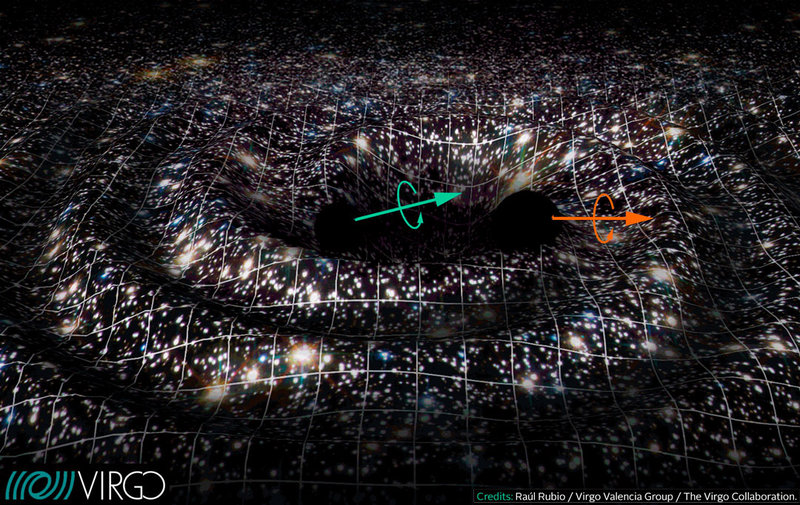
Image: GW190521 - Unexpected Black Holes Collide - Illustration Credit - Raúl Rubio (Virgo Valencia Group, The Virgo Collaboration)
APOD Background
"Explanation: How do black holes like this form? The two black holes that spiraled together to produce the gravitational wave event GW190521 were not only the most massive black holes ever seen by LIGO and VIRGO so far, their masses -- 66 and 85 solar masses -- were unprecedented and unexpected. Lower mass black holes, below about 65 solar masses are known to form in supernova explosions. Conversely, higher mass black holes, above about 135 solar masses, are thought to be created by very massive stars imploding after they use up their weight-bearing nuclear-fusion-producing elements. How such intermediate mass black holes came to exist is yet unknown, although one hypothesis holds that they result from consecutive collisions of stars and black holes in dense star clusters. Featured is an illustration of the black holes just before collision, annotated with arrows indicating their spin axes. In the illustration, the spiral waves indicate the production of gravitational radiation, while the surrounding stars highlight the possibility that the merger occurred in a star cluster. Seen last year but emanating from an epoch when the universe was only about half its present age (z ~ 0.8), black hole merger GW190521 is the farthest yet detected, to within measurement errors."
Montreux Jazz Festival 2017 | Chilly Gonzales - Black Hole Sun (Soundgarden cover)
https://www.youtube.com/watch?v=IY30KFTGoYI
FYI Maj Robert Thornton Lt Col Charlie Brown COL Mikel J. Burroughs Sgt (Join to see) PO1 William "Chip" Nagel Maj Bill Smith, Ph.D. Lt Col John (Jack) Christensen SGT Denny Espinosa Sgt Vance Bonds MAJ Dale E. Wilson, Ph.D. TSgt David L. SPC Nancy GreenePO2 (Join to see) SSG Michael Noll SGT Denny Espinosa SPC Margaret Higgins Maj Marty Hogan TSgt Joe C. TSgt David L.
Image: GW190521 - Unexpected Black Holes Collide - Illustration Credit - Raúl Rubio (Virgo Valencia Group, The Virgo Collaboration)
APOD Background
"Explanation: How do black holes like this form? The two black holes that spiraled together to produce the gravitational wave event GW190521 were not only the most massive black holes ever seen by LIGO and VIRGO so far, their masses -- 66 and 85 solar masses -- were unprecedented and unexpected. Lower mass black holes, below about 65 solar masses are known to form in supernova explosions. Conversely, higher mass black holes, above about 135 solar masses, are thought to be created by very massive stars imploding after they use up their weight-bearing nuclear-fusion-producing elements. How such intermediate mass black holes came to exist is yet unknown, although one hypothesis holds that they result from consecutive collisions of stars and black holes in dense star clusters. Featured is an illustration of the black holes just before collision, annotated with arrows indicating their spin axes. In the illustration, the spiral waves indicate the production of gravitational radiation, while the surrounding stars highlight the possibility that the merger occurred in a star cluster. Seen last year but emanating from an epoch when the universe was only about half its present age (z ~ 0.8), black hole merger GW190521 is the farthest yet detected, to within measurement errors."
Montreux Jazz Festival 2017 | Chilly Gonzales - Black Hole Sun (Soundgarden cover)
https://www.youtube.com/watch?v=IY30KFTGoYI
FYI Maj Robert Thornton Lt Col Charlie Brown COL Mikel J. Burroughs Sgt (Join to see) PO1 William "Chip" Nagel Maj Bill Smith, Ph.D. Lt Col John (Jack) Christensen SGT Denny Espinosa Sgt Vance Bonds MAJ Dale E. Wilson, Ph.D. TSgt David L. SPC Nancy GreenePO2 (Join to see) SSG Michael Noll SGT Denny Espinosa SPC Margaret Higgins Maj Marty Hogan TSgt Joe C. TSgt David L.
(10)
(0)
LTC Stephen F.
Norah Jones – Black Hole Sun (Detroit Fox Theatre 5.23.17)
Norah paid tribute to Chris Cornell at Detroit’s Fox Theatre with ‘Black Hole Sun.’ Filmed by: Ed Davis
Norah Jones – Black Hole Sun (Detroit Fox Theatre 5.23.17)
Norah paid tribute to Chris Cornell at Detroit’s Fox Theatre with ‘Black Hole Sun.’
https://www.youtube.com/watch?v=XbQ08Ixczvo
FYI MSG Felipe De Leon Brown PO3 Phyllis MaynardSSG Franklin BriantPO1 Robert GeorgeMSG Felipe De Leon Brown Sgt John H. CW5 Jack Cardwell SGT David A. 'Cowboy' Groth SGT (Join to see) SMSgt Dr. G. A. ThomasSSgt Marian MitchellSSG Jeffrey LeakePFC (Join to see)SP5 Dennis LobergerSGT Michael Hearn1619267:SPC Michael Duricko-phd] SFC (Join to see) Capt Dwayne Conyers PO1 William "Chip" Nagel
Norah paid tribute to Chris Cornell at Detroit’s Fox Theatre with ‘Black Hole Sun.’
https://www.youtube.com/watch?v=XbQ08Ixczvo
FYI MSG Felipe De Leon Brown PO3 Phyllis MaynardSSG Franklin BriantPO1 Robert GeorgeMSG Felipe De Leon Brown Sgt John H. CW5 Jack Cardwell SGT David A. 'Cowboy' Groth SGT (Join to see) SMSgt Dr. G. A. ThomasSSgt Marian MitchellSSG Jeffrey LeakePFC (Join to see)SP5 Dennis LobergerSGT Michael Hearn1619267:SPC Michael Duricko-phd] SFC (Join to see) Capt Dwayne Conyers PO1 William "Chip" Nagel
(6)
(0)
(1)
(0)
10
10
0
MSgt Paul Connors LTC Tom McNew LTC Stephen C. SSG Michael Noll SGT Steve McFarland LTC Stephen F. 1SG Steven Imerman Cpl (Join to see) Sgt Kelli Mays MSgt Robert "Rock" Aldi PO3 Lynn Spalding LTC (Join to see) SSG Gordon Holmes SMSgt Lawrence McCarterSGT Mark Anderson SPC Nancy Greene 1SG (Join to see) PO2 (Join to see) SGT Denny Espinosa SSG C.V. Shaw
(10)
(0)
SPC Margaret Higgins
Maj William W. 'Bill' Price; Good Morning, Most Adored Brother Bill! Dear Bill, I have responded in kind before: I Love Astronomy! And, I Love the Space Program! And, I Love NASA! And, I Love the Constellations!
(2)
(0)
10
10
0

Read This Next


 Continue with Facebook
 Continue with Google