

26
26
0
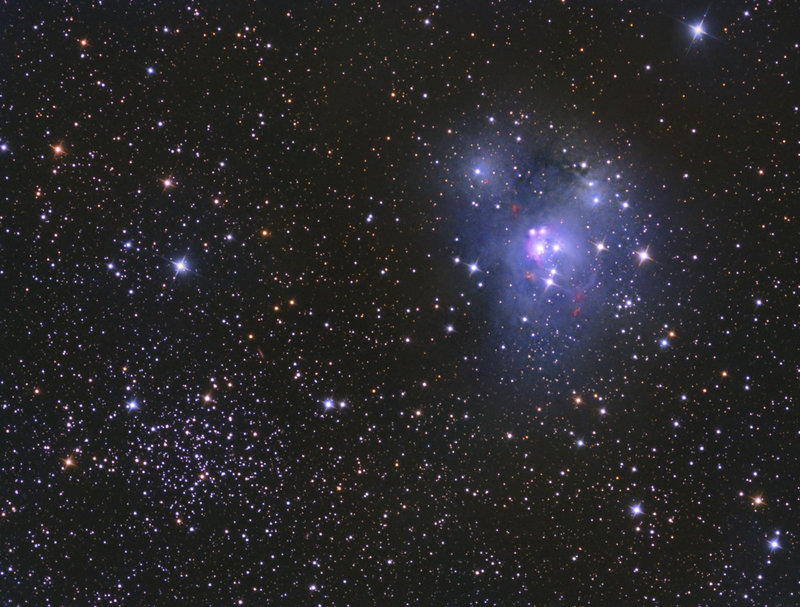
Good Red Friday morning, Rallypoint. Today's Astronomy Picture of the Day (APOD) is titled "NGC 7129 and NGC 7142." Located in the constellation Cepheus, NGC 7129 (foreground) is about 3,000 light years away and NGC 7142 (background) is about 6,000 light years away. The dust in NGC 7129, a reflection nebula, blocks and absorbs the blue spectrum of visible light from the cluster of stars in NGC 7142. This makes objects appear dimmer and redder than they really are. The reddish crescent shape around the central stars of NGC 7129 are associated with energetic jets streaming away from newly formed stars, hence the suggestion that the bright stars embedded in NGC 7129 are perhaps a few million years young.
Astronomy Picture of the Day
Posted from apod.nasa.gov NASA
NASA Space
Space Science
 Photography
 Astronomy
Posted >1 y ago
Responses: 8

13
13
0

In this large celestial mosaic taken by NASA's Spitzer Space Telescope, there's a lot to see, including multiple clusters of stars born from the same dense c...
Wow! Gorgeous Galactic Image of the area surrounding NG 7129 & NGC 7142... Maj William W. 'Bill' Price !!! These two galactic nebulae are located within the Constellation Cepheus... I could not find a Video Clip which articulated visually each of these Nebulas separately, but I did find a short clip of the area within the Constellation Cepheus where NGC 4129 & NGC 4142 lie... I believe your followers will enjoy this clip which will put these two beauties in perspective to the Constellation, Cepheus as seen by NASA's Spitzer Space Telescope... https://youtu.be/7tcX9fTp4uA
Detail Per NASA:
In this large celestial mosaic taken by NASA's Spitzer Space Telescope, there's a lot to see, including multiple clusters of stars born from the same dense clumps of gas and dust. Some of these clusters are older than others and more evolved, making this a generational stellar portrait. The grand green-and-orange delta filling most of the image is a faraway nebula, or a cloud of gas and dust in space. Though the cloud may appear to flow from the bright white spot at its tip, it is actually what remains of a much larger cloud that has been carved away by radiation from stars. The bright region is illuminated by massive stars, belonging to a cluster that extends above the white spot. The white colour is the combination of four colours (blue, green, orange and red), each representing a different wavelength of infrared light, which is invisible to human eyes. Dust that has been heated by the stars' radiation creates the surrounding red glow. On the left side of this image, a dark filament runs horizontally through the green cloud. A smattering of baby stars (the red and yellow dots) appear inside it. Known as Cepheus C, the area is a particularly dense concentration of gas and dust where infant stars form. The dark vein of material will eventually be dispersed by strong winds produced as the stars get older, as well as when they eventually explode and die. This will create an illuminated puffed-up region that will look similar to the bright red-and-white region on the large nebula's upper-right side. The region is called Cepheus C because it lies in the constellation Cepheus, which can be found near the constellation Cassiopeia. Cepheus C is about 6 light-years long and lies about 40 light-years from the bright spot at the tip of the nebula. A second large nebula can be seen on the right side of the image, with a star cluster located just above it. Known as Cepheus B, the cluster sits within a few thousand light-years of our Sun. A study of this region using Spitzer data found that the dramatic collection is about 4 million to 5 million years old - slightly older than those in Cepheus C. In that way, the mosaic is a veritable family portrait, featuring infants, parents and grandparents of star-forming regions: Stars form in dense clouds of material, like the dark vein that makes up Cepheus C. As the stars grow, they produce winds that blow the gas and dust outward, to form beautiful, illuminated nebulas like the bright white spot at the top of the larger nebula. Finally, the dust and gas disperse, and the star clusters stand alone in space, as with Cepheus B.
Maj Marty Hogan COL Mikel J. Burroughs Lt Col Charlie Brown SSG Byron Howard Sr LTC Stephen F. Col Carl Whicker Maj Robert Thornton CWO3 Dennis M. LTC Wayne Brandon Sgt Deborah Cornatzer PO3 Bob McCord CW5 Jack Cardwell TSgt Joe C. SFC Stephen Lucas SMSgt Lawrence McCarter Lt Col John (Jack) Christensen MSgt Robert "Rock" Aldi SrA Marianne Santangelo Sgt Albert Castro
Detail Per NASA:
In this large celestial mosaic taken by NASA's Spitzer Space Telescope, there's a lot to see, including multiple clusters of stars born from the same dense clumps of gas and dust. Some of these clusters are older than others and more evolved, making this a generational stellar portrait. The grand green-and-orange delta filling most of the image is a faraway nebula, or a cloud of gas and dust in space. Though the cloud may appear to flow from the bright white spot at its tip, it is actually what remains of a much larger cloud that has been carved away by radiation from stars. The bright region is illuminated by massive stars, belonging to a cluster that extends above the white spot. The white colour is the combination of four colours (blue, green, orange and red), each representing a different wavelength of infrared light, which is invisible to human eyes. Dust that has been heated by the stars' radiation creates the surrounding red glow. On the left side of this image, a dark filament runs horizontally through the green cloud. A smattering of baby stars (the red and yellow dots) appear inside it. Known as Cepheus C, the area is a particularly dense concentration of gas and dust where infant stars form. The dark vein of material will eventually be dispersed by strong winds produced as the stars get older, as well as when they eventually explode and die. This will create an illuminated puffed-up region that will look similar to the bright red-and-white region on the large nebula's upper-right side. The region is called Cepheus C because it lies in the constellation Cepheus, which can be found near the constellation Cassiopeia. Cepheus C is about 6 light-years long and lies about 40 light-years from the bright spot at the tip of the nebula. A second large nebula can be seen on the right side of the image, with a star cluster located just above it. Known as Cepheus B, the cluster sits within a few thousand light-years of our Sun. A study of this region using Spitzer data found that the dramatic collection is about 4 million to 5 million years old - slightly older than those in Cepheus C. In that way, the mosaic is a veritable family portrait, featuring infants, parents and grandparents of star-forming regions: Stars form in dense clouds of material, like the dark vein that makes up Cepheus C. As the stars grow, they produce winds that blow the gas and dust outward, to form beautiful, illuminated nebulas like the bright white spot at the top of the larger nebula. Finally, the dust and gas disperse, and the star clusters stand alone in space, as with Cepheus B.
Maj Marty Hogan COL Mikel J. Burroughs Lt Col Charlie Brown SSG Byron Howard Sr LTC Stephen F. Col Carl Whicker Maj Robert Thornton CWO3 Dennis M. LTC Wayne Brandon Sgt Deborah Cornatzer PO3 Bob McCord CW5 Jack Cardwell TSgt Joe C. SFC Stephen Lucas SMSgt Lawrence McCarter Lt Col John (Jack) Christensen MSgt Robert "Rock" Aldi SrA Marianne Santangelo Sgt Albert Castro
(13)
(0)
Sgt (Join to see)
TSgt David L. SFC Joe S. Davis Jr., MSM, DSL SP5 Jeannie Carle Sgt (Join to see) Maj Rev. Fr. Samuel WATERS - Traditional RC Priest sgt-elizabeth-scheck SSG Donald H "Don" Bates SPC Margaret Higgins SSG Jose M. Hernandezsanchez LTJG Josh Thaxton SGT David A. 'Cowboy' Groth SGT Kevin Foley Lt Col Scott Shuttleworth cmsgt-rickey-denicke-sr MSgt Stephen Council CWO3 Dave Alcantara Sgt John H. SP5 Mark Kuzinski SPC Douglas Bolton SPC Mark Huddleston
(5)
(0)
Sgt (Join to see)
TSgt Tim (lj) Littlejohn SFC James Shanks Sgt Kristina Snell SGT Everett Bickford SSgt Harvey "Skip" Porter SGT Shannon Weaver Logan SSgt Clare May SSG William Jones SGT John " Mac " McConnell Sgt Kelli Mays sgt-james-murphy PO1 Tony Holland Capt (Join to see) military-family SPC Woody Bullard CW4 Craig Urban SP5 Billy Mullins SPC Michael Oles SR SGT (Join to see) SGT Steve McFarland
(5)
(0)
Sgt (Join to see)
PV2 Mark Zehner SGT Mark Anderson SFC Jay Thompson SrA Elizabeth Fontenot SSG Shavonde Chase PO3 Phyllis Maynard Lt Col Jim Coe SrA Edward Vong Sgt Dale Cusack SSgt Rilene Ann LTC John Mohor ssgt-terry-kohler cpl-tony-lee-hamilton CW3 Michael Bodnar SPC Deborah Root-White SFC Jay Thompson po3-craig-phillips MSgt Ken "Airsoldier" Collins-Hardy
(5)
(0)
9
9
0

8
8
0

Really cool astronomy picture share sir, have a great morning and day sir.
(8)
(0)
Read This Next


 Continue with Facebook
 Continue with Google